




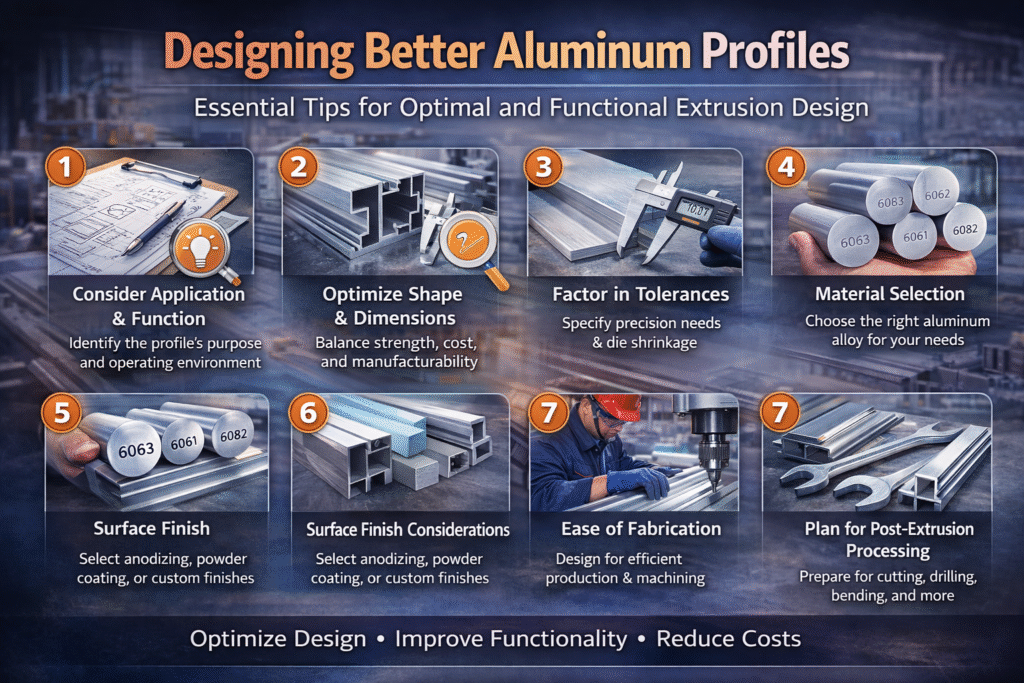
When designing custom aluminum profiles, the design phase is crucial for ensuring performance, efficiency, and manufacturability. Aluminum extrusion offers endless possibilities for creating lightweight, durable, and functional components, but the design process requires careful consideration of a range of factors, from structural integrity to production feasibility.
This comprehensive guide provides essential tips and best practices for designing better aluminum profiles, whether you’re an engineer, architect, or designer looking to optimize your aluminum extrusion projects.
Understanding the Basics of Aluminum Extrusion
Aluminum extrusion is a manufacturing process where aluminum billets are heated and forced through a die to create profiles with a fixed cross-section. The profile shape is determined by the die design, which can be customized for specific applications.
Key benefits of aluminum extrusion include:
- Ability to create complex shapes
- Excellent strength-to-weight ratio
- High corrosion resistance
- Flexibility in design
However, the success of a custom aluminum extrusion depends heavily on a well-thought-out design that meets both functional and production requirements.
Step 1: Consider the Application and Function
The first step in designing an aluminum profile is understanding the specific application and the profile’s function. Ask yourself the following questions:
- What is the primary purpose of the profile? (e.g., structural support, aesthetic enhancement, cable management, etc.)
- What type of load will the profile carry? (e.g., static load, dynamic load, weight-bearing, etc.)
- Are there specific environmental factors to consider? (e.g., exposure to chemicals, moisture, high temperatures, etc.)
Understanding the purpose of the profile helps in choosing the right aluminum alloy, profile shape, and design features that align with performance and safety requirements.
Step 2: Optimize Profile Shape and Dimensions
Aluminum extrusion allows for a wide range of profile shapes, from simple rectangular sections to intricate, customized forms. However, not all designs are created equal. To ensure the best balance of strength, cost, and manufacturability, consider the following:
Profile Thickness
- Uniform thickness: Profiles with uniform wall thickness are easier to extrude and result in fewer material defects.
- Variable thickness: For specific applications, varying the thickness of the profile can enhance strength in certain areas, but it may increase tooling complexity.
Cross-Section Design
- Hollow sections: Hollow profiles are ideal for lightweight structures, offering strength with reduced material usage.
- Solid sections: Solid profiles are better for weight-bearing applications where structural integrity is critical.
The more intricate the profile’s cross-section, the more complex the extrusion die, which can increase the initial tooling cost but provide more design flexibility.
Step 3: Factor in Tolerances and Precision
Precision is crucial in aluminum extrusion. The tighter the tolerances required for the profile, the more critical the design phase becomes. For highly precise components, it’s important to:
- Specify acceptable tolerances: Determine the allowable variance in dimensions, and communicate these clearly with the manufacturer.
- Account for die shrinkage: Aluminum contracts slightly after extrusion, so designs need to consider the effects of shrinkage to maintain dimensional accuracy.
Tight tolerances require high-quality extrusion equipment, and the cost of production may increase if your design requires high precision.
Step 4: Material Selection
Choosing the right aluminum alloy for your extrusion project is essential for achieving optimal performance. The choice of alloy affects the material’s strength, corrosion resistance, and ability to be anodized or coated.
Common aluminum alloys used in extrusion include:
- 6063 Aluminum: Known for excellent surface finish and medium strength, ideal for architectural applications like window frames and decorative components.
- 6061 Aluminum: Offers higher strength and better machinability, making it suitable for structural and industrial applications.
- 6082 Aluminum: High-strength and highly corrosion-resistant, often used for demanding mechanical applications.
The right alloy selection ensures that the final product meets performance requirements and enhances its lifespan.
Step 5: Surface Finish Considerations
The surface finish of an aluminum profile impacts both its aesthetics and durability. Depending on the application, different finishes may be required, such as:
- Anodizing: Provides a durable, corrosion-resistant layer, ideal for outdoor and high-moisture environments.
- Powder Coating: Offers a wide range of colors and additional UV protection, making it perfect for decorative and architectural applications.
- Brushed Finish: Creates a sleek, modern look often used in interior design and consumer electronics.
- Mill Finish: The natural appearance of aluminum, often used when minimal finishing is required.
Select the finish that best complements the application and enhances the profile’s performance in the intended environment.
Step 6: Design for Ease of Fabrication
While creativity is important in the design process, it’s also essential to consider the manufacturability of the design. Complex profiles may require more sophisticated tooling and result in higher costs.
Design tips to enhance manufacturability include:
- Minimize tight radii: Sharp corners can cause extrusion defects, especially when using thicker profiles. Consider designing profiles with rounded or larger radii.
- Simplify the profile geometry: Less complex profiles are easier and cheaper to extrude and finish.
- Avoid extreme variations in wall thickness: Excessive changes in wall thickness can complicate extrusion and result in material waste.
By working closely with the manufacturer during the design phase, you can ensure that the profile is optimized for both performance and cost efficiency.
Step 7: Plan for Post-Extrusion Processing
Many aluminum profiles require additional processing after extrusion, such as cutting, drilling, machining, or bending. To minimize delays and additional costs, plan for these processes early in the design phase.
Ensure that your design accounts for:
- Ease of cutting and machining: Specify any required cuts or holes in the design, and ensure they can be easily incorporated into the extrusion process.
- Alignment and assembly: If your profile will be part of an assembly, include features like grooves or slots to improve alignment and ease of assembly.
Conclusion
Designing a better aluminum profile requires careful consideration of the application, material, shape, tolerances, and post-extrusion processes. By optimizing each element of the design, you can achieve profiles that are not only cost-effective but also highly functional, durable, and aesthetically appealing.
Collaboration with an experienced aluminum extrusion manufacturer is key to ensuring that your design can be efficiently produced and meets the required specifications.
By following these design principles, engineers and designers can create high-quality custom aluminum profiles that deliver optimal performance and long-term value.