



In today’s competitive manufacturing market, businesses increasingly require customized components that improve product performance, simplify assembly, and strengthen brand identity. This is why OEM aluminum extrusion services have become an essential solution across industries such as construction, industrial automation, electronics, transportation, and renewable energy.
Custom aluminum extrusion allows OEM manufacturers to create specialized profiles designed specifically for their products and systems. From concept development to mass production, aluminum extrusion supports efficient, scalable, and cost-effective manufacturing.
This guide explains how OEM aluminum extrusion services work and why they are critical for modern product development.
What Is OEM Aluminum Extrusion?
OEM stands for Original Equipment Manufacturer.
OEM aluminum extrusion refers to custom aluminum profiles produced according to a customer’s unique specifications, including:
- Cross-sectional design
- Alloy selection
- Surface finishing
- Functional integration
- Branding requirements
These profiles are typically used as components in the customer’s final products or systems.
Why OEM Manufacturers Choose Aluminum Extrusion
Aluminum extrusion offers several advantages that make it highly suitable for OEM production.
Design Flexibility
Custom extrusion enables manufacturers to create profiles with:
- Complex geometries
- Integrated functional features
- Lightweight structures
- Modern aesthetics
This flexibility supports innovation and product differentiation.
Cost Efficiency
Custom aluminum profiles can reduce overall production costs by:
- Minimizing material waste
- Reducing secondary machining
- Simplifying assembly processes
- Lowering transportation costs through lightweight design
Scalability
Aluminum extrusion supports both:
- Prototype development
- Large-scale mass production
Once the extrusion die is developed, production can scale efficiently while maintaining consistent quality.
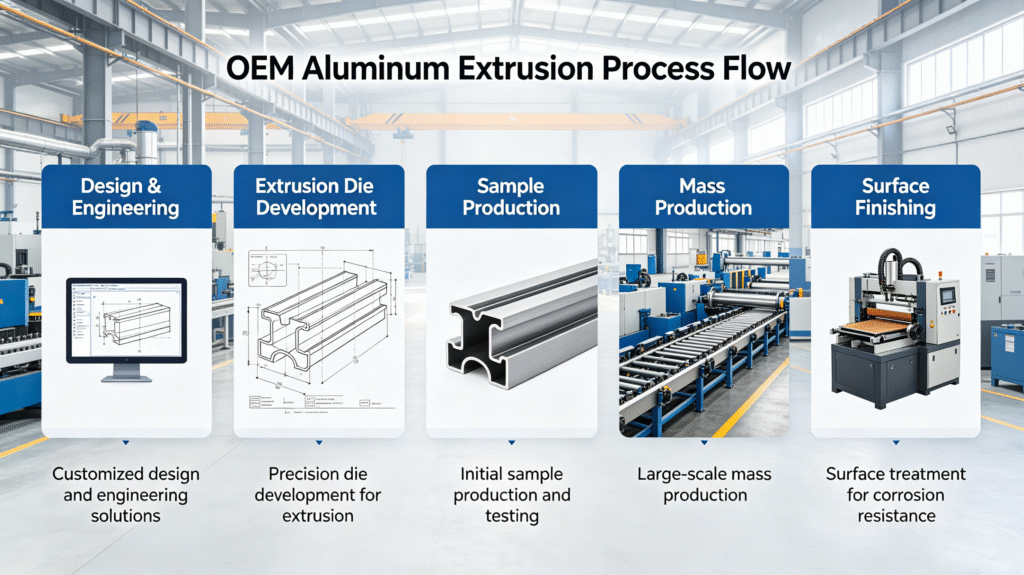
The OEM Aluminum Extrusion Process
1. Design and Engineering
The process begins with technical drawings or concept development.
Manufacturers work closely with customers to optimize:
- Profile geometry
- Wall thickness
- Structural performance
- Manufacturability
Early engineering collaboration helps reduce future production problems.
2. Extrusion Die Development
A custom die is manufactured based on the approved design.
The die determines:
- Profile shape
- Dimensional accuracy
- Surface consistency
High-quality die design is essential for stable long-term production.
3. Sample Production
Prototype or sample profiles are produced for testing and evaluation.
Customers verify:
- Dimensions
- Surface quality
- Functional performance
- Assembly compatibility
Sample approval is an important step before mass production.
4. Mass Production
After approval, full-scale production begins.
Modern extrusion facilities can support:
- High-volume orders
- Stable dimensional control
- Consistent surface quality
5. Surface Finishing and Fabrication
OEM aluminum profiles often require additional processing such as:
- Anodizing
- Powder coating
- CNC machining
- Drilling and cutting
- Assembly preparation
Integrated manufacturing services improve efficiency and quality control.
Industries That Use OEM Aluminum Extrusion
Architectural Systems
OEM extrusion is widely used for:
- Window and door systems
- Curtain walls
- Decorative trim profiles
Industrial Automation
Applications include:
- Machine frames
- Conveyor systems
- Workstations
- Safety enclosures
LED Lighting Systems
Custom aluminum profiles support:
- Heat dissipation
- LED channels
- Decorative lighting structures
Solar Energy Systems
OEM aluminum extrusion is essential for:
- Solar mounting rails
- Structural supports
- Panel framing systems
Transportation Industry
Aluminum profiles help reduce vehicle weight while maintaining structural performance.
Applications include:
- Rail systems
- Automotive components
- EV battery structures
Advantages of Working with an OEM Aluminum Manufacturer
Product Customization
OEM manufacturers can create unique products tailored to market needs.
Consistent Quality
Professional extrusion manufacturers maintain:
- Stable tolerances
- Reliable material quality
- Consistent surface finishing
Faster Product Development
Integrated engineering support helps reduce development time.
Supply Chain Stability
Long-term manufacturing partnerships improve production planning and delivery reliability.
Key Factors When Choosing an OEM Aluminum Extrusion Supplier
Manufacturing Capability
Evaluate:
- Extrusion capacity
- Surface treatment capability
- CNC machining services
- Quality control systems
Engineering Support
Experienced suppliers can help optimize designs for better manufacturability and lower cost.
OEM and ODM Experience
Manufacturers with extensive OEM experience better understand project coordination and long-term production requirements.
Quality Assurance
Look for suppliers with:
- Material traceability
- Inspection systems
- Stable process control
Customization Options in OEM Aluminum Extrusion
OEM projects often involve extensive customization.
Profile Geometry
- Hollow structures
- Multi-functional cross-sections
- Integrated channels and mounting systems
Surface Finishes
- Anodized finishes
- Powder coating
- Wood grain effects
- Brushed textures
Alloy Selection
Different alloys provide different advantages in strength, machinability, and surface quality.
Secondary Processing
Additional fabrication services improve assembly efficiency and reduce downstream production work.
Challenges in OEM Aluminum Projects
Design Complexity
Overly complicated profiles may increase tooling cost and production difficulty.
Tolerance Requirements
Extremely tight tolerances can affect cost and lead time.
Communication Delays
Clear technical communication is essential for smooth project execution.
Future Trends in OEM Aluminum Extrusion
The future of OEM aluminum manufacturing is moving toward:
- Lightweight engineering
- Smart modular systems
- Sustainable materials
- Integrated multifunctional profiles
- Faster product customization cycles
As industries continue to evolve, aluminum extrusion will remain a key manufacturing technology.
Conclusion
OEM aluminum extrusion services provide businesses with flexible, scalable, and cost-effective solutions for custom product development. From industrial systems and architectural applications to LED lighting and renewable energy, custom aluminum profiles support innovation and efficient manufacturing.
By working with an experienced aluminum extrusion manufacturer, businesses can improve product quality, reduce production complexity, and strengthen long-term competitiveness in the global market.