



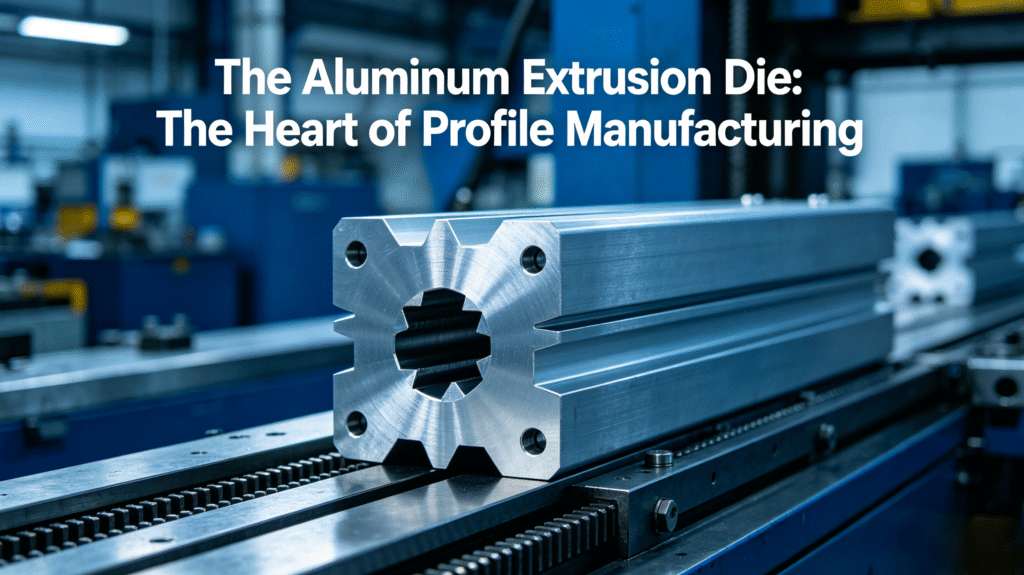
In the aluminum extrusion industry, the quality of the final profile begins long before production starts. One of the most critical factors in successful extrusion manufacturing is the aluminum extrusion die.
Whether producing architectural profiles, industrial framing systems, LED heat sinks, or custom OEM components, the extrusion die determines the shape, dimensional accuracy, surface quality, and production efficiency of the finished product.
This guide explains what aluminum extrusion dies are, how they work, and why proper die design is essential for high-quality aluminum profile manufacturing.
What Is an Aluminum Extrusion Die?
An aluminum extrusion die is a precision-engineered steel tool used to shape aluminum during the extrusion process.
During production:
- Aluminum billets are heated to extrusion temperature.
- The softened aluminum is pushed through the die under high pressure.
- The aluminum exits the die opening in the desired profile shape.
- The profile is cooled, stretched, and cut to length.
The die functions much like a mold, but instead of creating individual parts, it creates continuous aluminum profiles with a consistent cross-section.
Why Extrusion Dies Are So Important
The extrusion die directly influences:
- Profile geometry
- Surface quality
- Production speed
- Material flow
- Dimensional consistency
- Manufacturing cost
Even a small flaw in die design can result in production difficulties, poor tolerances, or excessive scrap rates.
For this reason, die engineering is one of the most specialized areas of aluminum extrusion manufacturing.
Types of Aluminum Extrusion Dies
Solid Dies
Solid dies are used for simple profiles that do not contain enclosed hollow sections.
Examples
- Flat bars
- Round rods
- Square bars
- Structural strips
Advantages
- Lower manufacturing cost
- Simpler design
- Faster production
Solid dies are commonly used for basic industrial profiles.
Hollow Dies
Hollow dies are designed to produce profiles containing enclosed cavities.
Examples
- Window frames
- Door profiles
- Structural tubes
- Solar mounting rails
Advantages
- Lightweight structures
- Improved strength-to-weight ratio
- Complex geometry capability
Hollow dies are more difficult to manufacture and require advanced engineering.
Semi-Hollow Dies
Semi-hollow profiles contain partially enclosed cavities.
These designs fall between solid and hollow profile structures.
Common Applications
- Industrial components
- Architectural trim systems
- Custom OEM profiles
Semi-hollow dies often require careful balancing of material flow.
The Aluminum Die Manufacturing Process
Step 1: Profile Design Review
Engineers first analyze:
- Profile geometry
- Wall thickness
- Tolerance requirements
- Surface finish expectations
This ensures the design can be manufactured efficiently.
Step 2: Die Engineering
The die is designed using CAD and simulation software.
Engineers evaluate:
- Material flow behavior
- Pressure distribution
- Thermal characteristics
- Potential distortion risks
Modern simulation significantly improves production success rates.
Step 3: Die Machining
High-precision CNC equipment is used to manufacture the die from specialized tool steel.
Accuracy at this stage is critical.
Step 4: Heat Treatment
The die undergoes heat treatment to improve:
- Hardness
- Wear resistance
- Service life
This helps the die withstand high extrusion pressures.
Step 5: Trial Production
Before mass production, trial extrusion runs are conducted to verify:
- Profile dimensions
- Surface quality
- Material flow consistency
Adjustments may be made if necessary.
Factors That Affect Die Performance
Profile Complexity
More complex profiles require more advanced die engineering.
Features such as:
- Thin walls
- Multiple cavities
- Deep channels
can increase design difficulty.
Alloy Selection
Different aluminum alloys behave differently during extrusion.
For example:
- 6063 aluminum generally extrudes more easily
- 6061 aluminum often requires greater extrusion force
Die design must account for these differences.
Wall Thickness
Uniform wall thickness improves:
- Material flow
- Surface quality
- Dimensional stability
Large variations in wall thickness can create production challenges.
Extrusion Speed
Excessive speed may cause:
- Surface defects
- Dimensional variation
- Reduced die life
Proper process control is essential.
Common Die Design Challenges
Uneven Material Flow
Some areas of the profile may fill faster than others.
Engineers use flow-balancing techniques to solve this problem.
Profile Distortion
Complex shapes may warp during cooling.
Proper die design helps minimize distortion.
Surface Defects
Poor die design can contribute to:
- Lines
- Drag marks
- Surface roughness
High-quality tooling reduces these risks.
How Long Does an Extrusion Die Last?
Die lifespan depends on:
- Alloy type
- Profile complexity
- Production volume
- Process control
A well-maintained extrusion die can often produce tens of thousands of kilograms of aluminum profiles before refurbishment is required.
Many OEM projects use the same die for years of repeat production.
Advantages of High-Quality Extrusion Dies
Investing in professional die engineering provides several benefits:
Better Product Quality
Improved dimensional consistency and surface finish.
Lower Production Cost
Reduced scrap and higher efficiency.
Faster Production
Optimized material flow improves throughput.
Greater Reliability
Consistent performance across production batches.
Custom Die Development for OEM Projects
Custom aluminum extrusion projects typically require dedicated die development.
Benefits include:
- Unique profile geometry
- Product differentiation
- Improved assembly efficiency
- Enhanced functionality
For OEM manufacturers, the extrusion die is often one of the most valuable production assets.
Future Trends in Extrusion Die Technology
The aluminum extrusion industry continues to adopt advanced technologies such as:
Simulation-Based Engineering
Improves die performance before production begins.
High-Precision CNC Manufacturing
Enhances dimensional accuracy.
Advanced Tool Steels
Extends die lifespan and improves productivity.
AI-Assisted Process Optimization
Helps manufacturers predict and solve production challenges more efficiently.
Conclusion
Aluminum extrusion dies are the foundation of successful aluminum profile manufacturing. They determine the shape, quality, consistency, and production efficiency of every profile produced.
Whether manufacturing architectural systems, industrial components, solar mounting structures, or custom OEM products, investing in high-quality die design is essential for achieving reliable results.
For companies seeking long-term success in aluminum extrusion projects, choosing an experienced manufacturer with strong die engineering capabilities is one of the most important decisions they can make.