




When sourcing aluminum profiles, one of the most common questions buyers ask is: Why do aluminum extrusion prices vary so much?
The cost of aluminum extrusion is influenced by multiple factors, including raw materials, profile design, tooling, surface treatment, processing requirements, and production volume. Understanding these variables helps buyers control budgets and make smarter purchasing decisions.
This guide explains the major factors affecting aluminum extrusion costs and how businesses can optimize projects for better cost efficiency.
Understanding Aluminum Extrusion Pricing
The final price of an aluminum profile is not determined by material cost alone.
Typical pricing components may include:
Aluminum raw material cost
Extrusion die cost
Production cost
Surface finishing cost
Secondary fabrication cost
Packaging and shipping cost
Different projects may emphasize different cost factors.
Aluminum Raw Material Cost
Raw aluminum is usually one of the largest cost components.
Pricing can fluctuate due to:
Global aluminum market conditions
Supply and demand changes
Energy costs
International trade conditions
Because aluminum prices are often linked to commodity markets, profile pricing can change over time.
Alloy Selection and Material Cost
Different alloys have different pricing levels.
Common examples include:
6063 Aluminum
Advantages:
Excellent extrusion performance
Good surface quality
Cost-effective for many applications
6061 Aluminum
Advantages:
Higher strength
Better machining performance
Potential consideration:
May cost slightly more because of processing requirements
Specialized Alloys
High-performance alloys may increase material costs further.
Extrusion Die Cost
Custom aluminum profiles require dedicated tooling.
What Influences Die Cost?
Profile complexity
Hollow sections
Wall thickness variation
Tight tolerance requirements
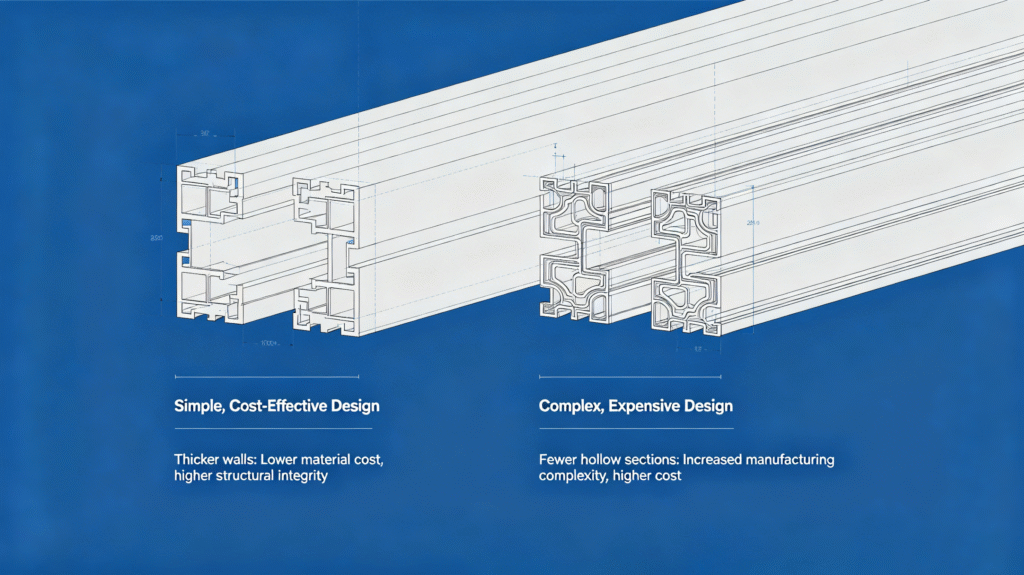
Simple profiles generally require less expensive tooling than highly complex designs.
Die Cost Consideration for OEM Projects
Although die development creates an initial investment, long-term production can spread tooling costs across larger quantities.
For repeat orders, tooling becomes increasingly cost-efficient.
Profile Design Complexity
Profile geometry directly affects manufacturing cost.
Design features that may increase cost include:
Thin walls
Multiple cavities
Deep channels
Tight corners
Complex hollow structures
More complicated profiles often require:
Advanced tooling
Slower production speeds
Additional process control
Profile Weight
Aluminum profiles are commonly priced based on weight.
Heavier profiles naturally use:
More raw material
More production resources
Reducing unnecessary material can improve cost efficiency.
Lightweight Optimization
Engineers often reduce cost through:
Hollow structures
Reinforcement ribs
Material-efficient geometry
This helps maintain strength while reducing material consumption.
Production Quantity
Order volume significantly affects unit pricing.
Small Orders
Characteristics:
Higher unit cost
Tooling cost distributed across fewer units
Lower production efficiency
Large Orders
Characteristics:
Lower unit cost
Better material utilization
Higher production efficiency
Large production runs often provide stronger pricing advantages.
Surface Finishing Cost
Surface treatment adds additional value but also increases cost.
Common finishing options include:
Mill Finish
Lowest cost option.
Anodizing
Adds:
Corrosion resistance
Durability
Premium appearance
Powder Coating
Provides:
Color customization
Weather resistance
Decorative flexibility
Decorative Finishes
Special finishes such as:
Wood grain
Brushed textures
Metallic effects
may involve additional processing costs.
Secondary Fabrication Cost
Many custom aluminum profiles require post-processing.
Common services include:
CNC machining
Drilling
Tapping
Punching
Milling
Assembly preparation
Additional processing improves convenience but increases manufacturing cost.
Tolerance Requirements
Many buyers request extremely tight tolerances without understanding their impact.
Tighter tolerances often require:
Additional process control
More inspections
Slower production
Secondary machining
Only critical dimensions should require precision beyond standard manufacturing limits.
Packaging and Transportation Cost
Shipping can become a significant cost factor, especially for international projects.
Factors affecting transportation cost include:
Profile Length
Longer profiles may require specialized packaging.
Order Weight
Heavier shipments increase transportation expense.
Destination
International shipping costs vary depending on:
Distance
Shipping method
Customs requirements
How Buyers Can Reduce Aluminum Extrusion Cost
Optimize Profile Design
Simpler profile geometry often reduces:
Tooling cost
Production difficulty
Material usage
Avoid Unnecessary Tight Tolerances
Specify precision only where necessary.
Increase Order Volume
Larger production runs improve unit cost efficiency.
Select Appropriate Surface Treatments
Choose finishes based on actual performance requirements.
Work With Experienced Manufacturers
Professional manufacturers can recommend cost-saving improvements without affecting functionality.
Common Buyer Mistakes
Choosing the Lowest Quotation Only
The lowest price does not always provide the best value.
Poor quality may lead to:
Production delays
Higher defect rates
Additional costs later
Ignoring Long-Term Costs
Lower upfront costs may increase:
Maintenance expenses
Installation difficulty
Product failure risk
Overdesigning the Profile
Unnecessary complexity often adds cost without improving performance.
Industries Sensitive to Aluminum Cost Optimization
Architecture
Large project volumes make cost control essential.
Industrial Automation
Manufacturers seek efficient structural solutions.
Solar Energy
Large-scale projects require competitive material pricing.
Transportation
Weight reduction directly affects operating efficiency.
Consumer Products
Cost competitiveness strongly influences profitability.
Future Trends in Aluminum Cost Management
The aluminum industry continues to improve cost efficiency through:
Smart manufacturing
AI-assisted process optimization
Lightweight engineering
Recycling technologies
Improved production automation
These innovations help manufacturers reduce waste and improve pricing stability.
Conclusion
The cost of aluminum extrusion depends on much more than raw material pricing. Profile design, tooling, finishing, fabrication, production volume, and logistics all contribute to the final cost.
By understanding these cost factors and collaborating with experienced manufacturers, businesses can optimize product design, improve manufacturing efficiency, and achieve better long-term value.
For successful custom aluminum projects, cost should always be evaluated together with quality, performance, and reliability.