



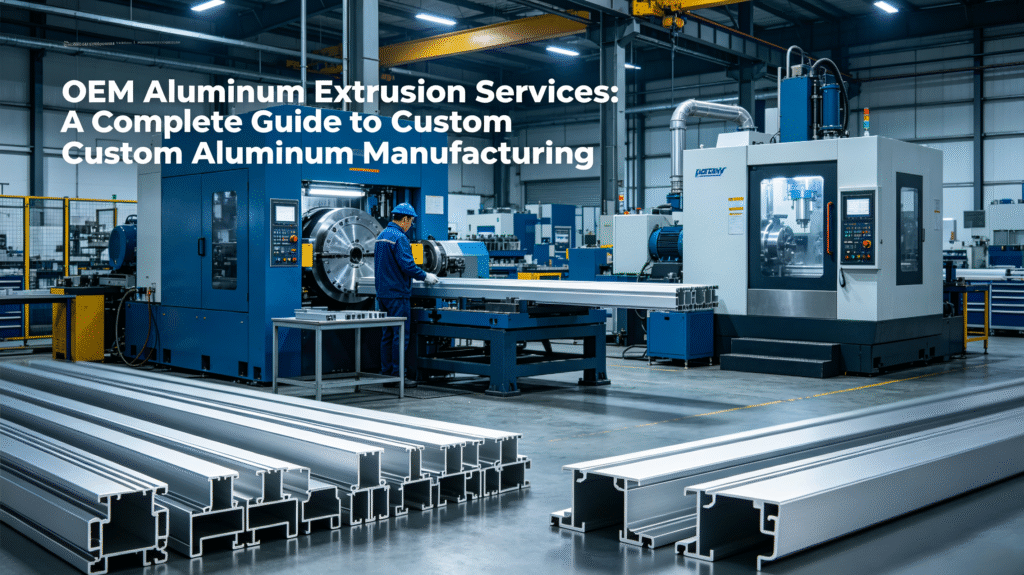
As industries continue to demand innovative, lightweight, and high-performance products, OEM aluminum extrusion services have become an essential part of modern manufacturing. From architectural systems and industrial automation to automotive components, solar energy, electronics, and consumer products, custom aluminum extrusions enable businesses to transform product concepts into reliable, large-scale production.
Choosing the right OEM aluminum extrusion manufacturer is about more than simply producing aluminum profiles. A qualified supplier provides engineering support, tooling development, precision machining, surface finishing, quality assurance, and supply chain management—all under one roof.
This guide explains what OEM aluminum extrusion services include, their advantages, the manufacturing process, and how to select the right manufacturing partner for your business.
What Are OEM Aluminum Extrusion Services?
OEM (Original Equipment Manufacturer) aluminum extrusion services involve designing and manufacturing custom aluminum profiles according to a customer’s drawings, specifications, or product requirements.
Unlike standard aluminum profiles, OEM products are developed specifically for a customer’s application.
OEM services may include:
-
Custom profile design
-
Extrusion die development
-
Aluminum extrusion
-
CNC machining
-
Surface finishing
-
Assembly services
-
Packaging customization
-
Global logistics support
The goal is to deliver ready-to-use components that integrate seamlessly into the customer’s products.
Why Businesses Choose OEM Aluminum Extrusion
Customized Product Design
Every industry has unique technical requirements.
OEM aluminum extrusion allows manufacturers to create profiles that perfectly match their products instead of adapting to standard market profiles.
Customized profiles can integrate:
-
Structural reinforcement
-
Cable management channels
-
Mounting features
-
Decorative surfaces
-
Connection systems
This improves product functionality while reducing the number of separate components.
Lower Manufacturing Costs
Although custom tooling requires an initial investment, OEM extrusion often reduces long-term production costs by:
-
Minimizing machining operations
-
Reducing assembly time
-
Lowering material waste
-
Improving manufacturing efficiency
For medium- and high-volume production, custom extrusion is often the most economical solution.
Consistent Product Quality
Professional OEM manufacturers maintain strict quality control throughout production.
Consistency is achieved through:
-
Precision die engineering
-
Stable extrusion processes
-
Automated inspection systems
-
Material traceability
-
Standardized production procedures
Reliable quality helps reduce warranty claims and production delays.
The OEM Aluminum Extrusion Process
Step 1: Product Consultation
The project begins with a discussion of the customer’s requirements.
Typical information includes:
-
Technical drawings
-
3D CAD models
-
Performance requirements
-
Material specifications
-
Surface finish preferences
-
Production volume
Early communication helps optimize manufacturability.
Step 2: Engineering Review
Engineers analyze the design to improve:
-
Structural performance
-
Extrusion feasibility
-
Material efficiency
-
Production cost
-
Assembly convenience
Design optimization often reduces manufacturing complexity without affecting functionality.
Step 3: Extrusion Die Development
A precision extrusion die is manufactured based on the approved profile design.
Engineers carefully design:
-
Material flow
-
Bearing lengths
-
Wall thickness transitions
-
Dimensional accuracy
High-quality tooling ensures stable production throughout the product lifecycle.
Step 4: Aluminum Extrusion
Heated aluminum billets are extruded through the custom die to produce continuous profiles.
Common alloys include:
-
6063 aluminum
-
6061 aluminum
-
6005 aluminum
-
6082 aluminum
The alloy selection depends on the required strength, corrosion resistance, and application.
Step 5: Secondary Processing
Additional fabrication may include:
-
CNC machining
-
Precision cutting
-
Drilling
-
Milling
-
Tapping
-
Punching
These operations prepare the profiles for direct assembly.
Step 6: Surface Finishing
Popular finishing options include:
Anodizing
Provides:
-
Excellent corrosion resistance
-
Metallic appearance
-
Improved wear resistance
Powder Coating
Offers:
-
Wide color selection
-
UV resistance
-
Decorative flexibility
Wood Grain Transfer
Ideal for architectural products requiring the appearance of natural wood with the durability of aluminum.
Step 7: Inspection and Packaging
Before shipment, products undergo comprehensive quality inspections.
Checks may include:
-
Dimensional measurements
-
Surface appearance
-
Mechanical properties
-
Coating quality
-
Packaging verification
Customized packaging protects products during international transportation.
Industries That Use OEM Aluminum Extrusion
Construction and Architecture
Applications include:
-
Windows and doors
-
Curtain wall systems
-
Railings
-
Pergolas
-
Decorative trim
Industrial Automation
Custom aluminum profiles are widely used for:
-
Machine frames
-
Conveyor systems
-
Robotic equipment
-
Safety enclosures
Renewable Energy
OEM aluminum components support:
-
Solar mounting systems
-
Battery enclosures
-
Energy storage equipment
Transportation
Manufacturers use aluminum extrusions for:
-
Automotive components
-
Electric vehicles
-
Rail transportation
-
Marine equipment
Electronics
Applications include:
-
Heat sinks
-
LED lighting profiles
-
Electronic housings
-
Communication equipment
Advantages of Working with a Full-Service OEM Manufacturer
Choosing a supplier that offers complete manufacturing services provides several benefits.
Faster Product Development
Integrated engineering and production reduce development time.
Better Cost Control
Manufacturing under one roof minimizes supplier coordination and logistics costs.
Improved Quality Management
Unified quality systems ensure consistency throughout every production stage.
Simplified Supply Chain
A single supplier can manage:
-
Tooling
-
Extrusion
-
Machining
-
Surface treatment
-
Packaging
-
Export logistics
This reduces purchasing complexity and improves delivery reliability.
How to Choose an OEM Aluminum Extrusion Manufacturer
Before selecting a supplier, evaluate the following factors.
Engineering Capability
Choose a manufacturer with experienced design engineers who can optimize your product for both performance and manufacturability.
Production Capacity
Ensure the supplier can support:
-
Prototype production
-
Small batches
-
High-volume manufacturing
-
Long-term supply agreements
Quality Assurance
Reliable manufacturers implement comprehensive inspection procedures and maintain international quality standards.
Customization Experience
A strong OEM partner should have experience serving customers from different industries and international markets.
Communication and Technical Support
Effective communication is essential throughout product development.
A responsive engineering team can quickly solve technical issues and accelerate project timelines.
Future Trends in OEM Aluminum Manufacturing
The aluminum extrusion industry continues to evolve with advanced manufacturing technologies.
Key trends include:
-
AI-assisted profile design
-
Digital production monitoring
-
Automated quality inspection
-
Sustainable aluminum production
-
Lightweight engineering
-
Smart manufacturing systems
These innovations help manufacturers improve efficiency while delivering increasingly customized solutions.
Conclusion
OEM aluminum extrusion services provide businesses with a complete solution for developing customized aluminum products that meet exact technical and commercial requirements. From engineering and die development to machining, finishing, and global delivery, an experienced OEM manufacturer can simplify production while improving product quality and reducing overall costs.
Whether your business serves the construction, industrial, automotive, renewable energy, or electronics sector, partnering with a trusted OEM aluminum extrusion supplier is an investment in long-term success, product innovation, and supply chain reliability.