

The surface finish of an aluminum profile is more than a matter of appearance. The right finishing process can improve corrosion resistance, surface durability, weather performance, and the overall service life of an aluminum product.
For architectural projects, industrial equipment, LED lighting, furniture, solar systems, and custom aluminum extrusion products, selecting the appropriate aluminum extrusion surface finish is an important part of product development.
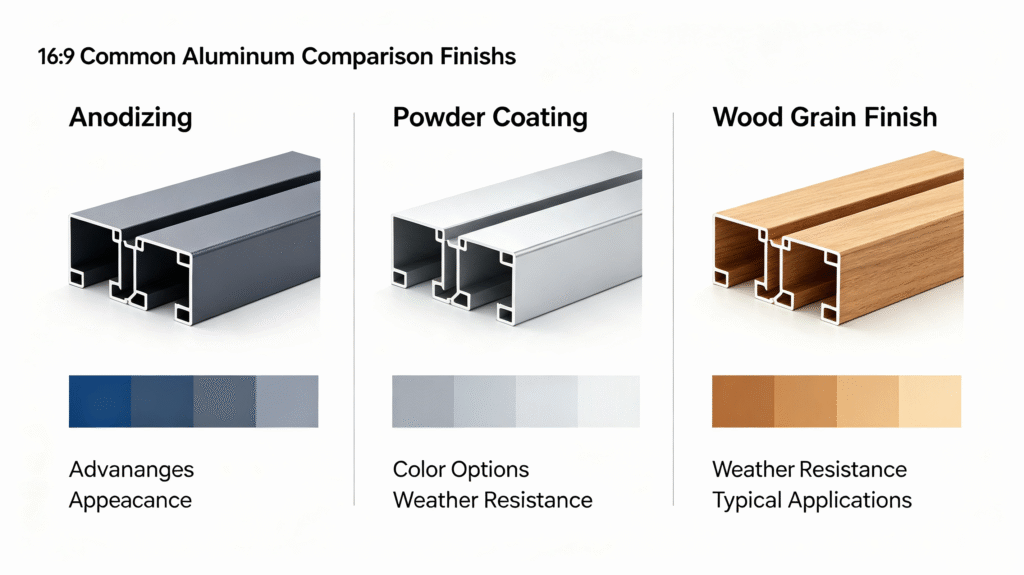
Among the most widely used finishing methods are anodizing, powder coating, and wood grain finishes. Each process offers different advantages and is suited to different applications.
This guide explains the most common aluminum extrusion finishes and how to select the right option for your project.
Why Surface Finishing Matters
Freshly extruded aluminum already has good corrosion resistance because it naturally forms a thin oxide layer when exposed to air. However, additional surface treatment can significantly improve its appearance and performance.
A professional surface finish can provide:
-
Better corrosion resistance
-
Improved scratch resistance
-
UV protection
-
Consistent color
-
Easier maintenance
-
Enhanced decorative appearance
For outdoor aluminum profiles, the finishing system can be especially important because the product may be exposed to sunlight, rain, humidity, temperature changes, and pollution for many years.
Anodized Aluminum Profiles
Anodizing is one of the most established finishing processes for aluminum extrusion.
Instead of applying a separate coating to the surface, anodizing uses an electrochemical process to increase the thickness and durability of the natural oxide layer.
Advantages of Anodizing
Anodized aluminum provides:
-
Excellent corrosion resistance
-
Improved surface hardness
-
Good wear resistance
-
Long-term color stability
-
A distinctive metallic appearance
The finish is also firmly integrated with the aluminum surface, making it less likely to peel or flake than a conventional coating.
Common Anodized Colors
Popular options include:
-
Natural silver
-
Champagne
-
Bronze
-
Dark bronze
-
Black
-
Custom anodized shades
The final appearance depends on the alloy, surface preparation, anodizing process, and coloring method.
For architectural applications, maintaining consistent appearance between production batches is particularly important.
Powder Coated Aluminum Profiles
Powder coating is another widely used finishing method.
During the process, electrically charged powder particles are sprayed onto the aluminum surface and then cured at high temperature. The powder melts and forms a continuous protective coating.
Advantages of Powder Coating
Powder coating offers:
-
Extensive color choices
-
Excellent decorative flexibility
-
Good weather resistance
-
Strong surface protection
-
Multiple gloss levels
-
Textured and special-effect finishes
One of its biggest advantages is color flexibility.
Manufacturers can produce aluminum profiles in many RAL colors to match architectural designs, corporate branding, or product requirements.
Wood Grain Aluminum Profiles
Wood grain finishing combines the appearance of natural wood with the durability of aluminum.
The process generally involves applying a base coating followed by a wood-grain transfer process and controlled heating.
The result can reproduce the appearance of materials such as:
-
Oak
-
Walnut
-
Teak
-
Mahogany
-
Dark wood
-
Custom wood patterns
Why Choose Wood Grain Aluminum?
Wood grain aluminum is particularly useful when designers want a traditional appearance without the maintenance requirements of natural timber.
Compared with wood, aluminum does not:
-
Rot
-
Warp easily
-
Attract termites
-
Require regular wood staining
This makes wood grain aluminum popular for windows, doors, pergolas, railings, decorative systems, and exterior architectural products.
PVDF Coating for Architectural Aluminum
For large exterior building projects, PVDF coating can also be considered.
PVDF systems are known for strong resistance to:
-
UV exposure
-
Weathering
-
Color fading
-
Chemical pollution
They are commonly used for demanding architectural applications where long-term exterior appearance is important.
The appropriate coating system should be selected according to project specifications, environmental exposure, and required service life.
Anodizing vs. Powder Coating
Choosing between anodizing and powder coating depends on the application’s requirements.
Anodizing
Best suited for:
-
Modern architectural systems
-
Metallic finishes
-
Premium window and door profiles
-
Applications requiring strong surface hardness
Powder Coating
Best suited for:
-
Custom colors
-
Residential architecture
-
Commercial buildings
-
Outdoor products
-
Industrial equipment
Neither process is universally better. The correct choice depends on appearance, environment, performance requirements, and budget.
What Determines the Final Surface Quality?
Surface quality starts before the finishing process.
Aluminum Alloy
Different alloys can produce different extrusion surfaces.
6063 aluminum is widely used for architectural profiles because it provides excellent extrudability and attractive surface quality.
Extrusion Die Quality
A properly designed and maintained die helps produce a consistent extrusion surface.
Poor tooling can create:
-
Die lines
-
Surface marks
-
Uneven material flow
-
Dimensional variations
These defects can become more visible after anodizing or coating.
Pre-Treatment
Cleaning and chemical pretreatment are essential for achieving reliable coating adhesion and corrosion resistance.
Production Control
Finishing quality depends on controlling:
-
Temperature
-
Chemical concentration
-
Coating thickness
-
Curing conditions
-
Line speed
Professional process control helps maintain consistent results across large production orders.
Surface Finish for Different Applications
Aluminum Windows and Doors
Powder coating and anodizing are both common choices.
Anodizing works well for a natural metallic appearance, while powder coating provides more color options.
Curtain Wall Systems
Architectural curtain walls may use anodized, powder coated, or PVDF-finished aluminum depending on project requirements.
Aluminum Pergolas
Outdoor pergolas require strong weather resistance. Powder coating is a popular choice because it combines durable protection with extensive color options.
LED Profiles
Anodized aluminum is commonly used for LED channels because it provides a clean appearance and durable surface.
Industrial Aluminum Profiles
Industrial profiles may use anodizing or powder coating depending on the working environment, appearance requirements, and desired level of protection.
How to Choose the Right Aluminum Finish
Before selecting a surface treatment, consider five important questions.
1. Is the product installed indoors or outdoors?
Outdoor applications generally require stronger weather and UV resistance.
2. Is appearance important?
Architectural products may require highly consistent color and texture.
3. What environment will the product face?
Coastal, humid, industrial, or chemically aggressive environments may require additional protection.
4. What color is required?
Powder coating generally provides the greatest range of color options.
5. What service life is expected?
The finishing system should match the expected operating environment and product lifespan.
Why Choose an Integrated Aluminum Extrusion Manufacturer?
Surface finishing should be considered together with extrusion rather than treated as a completely separate process.
An integrated manufacturer can control the complete production chain:
-
Aluminum billet selection
-
Extrusion die design
-
Aluminum extrusion
-
Profile inspection
-
Surface pretreatment
-
Anodizing or powder coating
-
CNC machining
-
Final inspection
-
Packaging
This reduces communication between multiple suppliers and helps maintain consistent quality.
Sustainable Aluminum Finishing
Sustainability is becoming increasingly important for global construction and manufacturing.
Modern aluminum finishing technologies continue to focus on:
-
Lower energy consumption
-
Reduced chemical waste
-
More efficient powder utilization
-
Improved recycling
-
Longer product service life
Because aluminum itself is highly recyclable, combining durable extrusion products with efficient finishing processes can support more sustainable product development.
Conclusion
Choosing the right aluminum extrusion surface finish can have a major impact on product appearance, durability, corrosion resistance, and long-term performance.
Anodizing is an excellent choice for durable metallic finishes, powder coating provides exceptional color flexibility, and wood grain finishing delivers the appearance of natural timber with the advantages of aluminum. For demanding architectural projects, specialized coating systems such as PVDF may also be appropriate.
The best solution depends on the product’s application, environmental conditions, design requirements, and expected service life.
By working with an experienced aluminum extrusion manufacturer that offers extrusion, surface treatment, CNC machining, and quality control under one roof, businesses can develop aluminum products with consistent quality from the initial profile design to the final finished component.