




Modern outdoor living spaces are becoming an important part of residential and commercial architecture. From private patios and garden terraces to restaurants, hotels, and commercial developments, aluminum pergolas provide shade, weather protection, and a clean architectural appearance.
At the center of a well-designed pergola is the aluminum extrusion system. Custom aluminum pergola profiles allow manufacturers to integrate structural, drainage, lighting, and decorative features directly into the profile, creating a stronger and more refined finished product.
This guide explains how aluminum extrusion is used in pergola systems, the benefits of custom profiles, common profile designs, surface finishes, and important considerations when choosing an aluminum pergola manufacturer.
What Are Aluminum Pergola Profiles?
Aluminum pergola profiles are specially designed extrusions used to construct the primary structural and functional components of a pergola.
Depending on the design, aluminum extrusions can be used for:
-
Main beams
-
Roof louvers
-
Posts and columns
-
Gutter profiles
-
Drainage channels
-
Decorative covers
-
LED lighting channels
-
Motor and control housings
-
Connecting components
Because aluminum can be extruded into complex cross-sections, manufacturers can integrate multiple functions into a single profile.
Why Aluminum Is Ideal for Pergolas
Lightweight but Strong
Pergolas need to withstand outdoor conditions while maintaining an elegant appearance.
Aluminum provides a strong strength-to-weight ratio, allowing manufacturers to create substantial structural components without the weight associated with many traditional materials.
This can simplify:
-
Transportation
-
Handling
-
Installation
-
Structural assembly
Excellent Outdoor Durability
Outdoor structures are continuously exposed to environmental conditions.
Aluminum naturally provides good corrosion resistance, while suitable surface treatments can provide additional protection.
A properly designed aluminum pergola can withstand exposure to:
-
Rain
-
Sunlight
-
Humidity
-
Temperature changes
-
Outdoor pollutants
The exact performance depends on alloy selection, coating system, design, installation, and local environmental conditions.
Custom Aluminum Pergola Extrusions
Standard aluminum profiles may not provide all the features required for a modern pergola.
Custom extrusion allows manufacturers to develop profiles specifically around the product design.
A custom beam, for example, may incorporate:
-
Internal reinforcement
-
Drainage channels
-
LED channels
-
Fastener locations
-
Decorative covers
-
Motor components
This approach can reduce the number of separate parts required during assembly.
Aluminum Pergola Roof Louvers
Adjustable louvers are one of the defining features of many modern pergola systems.
The louver profile must balance several requirements:
-
Low weight
-
Structural rigidity
-
Weather resistance
-
Smooth movement
-
Attractive appearance
Extrusion allows engineers to create hollow or reinforced louver profiles that provide stiffness while keeping weight under control.
Depending on the system, louvers may be manually operated or connected to an electric motor.
Integrated Drainage Systems
Water management is an important consideration in outdoor pergola design.
A well-designed pergola can incorporate drainage channels directly into the aluminum extrusion.
Rainwater can be directed:
-
From the roof surface
-
Into internal channels
-
Through the structural beam
-
Toward designated drainage points
Integrating drainage into the profile can create a cleaner appearance compared with adding large external gutters.
The exact drainage design should be engineered according to the roof geometry and expected rainfall conditions.
Aluminum Pergola Posts and Columns
Posts provide the primary vertical support for the pergola structure.
Custom extrusions can be designed with internal cavities for:
-
Structural reinforcement
-
Electrical wiring
-
Drainage pipes
-
Fasteners
-
Motor cables
This allows functional components to remain hidden inside the structure.
The result is a cleaner architectural appearance.
Integrated LED Lighting
Lighting is increasingly becoming part of modern pergola systems.
LED channels can be incorporated directly into aluminum profiles.
Possible locations include:
-
Roof louvers
-
Main beams
-
Posts
-
Decorative trim
Integrated lighting eliminates the need for visible external cable routing and creates a more finished appearance.
Motorized Aluminum Pergolas
Motorized pergola systems require additional space for electrical and mechanical components.
Custom aluminum extrusion can be designed around:
-
Motors
-
Gear mechanisms
-
Wiring
-
Control systems
-
Access panels
This allows the structural profile to serve multiple purposes.
A well-designed system can conceal the motor and wiring while maintaining access for future maintenance.
Aluminum Pergola Surface Finishes
The surface finish is particularly important for outdoor pergolas because appearance and weather resistance are both critical.
Powder Coating
Powder coating is one of the most common finishes for aluminum pergolas.
Advantages include:
-
Wide color selection
-
Good weather resistance
-
UV-resistant coating options
-
Attractive appearance
-
Multiple gloss levels
-
Textured finishes
Popular colors often include black, white, gray, bronze, and other architectural shades.
For outdoor applications, the coating specification should be selected according to the expected environmental exposure and required durability.
Wood Grain Finish
Wood grain aluminum provides the visual character of timber while retaining the practical benefits of aluminum.
It can be used for:
-
Pergola beams
-
Louvers
-
Posts
-
Decorative components
This finish is particularly attractive for residential projects where the designer wants a warmer, more traditional appearance.
Aluminum vs. Wood Pergolas
Both aluminum and wood have applications in outdoor architecture, but they offer different characteristics.
Aluminum
Advantages include:
-
Low maintenance
-
Corrosion resistance
-
Lightweight construction
-
Consistent dimensions
-
No termite damage
-
Wide range of finishes
Wood
Advantages include:
-
Natural appearance
-
Traditional aesthetic
-
Natural material characteristics
However, wood may require regular maintenance depending on the species and environmental conditions.
For customers seeking a modern, low-maintenance outdoor structure, aluminum is often an attractive alternative.
Designing Custom Pergola Profiles
Good profile design can significantly improve both structural performance and manufacturing efficiency.
Wall Thickness
The wall thickness should be appropriate for the required load and extrusion process.
Excessively thick walls increase material usage and weight, while extremely thin walls can create extrusion and structural challenges.
Internal Reinforcement
Ribs and internal structures can improve rigidity without simply increasing the overall profile size.
Connection Design
Integrated channels and mounting features can simplify assembly.
For example, a beam may be designed to accept hidden fasteners rather than requiring visible external brackets.
Thermal Expansion
Outdoor aluminum structures experience temperature changes.
Designers should consider thermal expansion when determining:
-
Connection methods
-
Profile lengths
-
Expansion gaps
-
Mounting systems
Proper engineering helps prevent unnecessary stress within the structure.
Aluminum Pergola Manufacturing Process
A typical manufacturing process includes:
1. Profile Design
Engineers develop the cross-section according to structural and functional requirements.
2. Die Development
A custom extrusion die is manufactured for the required profile.
3. Aluminum Extrusion
The aluminum billet is heated and pressed through the die.
4. Cutting and Straightening
The extrusion is cooled, straightened, and cut to the required length.
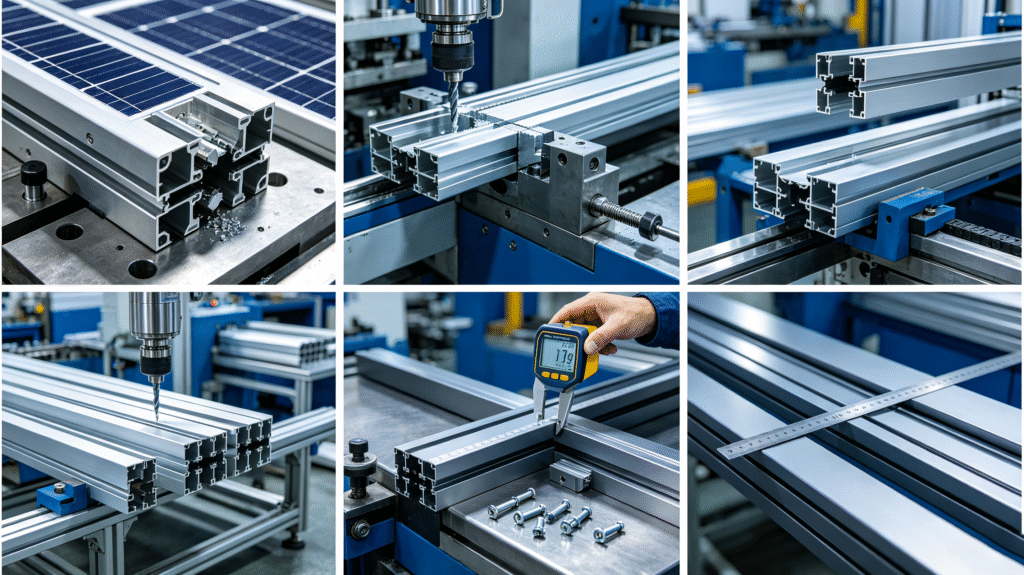
5. CNC Machining
Mounting holes, slots, drainage openings, and other features are machined.
6. Surface Finishing
Powder coating or wood grain finishing is applied.
7. Assembly
Components can be assembled and inspected before shipment when required.
Why One-Stop Manufacturing Matters
A pergola system may contain dozens of different aluminum components.
Working with an integrated manufacturer can simplify:
-
Profile development
-
Tooling
-
Extrusion
-
Machining
-
Finishing
-
Assembly
-
Packaging
This reduces the need to coordinate multiple suppliers and can improve consistency between components.
For international OEM customers, this can also simplify purchasing and export logistics.
Quality Control for Aluminum Pergola Profiles
Quality control should cover both the aluminum extrusion and the finished component.
Important checks may include:
-
Profile dimensions
-
Wall thickness
-
Straightness
-
Cut length
-
Machining accuracy
-
Surface finish
-
Coating thickness
-
Assembly dimensions
For complete pergola systems, additional testing may be required based on the product’s intended use and applicable local requirements.
Choosing an Aluminum Pergola Manufacturer
When evaluating a supplier, look for experience in both aluminum extrusion and finished outdoor products.
Important capabilities include:
-
Custom extrusion die design
-
Aluminum extrusion
-
CNC machining
-
Powder coating
-
Wood grain finishing
-
Assembly
-
Quality inspection
-
OEM and ODM development
A supplier with integrated engineering and manufacturing capabilities can help optimize the product from the initial concept through mass production.
Conclusion
Aluminum pergola profiles are the foundation of modern outdoor shading systems. Through custom extrusion, manufacturers can integrate structural reinforcement, drainage channels, LED lighting, wiring passages, motor housings, and connection features directly into the aluminum profile.
This combination of structural performance, lightweight construction, weather resistance, and design flexibility makes aluminum an excellent material for modern pergolas.
For brands and distributors developing their own pergola systems, choosing an experienced OEM or ODM aluminum extrusion manufacturer can provide significant advantages—from custom profile development and tooling to CNC machining, powder coating, assembly, and final delivery.
As outdoor living continues to influence residential and commercial architecture, well-engineered aluminum pergola extrusion systems will remain an important solution for creating durable, attractive, and low-maintenance outdoor spaces.