



When a standard aluminum profile cannot meet the dimensional, structural, or functional requirements of a product, custom aluminum extrusion provides a flexible solution.
Custom extrusion allows manufacturers to develop an aluminum profile specifically around the customer’s application. The process can begin with a 2D drawing, 3D CAD model, sample, or even an initial product concept, and continue through tooling, prototype production, machining, surface finishing, inspection, and mass production.
For OEMs, product developers, engineers, and purchasing teams, understanding this process can make it easier to plan a successful aluminum extrusion project.
What Is Custom Aluminum Extrusion?
Custom aluminum extrusion is a manufacturing process in which an aluminum billet is heated and forced through a specially designed extrusion die.
The die determines the cross-sectional shape of the finished profile.
Unlike standard aluminum profiles, a custom extrusion is developed according to the customer’s specific requirements.
A custom profile may include:
-
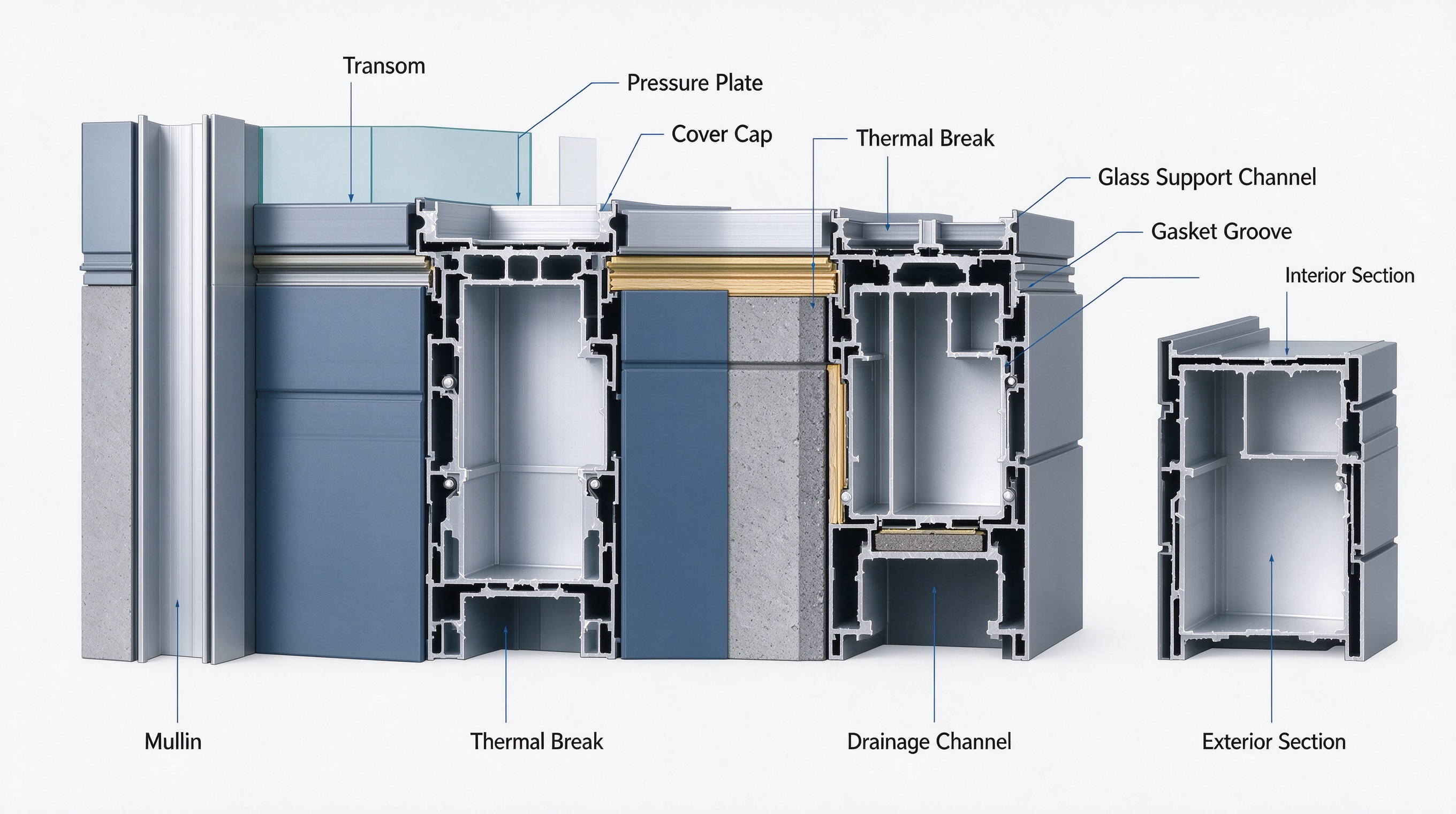
Complex channels
-
Internal cavities
-
Mounting grooves
-
Screw slots
-
Reinforcing ribs
-
Decorative features
-
Wiring channels
-
Interlocking structures
-
Integrated mounting surfaces
This allows engineers to combine multiple functions into a single aluminum extrusion.
When Should You Use Custom Aluminum Extrusion?
Custom extrusion is particularly useful when a standard profile cannot provide the required combination of dimensions and functions.
Typical reasons for developing a custom profile include:
-
Unique product dimensions
-
Special mounting requirements
-
Weight reduction
-
Improved structural performance
-
Integrated channels
-
Specialized appearance
-
Reduced assembly components
-
Compatibility with existing hardware
For example, instead of assembling several separate aluminum components, an engineer may be able to combine their functions into one custom extrusion.
This can simplify assembly and reduce the number of individual parts.
Step 1: Provide a Drawing or Product Concept
The first stage is understanding the customer’s requirements.
The manufacturer may work from:
-
2D engineering drawings
-
3D CAD files
-
Existing samples
-
Technical specifications
-
Product photographs
-
Preliminary sketches
A complete drawing is helpful, but it is not always necessary at the beginning of a project.
The most important information is the intended function of the profile and the key dimensional requirements.
Step 2: Engineering and Design Review
Before manufacturing the extrusion die, the profile should be reviewed for manufacturability.
Engineers may evaluate:
-
Wall thickness
-
Profile symmetry
-
Internal cavities
-
Sharp corners
-
Complex features
-
Dimensional tolerances
-
Material requirements
-
Surface treatment
-
Machining requirements
This stage can identify potential production problems before tooling begins.
Small changes to the profile geometry may sometimes improve extrusion stability, reduce die complexity, and lower production costs without changing the product’s functionality.
Step 3: Select the Aluminum Alloy
The aluminum alloy should be selected according to the application rather than simply choosing the most commonly used option.
Common extrusion alloys include 6063 and 6061.
Factors to consider include:
-
Required strength
-
Extrudability
-
Surface appearance
-
Anodizing requirements
-
Machinability
-
Corrosion resistance
-
Final application
For architectural and decorative products, surface quality and extrusion performance may be particularly important.
For industrial components, mechanical strength and machining performance may receive greater attention.
Step 4: Extrusion Die Development
The extrusion die is one of the most important components in custom aluminum extrusion.
The die must be designed according to the profile’s geometry and expected aluminum flow.
A poorly optimized die can lead to problems such as:
-
Uneven material flow
-
Dimensional variation
-
Surface defects
-
Profile distortion
-
Excessive die wear
An experienced extrusion manufacturer can modify the die design to improve production stability before mass production begins.
Step 5: Prototype Production
After the die is manufactured, initial profiles can be extruded for evaluation.
Prototype or sample production allows the customer and manufacturer to verify:
-
Profile dimensions
-
Cross-sectional geometry
-
Surface appearance
-
Fit with mating components
-
Assembly compatibility
-
Machining requirements
-
Surface treatment
This stage is particularly valuable for new products because it provides an opportunity to identify problems before large-scale production.
Step 6: Surface Treatment
Once the extrusion has been approved, the aluminum profile can receive the required surface treatment.
Common options include:
Anodizing
Anodizing provides a durable oxide layer and is widely used for architectural and industrial profiles.
Powder Coating
Powder coating offers a wide selection of colors and can provide a durable decorative finish.
Woodgrain Transfer Printing
Woodgrain finishing can create a wood-like appearance while retaining the structural advantages of aluminum.
Brushed or Polished Finishes
These finishes can be used when the project requires a specific metallic appearance.
The surface treatment should be selected according to the product’s operating environment and appearance requirements.
Step 7: Cutting and CNC Machining
Many custom aluminum profiles require additional fabrication after extrusion.
Typical operations include:
-
Precision cutting
-
Drilling
-
Milling
-
Tapping
-
Slot machining
-
End machining
-
Countersinking
-
Hole machining
CNC machining can transform a continuous extrusion into finished components that are ready for assembly.
For OEM projects, combining extrusion and machining can simplify the customer’s supply chain by reducing the number of separate suppliers involved.
Step 8: Quality Inspection
Quality control should be performed throughout the production process rather than only at the end.
Inspection may include:
-
Raw material verification
-
Profile dimensions
-
Wall thickness
-
Straightness
-
Twist
-
Cut length
-
Hole position
-
Machining dimensions
-
Surface finish
-
Color consistency
-
Final appearance
For precision components, inspection equipment and measurement methods should be selected according to the required tolerances.
Step 9: Mass Production
After samples are approved, the project can move into mass production.
Production efficiency becomes increasingly important as order volume increases.
Manufacturers can optimize:
-
Extrusion speed
-
Cutting processes
-
Machining programs
-
Surface treatment
-
Inspection procedures
-
Packaging
-
Production scheduling
A well-designed profile can provide significant cost advantages when produced at scale.
How Custom Extrusion Can Reduce Manufacturing Costs
Custom extrusion is not necessarily more expensive than using standard profiles.
In some applications, it can actually reduce the total manufacturing cost.
For example, one custom extrusion may replace several separate components.
This can reduce:
-
Number of parts
-
Assembly labor
-
Fasteners
-
Machining requirements
-
Material waste
-
Inventory complexity
The correct comparison is therefore not simply the cost per kilogram of aluminum.
Instead, manufacturers should consider the total cost of the finished component.
Design for Manufacturability
One of the most important principles in custom aluminum extrusion is designing the profile with manufacturing in mind.
A good design should balance:
Function + Strength + Weight + Extrusion Feasibility + Machining + Surface Treatment + Cost
For example, a very complicated cross-section may provide excellent functionality but require a more complicated die and slower production.
A slightly simplified profile may provide almost the same performance while being significantly easier to manufacture.
Custom Aluminum Extrusion for OEM and ODM
OEM and ODM customers often require more than a basic extrusion profile.
A complete manufacturing program may include:
-
Product engineering
-
Aluminum alloy selection
-
Custom die development
-
Aluminum extrusion
-
Prototype production
-
CNC machining
-
Surface treatment
-
Assembly
-
Quality inspection
-
Packaging
This allows the manufacturer to provide a more complete solution rather than supplying only raw aluminum profiles.
Applications of Custom Aluminum Extrusion
Custom extrusion is used in a wide range of industries.
Architecture
-
Windows
-
Doors
-
Curtain walls
-
Railings
-
Decorative trims
-
Interior systems
Industrial Equipment
-
Machine frames
-
Automation equipment
-
Conveyor systems
-
Safety enclosures
-
Equipment housings
Electronics
-
Heat sinks
-
LED housings
-
Electronic enclosures
-
Mounting structures
Transportation
-
Structural components
-
Interior components
-
Equipment frames
-
Lightweight assemblies
Furniture
-
Furniture frames
-
Sliding systems
-
Decorative profiles
-
Modular structures
The ability to create application-specific cross-sections makes aluminum extrusion suitable for many different product categories.
What Should You Ask an Aluminum Extrusion Manufacturer?
Before starting a project, buyers should provide as much relevant information as possible.
Useful information includes:
-
Aluminum alloy
-
Profile dimensions
-
CAD drawings
-
Required quantity
-
Surface finish
-
Cutting length
-
Machining requirements
-
Tolerance requirements
-
Packaging requirements
-
Application environment
It is also useful to discuss the expected production volume early.
A profile intended for a small prototype run may require a different manufacturing strategy from a profile expected to be produced continuously for several years.
Final Thoughts
Custom aluminum extrusion provides manufacturers with a flexible way to develop lightweight, functional, and cost-effective aluminum components.
The process involves much more than simply creating an extrusion die. Successful projects require coordination between product design, alloy selection, extrusion engineering, tooling, machining, surface treatment, quality control, and production planning.
For OEM and ODM customers, working with an experienced aluminum extrusion manufacturer from the early design stage can help identify manufacturing issues before they become expensive problems.
From the first CAD drawing to the final mass-produced component, a well-planned extrusion project can deliver the right balance of performance, appearance, manufacturing efficiency, and total cost.