



Aluminum LED Profiles: Design, Applications, and Manufacturing
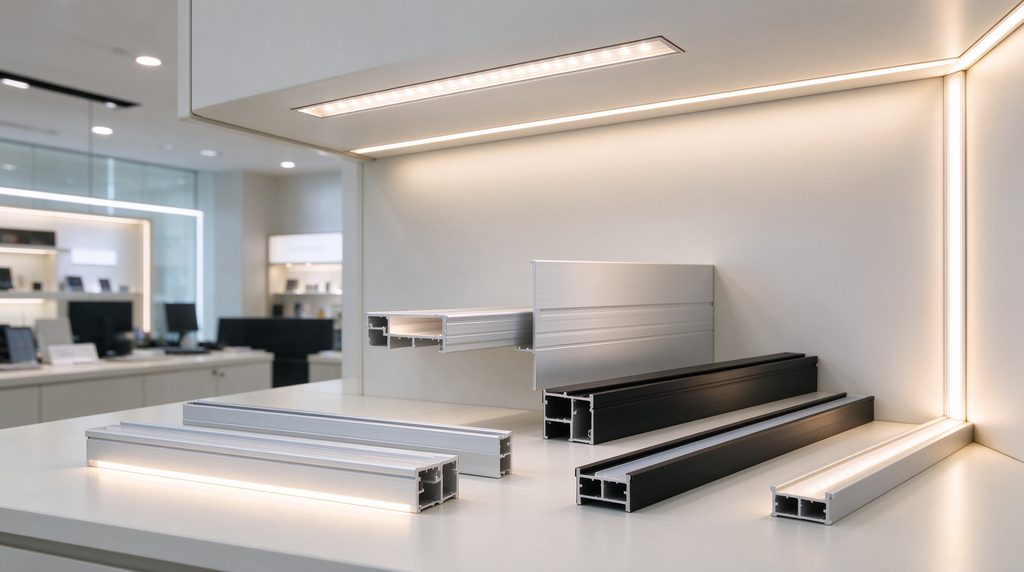
Aluminum LED profiles are widely used in residential lighting, commercial interiors, retail displays, offices, hotels, and architectural lighting systems. By combining an aluminum housing with an LED strip and a compatible diffuser, these profiles create a clean, professional lighting solution that can be integrated into walls, ceilings, cabinets, furniture, and other structures.
Compared with installing LED strips directly onto a surface, aluminum LED profiles provide a more organized mounting system, help manage heat, and protect the lighting components from everyday contact and environmental exposure.
However, selecting the right LED aluminum profile involves more than choosing a shape. Profile geometry, heat dissipation, LED strip compatibility, diffuser performance, installation method, and surface finish all influence the final result.
This guide explains how aluminum LED profiles are designed and manufactured, what to consider when selecting a profile, and how custom extrusion can support different lighting applications.
What Is an Aluminum LED Profile?
An aluminum LED profile is an extruded aluminum housing designed to hold LED strip lighting and, in many applications, a diffuser or cover.
The aluminum body typically provides a mounting surface for the LED strip, while the diffuser helps distribute light and reduces the visibility of individual LED points.
A typical LED profile system may include:
-
An extruded aluminum housing
-
An LED strip or lighting module
-
A diffuser or cover
-
End caps
-
Mounting clips or brackets
-
Connectors or other installation accessories
The exact components depend on the profile design and intended application.
Aluminum is commonly used because it is lightweight, durable, easy to fabricate, and an effective conductor of heat. Its extrusion characteristics also allow manufacturers to produce complex cross-sections with integrated mounting channels, diffuser grooves, and other functional features.
Why Is Aluminum Used for LED Profiles?
Aluminum offers several advantages for LED lighting systems.
1. Heat Dissipation
LEDs convert electrical energy into light and heat. Excessive operating temperature can reduce LED performance and shorten the service life of lighting components.
Aluminum conducts heat away from the LED strip and distributes it across the profile body, helping the system manage temperature.
Actual thermal performance depends on several factors, including the profile’s cross-sectional area, wall thickness, surface area, LED power density, installation conditions, and airflow.
A narrow decorative profile may be suitable for low-power accent lighting, while a higher-output lighting system may require a larger heat-dissipating profile.
The aluminum housing should therefore be selected according to the LED manufacturer’s thermal requirements rather than appearance alone.
2. Structural Support
Aluminum profiles provide a stable surface for mounting LED strips. They also help maintain consistent alignment in linear lighting installations.
This is especially useful for under-cabinet lighting, display shelving, architectural details, and long lighting runs where a straight, uniform appearance is important.
3. Clean Appearance
Extruded aluminum can be produced in different shapes and finished in a variety of colors.
Common finishes include silver anodizing, black anodizing, white powder coating, and other custom colors. These options help the profile coordinate with furniture, architectural materials, and interior design schemes.
4. Design Flexibility
Extrusion allows manufacturers to integrate several functions into one component.
For example, a single profile can include a strip mounting channel, diffuser grooves, mounting features, and external fins for heat dissipation.
This can reduce the need for separate brackets or additional structural components.
Common Types of Aluminum LED Profiles
Different lighting applications require different profile shapes and installation methods.
Surface-Mounted LED Profiles
Surface-mounted profiles are installed directly onto a wall, ceiling, cabinet, or other surface.
They are commonly used for:
-
Under-cabinet lighting
-
Office lighting
-
Display cabinets
-
Shelving systems
-
Decorative linear lighting
These profiles are relatively straightforward to install and are useful when the surrounding structure does not allow recessed mounting.
Their visible height, width, and diffuser design should be considered during product selection.
Recessed LED Profiles
Recessed profiles are installed inside a groove or opening in a ceiling, wall, floor, or furniture component.
The finished profile can sit nearly flush with the surrounding surface, creating a clean architectural appearance.
Recessed installation requires careful attention to the dimensions of the mounting channel, available installation depth, retaining features, and access for wiring.
The profile and mounting opening should be designed together to reduce installation difficulties.
Corner LED Profiles
Corner profiles are designed to direct light at an angle, often around 45 degrees, although the actual angle depends on the product design.
They are useful for cabinet corners, shelving, display cases, and other applications where the light needs to be directed toward a specific surface.
The profile’s orientation should be evaluated in the actual installation environment to avoid unwanted glare or uneven illumination.
Pendant LED Profiles
Pendant profiles are suspended from ceilings using cables, rods, or dedicated mounting systems.
They are frequently used in offices, meeting rooms, commercial interiors, and contemporary residential spaces.
These profiles may require additional space for wiring, suspension hardware, and thermal management. Larger designs can also provide room for multiple LED strips or different lighting distributions.
Flexible and Curved Lighting Systems
Some projects require curved lighting lines or lighting that follows a non-linear architectural feature.
A standard rigid aluminum extrusion cannot automatically follow a tight curve. Depending on the design, the solution may involve segmented profiles, specially processed components, flexible mounting systems, or a different lighting product.
Manufacturers should evaluate the required bend radius, visible joint lines, installation method, and lighting continuity before choosing a solution.
Key Design Considerations for Aluminum LED Profiles
Selecting a suitable profile requires coordination between the aluminum housing, LED strip, diffuser, and installation environment.
1. Profile Dimensions
The profile’s width and depth determine how much space is available for the LED strip, wiring, diffuser, and mounting hardware.
Before selecting a profile, confirm:
-
LED strip width
-
Number of LED strips
-
Required installation depth
-
Diffuser dimensions
-
Cable routing requirements
-
Available mounting space
-
Desired visible width
For custom projects, these dimensions should be established before the extrusion die is developed.
A profile that is too narrow may not accommodate the selected LED strip or its connectors. A profile that is too shallow may limit diffuser options or provide insufficient thermal performance for the intended LED output.
2. Wall Thickness and Structural Design
Wall thickness affects the profile’s rigidity, weight, extrusion behavior, and material consumption.
Thin walls may reduce weight and cost, but they can also increase the risk of deformation during manufacturing, cutting, handling, or installation.
Thicker sections may improve stiffness in some designs, although the best solution depends on the overall cross-section rather than wall thickness alone.
A good extrusion design balances structural requirements, heat dissipation, manufacturability, and material efficiency.
3. Heat Dissipation Requirements
Thermal performance is one of the most important considerations for higher-power LED lighting.
The profile’s ability to dissipate heat depends on its geometry, exposed surface area, installation method, surrounding materials, and operating environment.
For example, a profile mounted in an open area may dissipate heat differently from one installed inside a closed cabinet or recessed cavity.
Designers should evaluate the complete lighting assembly under representative operating conditions. Where necessary, temperature testing can help verify that the LED strip remains within its specified operating limits.
4. Diffuser Compatibility
LED profile diffusers are commonly made from materials such as polycarbonate or PMMA, depending on the required optical and physical properties.
Different diffuser designs can produce different lighting effects:
-
Clear diffusers allow high light transmission but may show individual LED points.
-
Frosted diffusers soften the appearance of the light source.
-
Opal diffusers provide greater visual diffusion but may reduce light output.
-
Specialized optical covers can help control glare or direct light distribution.
The diffuser should fit securely into the profile’s retaining grooves without excessive force or looseness.
Designers should also consider UV exposure, temperature, cleaning requirements, and the intended indoor or outdoor environment when choosing the cover material.
5. LED Strip Compatibility
Not all LED strips fit all aluminum profiles.
Important factors include strip width, electrical configuration, connector dimensions, operating power, and the strip’s thermal requirements.
For installations using multiple LED strips, the profile must provide sufficient mounting width and allow the strips to be positioned as intended.
The diffuser’s distance from the LEDs also affects the appearance of the illuminated surface. A suitable combination can reduce visible hotspots and improve visual uniformity.
Aluminum LED Profile Surface Finishes
Surface finishing affects appearance, durability, and how the profile coordinates with its surroundings.
Anodizing
Anodizing creates a protective oxide layer on the aluminum surface.
Common anodized finishes include natural silver and black. Depending on the process and specification, other colors may also be available.
Anodizing is often selected for its metallic appearance and suitability for architectural and decorative applications.
Powder Coating
Powder coating provides a wide range of colors and gloss levels.
White and black profiles are common in interior lighting, while custom colors may be specified to match cabinetry, ceiling systems, or architectural details.
The coating specification should consider appearance, adhesion, handling resistance, and the intended environment.
Custom Decorative Finishes
Some projects require a finish that coordinates with furniture or architectural materials.
Depending on the required appearance and available process, manufacturers may offer custom colors or decorative finishes.
For visible lighting systems, it is advisable to approve a production sample before ordering large quantities, particularly when color consistency is important across multiple components.
Manufacturing Aluminum LED Profiles
Aluminum LED profiles are commonly produced through an extrusion process, followed by secondary processing and finishing.
Step 1: Profile Design
The process begins with an engineering drawing or product concept.
The manufacturer evaluates the cross-section, mounting features, diffuser interface, wall thickness, thermal requirements, and intended installation method.
For custom projects, a design review can identify features that may increase tooling complexity or create manufacturing difficulties.
Step 2: Extrusion Die Development
A custom extrusion die is manufactured to create the required cross-sectional shape.
The die design must account for material flow, wall thickness distribution, dimensional requirements, and the complexity of the profile.
A well-designed die helps achieve consistent dimensions and a suitable surface condition.
Step 3: Aluminum Extrusion
The aluminum billet is heated and forced through the die to produce a continuous profile.
The extruded material is then cooled, stretched or straightened as required, and cut into manageable lengths.
Process parameters must be controlled to maintain dimensional consistency and an appropriate surface condition.
Step 4: Cutting and Machining
Profiles are cut to the required length. Depending on the design, additional operations may include drilling, milling, slotting, or machining mounting features.
Cutting accuracy is important because small length variations can become noticeable when multiple lighting sections are installed end to end.
Step 5: Surface Treatment
The profile receives the specified finish, such as anodizing or powder coating.
Surface preparation and process control are important for achieving consistent appearance and coating performance.
Step 6: Inspection and Packaging
Finished profiles are inspected for dimensions, straightness, surface appearance, and other specified requirements.
Diffuser fit and accessory compatibility may also be checked when these components are supplied as part of the product system.
Protective packaging helps reduce scratches, dents, and other damage during transportation.
Custom Aluminum LED Profiles for OEM and ODM Projects
Standard profiles are suitable for many applications, but custom extrusion can provide greater design flexibility when a project has specific requirements.
A custom aluminum LED profile may be developed to accommodate:
-
A non-standard LED strip width
-
Multiple lighting strips
-
Integrated mounting channels
-
Special diffuser dimensions
-
A particular visible shape
-
Improved heat dissipation
-
Custom lengths or machining features
-
Specific surface finishes
For OEM projects, the manufacturer typically works from customer drawings and specifications. For ODM projects, the manufacturer may also contribute to product design and engineering development.
When developing a custom profile, it is helpful to provide a cross-sectional drawing, target dimensions, LED strip specifications, installation details, finish requirements, and expected order quantities.
The earlier these details are clarified, the easier it is to evaluate tooling requirements, manufacturing feasibility, and potential cost savings.
Common Applications of Aluminum LED Profiles
Aluminum LED profiles are used across a wide range of lighting applications.
Residential lighting: Under-cabinet lighting, wardrobes, shelves, ceilings, stair details, and decorative wall features.
Commercial interiors: Offices, conference rooms, hotels, restaurants, and reception areas.
Retail displays: Product shelving, showcase cabinets, display walls, and illuminated signage structures.
Architectural lighting: Recessed ceiling lines, wall reveals, linear lighting details, and integrated building features.
Furniture manufacturing: Desks, cabinets, wardrobes, display furniture, and modular storage systems.
Industrial and technical environments: Equipment lighting, inspection stations, and selected machine enclosures where the profile and electrical components are appropriate for the operating conditions.
Each application may require different priorities for appearance, thermal performance, mounting strength, environmental protection, and maintenance access.
How to Choose the Right Aluminum LED Profile Manufacturer
When comparing suppliers, consider more than the initial price per meter.
A reliable supplier should be able to evaluate profile design, extrusion feasibility, finishing requirements, and the compatibility of supplied components.
Useful questions include:
-
Can the supplier manufacture custom cross-sections?
-
Is custom extrusion tooling available?
-
Can the profile accommodate the specified LED strip and diffuser?
-
What anodizing and powder coating options are available?
-
Can the supplier provide cutting and CNC machining?
-
How are dimensional consistency and surface quality inspected?
-
Can samples be produced for evaluation before mass production?
-
What packaging methods are used to protect long profiles during shipping?
It is also important to clarify whether the quotation includes only the aluminum housing or a complete system with diffusers, end caps, and mounting accessories.
Comparing quotations on the same technical basis makes it easier to assess the real cost of the finished solution.
Final Thoughts
Aluminum LED profiles combine structural support, heat management, and clean industrial design in a versatile lighting component. Their performance depends on choosing the right cross-section, ensuring compatibility with the LED strip and diffuser, selecting an appropriate finish, and maintaining consistent manufacturing quality.
For simple installations, a standard profile may provide a cost-effective solution. For specialized lighting projects, custom aluminum extrusion can create integrated mounting features, accommodate unique dimensions, and support a more consistent finished appearance.
By considering thermal requirements, optical performance, installation details, and manufacturing feasibility from the beginning, designers and buyers can select aluminum LED profiles that meet both functional and aesthetic goals.
SEO Keywords Naturally Covered
-
Aluminum LED profiles
-
LED aluminum extrusion
-
Aluminum LED channel
-
LED strip aluminum housing
-
LED profile heat dissipation
-
Recessed LED aluminum profile
-
Surface-mounted LED profile
-
Custom aluminum LED profiles
-
Aluminum LED diffuser channel
-
LED lighting extrusion manufacturer
-
Anodized aluminum LED profile
-
Powder-coated LED aluminum profile
-
Custom aluminum extrusion
-
Aluminum profiles for architectural lighting