




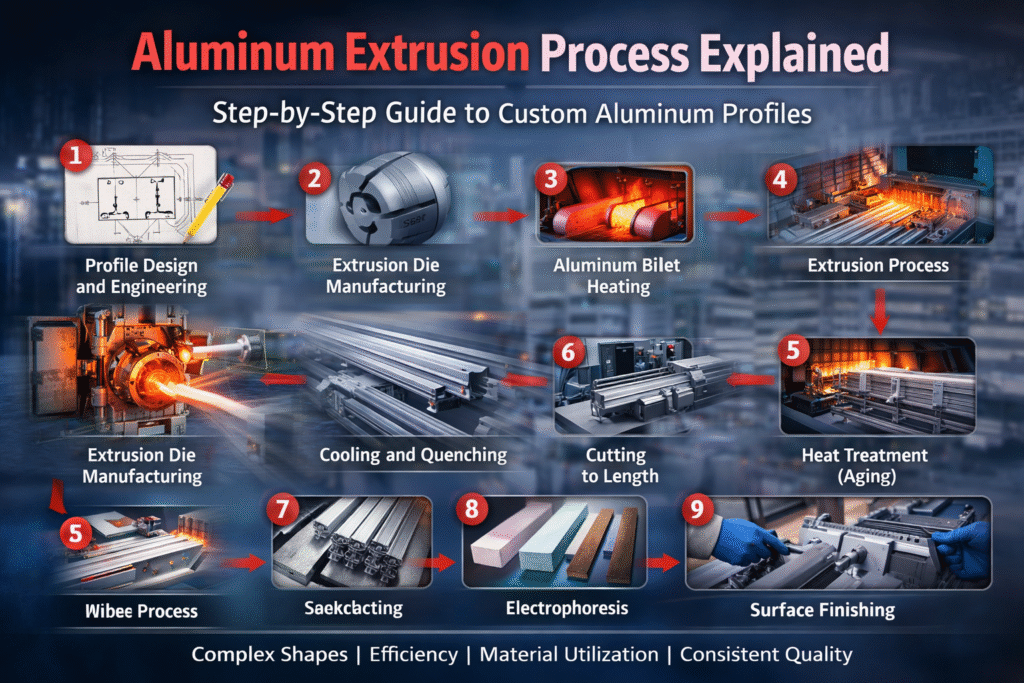
Aluminum Extrusion Process Explained: Step-by-Step Guide to Custom Aluminum Profiles
Aluminum extrusion is one of the most widely used manufacturing processes for producing aluminum profiles. From industrial equipment to architectural systems, extrusion allows manufacturers to create strong, lightweight, and complex shapes with high efficiency.
For buyers, engineers, and designers, understanding the aluminum extrusion process is essential when working on custom aluminum profile projects. This guide explains each step of the process and how it impacts the final product.
What Is Aluminum Extrusion?
Aluminum extrusion is a process in which heated aluminum is forced through a specially designed die to create a continuous profile with a fixed cross-section.
The process is often compared to squeezing toothpaste from a tube. The die determines the final shape of the aluminum profile, allowing for simple or highly complex designs.
This method is ideal for producing long, uniform components with precise dimensions.
Step 1: Profile Design and Engineering
The extrusion process begins with profile design. Engineers create a cross-sectional drawing based on the application requirements.
Key considerations include:
Structural strength
Wall thickness
Internal cavities
Extrusion feasibility
Surface finish requirements
Good design ensures that the profile can be extruded efficiently without defects.
Step 2: Extrusion Die Manufacturing
Once the design is finalized, a custom extrusion die is manufactured. The die is typically made from high-strength tool steel and precisely machined.
The quality of the die directly affects:
Dimensional accuracy
Surface finish
Production consistency
A well-made die can be used repeatedly for large production volumes.
Step 3: Aluminum Billet Heating
Aluminum billets (solid cylindrical blocks) are heated to a specific temperature, usually between 400°C and 500°C.
Heating softens the aluminum, making it easier to push through the die without cracking or breaking.
Proper temperature control is essential for maintaining material properties and ensuring smooth extrusion.
Step 4: Extrusion Process
The heated aluminum billet is placed into the extrusion press. A powerful hydraulic ram pushes the billet through the die, forming the desired profile shape.
As the aluminum exits the die, it takes on the exact cross-section defined by the die.
Key factors during extrusion include:
Pressure control
Extrusion speed
Temperature stability
These factors affect the quality and consistency of the final profile.
Step 5: Cooling and Quenching
After extrusion, the aluminum profile is cooled using air or water.
This process, known as quenching, helps lock in the material’s mechanical properties.
Proper cooling ensures that the profile maintains its strength and dimensional stability.
Step 6: Stretching and Straightening
Extruded aluminum profiles may have slight distortions after cooling. To correct this, the profiles are stretched and straightened.
This step ensures:
Accurate dimensions
Straight profiles
Improved structural integrity
Precision in this stage is important for applications requiring tight tolerances.
Step 7: Cutting to Length
After straightening, the profiles are cut to specified lengths based on customer requirements.
This can include:
Standard lengths
Custom cut-to-size pieces
Preparation for further machining
Cutting accuracy is important for efficient assembly and installation.
Step 8: Heat Treatment (Aging)
Some aluminum alloys require heat treatment to achieve their full strength. This process, known as aging, involves heating the profiles in a controlled environment.
Heat treatment improves:
Mechanical strength
Hardness
Durability
Alloys such as 6061 and 6063 often undergo this process.
Step 9: Surface Finishing
Surface finishing enhances both appearance and performance. Common finishing options include:
Anodizing
Creates a protective oxide layer that improves corrosion resistance.
Powder Coating
Adds color and a durable protective layer.
Electrophoresis
Provides smooth, uniform coatings for architectural applications.
Wood Grain Transfer
Simulates natural wood textures while maintaining aluminum durability.
Step 10: Inspection and Quality Control
Before shipment, aluminum profiles undergo strict quality inspection.
This includes:
Dimensional measurements
Surface quality checks
Mechanical testing
Packaging inspection
Quality control ensures that the final product meets customer specifications and industry standards.
Advantages of the Aluminum Extrusion Process
The extrusion process offers several key advantages:
Ability to create complex shapes
High production efficiency
Excellent material utilization
Consistent quality across batches
Lightweight yet strong structures
These benefits make aluminum extrusion a preferred manufacturing method in many industries.
Why Understanding the Process Matters
For buyers and engineers, understanding the aluminum extrusion process helps:
Improve communication with manufacturers
Optimize profile design
Reduce production risks
Ensure product quality
It also enables better decision-making when selecting materials and suppliers.
Conclusion
The aluminum extrusion process is a highly efficient and versatile manufacturing method that supports a wide range of industries. From design and die production to extrusion, finishing, and inspection, each step plays a critical role in delivering high-quality custom aluminum profiles.
By understanding how the process works, businesses can better leverage aluminum extrusion to create reliable, cost-effective, and scalable solutions.