




For buyers, engineers, and project managers, one of the most common questions is: How much does custom aluminum extrusion cost?
The answer depends on multiple factors, including design complexity, material selection, production volume, and finishing requirements. Understanding these variables helps businesses make informed decisions and control project budgets effectively.
This guide explains the key cost factors in aluminum profile customization and how to optimize your project for better value.
What Determines the Cost of Custom Aluminum Extrusion?
Custom aluminum extrusion pricing is not based on a single factor. Instead, it is influenced by a combination of engineering, production, and logistics elements.
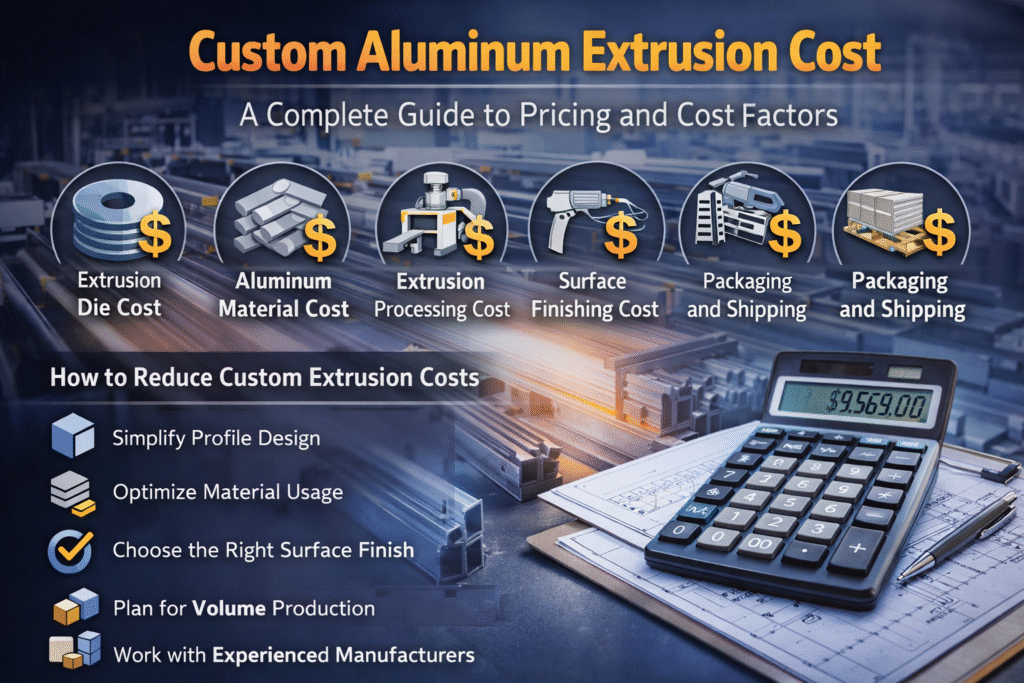
The main cost components include:
Extrusion die (tooling) cost
Aluminum material cost
Extrusion processing cost
Surface finishing cost
Fabrication and machining cost
Packaging and shipping
Each of these factors contributes to the final price of the aluminum profile.
Extrusion Die Cost (Tooling Cost)
The extrusion die is a critical part of custom aluminum profile production. It defines the shape and precision of the profile.
Tooling cost depends on:
Profile complexity
Size and cross-section
Tolerance requirements
Die material and manufacturing quality
Simple profiles may have relatively low tooling costs, while complex designs with thin walls or intricate features require higher investment.
However, the die is a one-time cost and can be reused for future production, making it more cost-effective over time.
Aluminum Material Cost
Material cost is typically calculated based on the weight of the aluminum used.
Factors affecting material cost include:
Aluminum alloy (e.g., 6063 vs 6061)
Profile weight per meter
Market price of aluminum
Lighter, optimized designs can significantly reduce material expenses without compromising performance.
Extrusion Processing Cost
Extrusion processing involves heating aluminum billets and forming them through the die.
Processing cost depends on:
Profile complexity
Production speed
Scrap rate
Machine efficiency
Profiles with simple shapes and uniform wall thickness are easier to produce and generally more cost-efficient.
Surface Finishing Cost
Surface finishing enhances both appearance and durability, but it also adds to the total cost.
Common finishing costs vary based on:
Type of treatment (anodizing, powder coating, etc.)
Coating thickness
Color requirements
Surface quality standards
For example, standard anodizing is usually more cost-effective than specialized finishes or custom colors.
Fabrication and Secondary Processing
Many custom aluminum profiles require additional processing after extrusion, such as:
Cutting
CNC machining
Drilling or punching
Bending
Each additional step increases production cost, but it can also reduce assembly time and improve overall efficiency.
Order Volume and Cost Efficiency
One of the most important factors in pricing is order volume.
Higher production volumes typically result in:
Lower unit cost
Better material utilization
Improved production efficiency
For low-volume orders, the unit price may be higher due to fixed costs such as tooling and setup.
Packaging and Shipping Costs
For international buyers, packaging and logistics also impact total cost.
These may include:
Protective packaging materials
Palletizing or crating
Ocean or air freight
Customs documentation
Efficient packaging reduces the risk of damage and avoids additional costs.
How to Reduce Custom Aluminum Extrusion Costs
Businesses can optimize costs by taking a strategic approach to design and production.
Simplify Profile Design
Avoid unnecessary complexity. Uniform wall thickness and practical geometry improve extrusion efficiency.
Optimize Material Usage
Design profiles to use only the material required for performance. This reduces weight and cost.
Choose the Right Surface Finish
Select finishes that meet performance requirements without over-specification.
Plan for Volume Production
Larger production runs reduce unit cost and improve overall cost efficiency.
Work with Experienced Manufacturers
Professional aluminum extrusion suppliers can provide design recommendations that reduce cost while maintaining quality.
Cost vs Value: What Really Matters
Focusing only on the lowest price can lead to problems such as:
Poor dimensional accuracy
Inconsistent surface finish
Delays in production
Increased rejection rates
Instead, buyers should evaluate total value, including quality, reliability, and long-term performance.
Typical Cost Expectations (General Reference)
While exact pricing varies, general cost ranges include:
Tooling cost: one-time investment depending on complexity
Unit cost: decreases significantly with higher volume
Surface finishing: varies by type and quality level
For accurate pricing, it is always recommended to request a quotation based on specific project details.
Conclusion
Custom aluminum extrusion cost depends on multiple factors, including design, material, processing, finishing, and order volume. By understanding these elements, businesses can make better decisions and optimize their budgets.
With the right design strategy and manufacturing partner, custom aluminum profiles provide excellent long-term value, balancing cost, performance, and scalability.