



When working with custom aluminum profiles, tolerances play a critical role in ensuring proper fit, function, and performance. Whether the application involves industrial equipment, architectural systems, or OEM products, even small dimensional variations can impact the final result.
Understanding aluminum extrusion tolerances helps engineers, designers, and buyers set realistic expectations and avoid costly production issues.
This guide explains what aluminum extrusion tolerances are, how they are controlled, and how to specify them effectively.
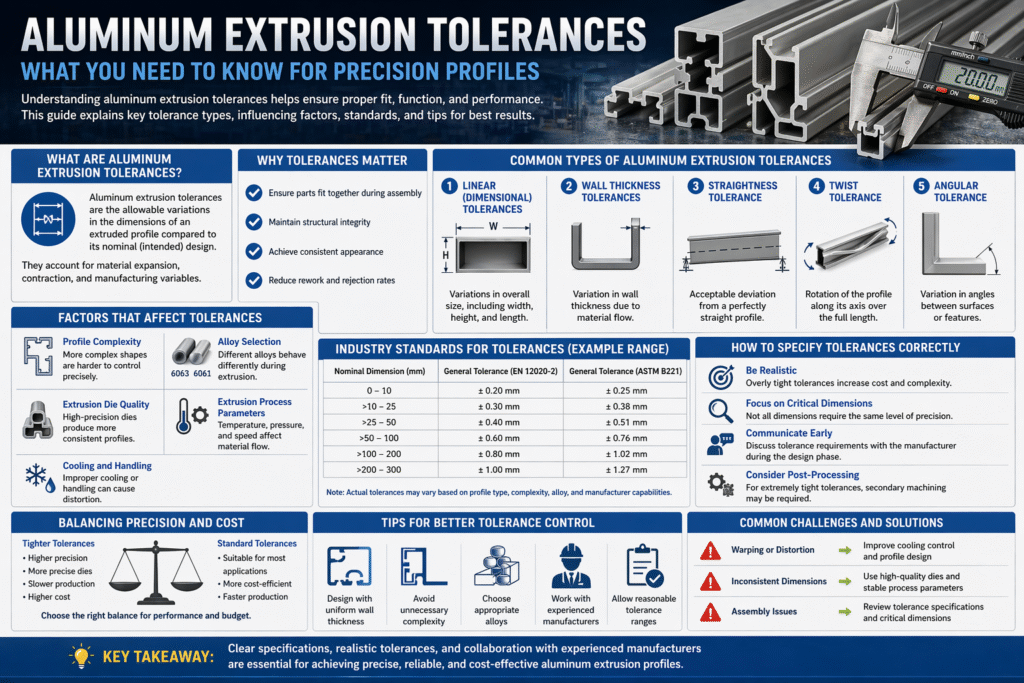
What Are Aluminum Extrusion Tolerances?
Aluminum extrusion tolerances refer to the allowable variation in the dimensions of an extruded profile compared to its nominal (intended) design.
Because aluminum expands when heated and contracts when cooled, it is impossible to produce profiles with absolutely exact dimensions. Instead, manufacturers work within defined tolerance ranges.
These tolerances ensure that the final product remains functional while accounting for manufacturing realities.
Why Tolerances Matter
Proper tolerance control is essential for:
- Ensuring parts fit together during assembly
- Maintaining structural integrity
- Achieving consistent appearance
- Reducing rework and rejection rates
In precision applications, even minor deviations can lead to misalignment, instability, or installation difficulties.
Common Types of Aluminum Extrusion Tolerances
1. Linear (Dimensional) Tolerances
These refer to variations in the overall size of the profile, including:
- Width
- Height
- Length
Linear tolerances are critical for ensuring compatibility with other components.
2. Wall Thickness Tolerances
Wall thickness can vary slightly during extrusion due to material flow and die design.
Uniform wall thickness improves extrusion stability and reduces variation.
3. Straightness Tolerance
Extruded profiles may not be perfectly straight after cooling.
Straightness tolerance defines the acceptable level of deviation along the length of the profile.
4. Twist Tolerance
Twist refers to the rotation of the profile along its axis.
This is especially important for long profiles used in structural or architectural applications.
5. Angular Tolerance
Angular tolerance controls the accuracy of corners and angles within the profile cross-section.
This is important for profiles with precise geometric requirements.
Factors That Affect Aluminum Extrusion Tolerances
Several factors influence the achievable tolerance in aluminum extrusion:
Profile Complexity
More complex shapes with thin walls or intricate details are harder to control precisely.
Alloy Selection
Different aluminum alloys behave differently during extrusion. For example:
- 6063 aluminum allows better surface finish and tighter tolerances
- 6061 aluminum may have slightly wider tolerances due to higher strength
Extrusion Die Quality
The precision of the extrusion die directly impacts dimensional accuracy.
High-quality dies produce more consistent profiles.
Extrusion Process Parameters
Temperature, pressure, and extrusion speed all affect material flow and final dimensions.
Cooling and Handling
Improper cooling or handling can cause distortion, affecting straightness and dimensional stability.
Industry Standards for Tolerances
Aluminum extrusion tolerances are often defined according to international standards, such as:
- EN standards (Europe)
- ASTM standards (United States)
These standards provide general tolerance ranges based on profile size and type.
However, custom projects may require tighter tolerances depending on application needs.
How to Specify Tolerances Correctly
To ensure successful production, buyers and engineers should clearly define tolerance requirements.
Be Realistic
Overly tight tolerances can significantly increase production cost and complexity.
Focus on Critical Dimensions
Not all dimensions require the same level of precision. Identify key areas that affect function and assembly.
Communicate Early
Discuss tolerance requirements with the manufacturer during the design phase to ensure feasibility.
Consider Post-Processing
For extremely tight tolerances, secondary machining may be required after extrusion.
Balancing Precision and Cost
There is always a trade-off between precision and cost.
- Tighter tolerances require more precise dies, slower production, and stricter quality control
- Standard tolerances are more cost-efficient and suitable for most applications
Optimizing this balance is key to achieving both performance and cost efficiency.
Tips for Better Tolerance Control
To improve tolerance outcomes:
- Design profiles with uniform wall thickness
- Avoid unnecessary complexity
- Choose appropriate alloys
- Work with experienced manufacturers
- Allow reasonable tolerance ranges
These practices help ensure consistent and reliable results.
Common Challenges and Solutions
Challenge: Warping or Distortion
Solution: Improve cooling control and profile design
Challenge: Inconsistent Dimensions
Solution: Use high-quality dies and stable process parameters
Challenge: Assembly Issues
Solution: Review tolerance specifications and critical dimensions
Conclusion
Aluminum extrusion tolerances are a fundamental aspect of custom aluminum profile manufacturing. By understanding how tolerances work and what affects them, businesses can improve design quality, reduce production risks, and ensure better performance.
Clear communication, realistic expectations, and collaboration with experienced manufacturers are essential for achieving precise and reliable aluminum profiles.
In modern engineering and manufacturing, tolerance control is not just a technical detail—it is a key factor in overall project success.
SEO Keywords Naturally Covered:
aluminum extrusion tolerances · aluminum profile tolerance standards · custom aluminum profile precision · aluminum extrusion accuracy · aluminum extrusion dimensional control