


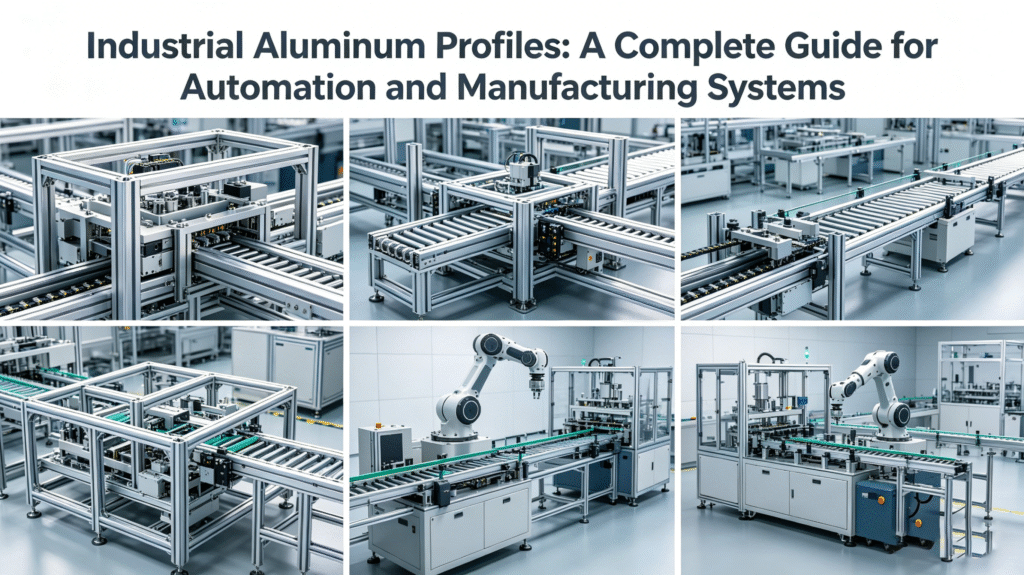
Industrial aluminum profiles have become a core component in modern manufacturing, automation, and engineering systems. Known for their lightweight structure, modular flexibility, and excellent strength-to-weight ratio, these profiles are widely used in factories, machine frames, workstations, and automated production lines.
As industries continue to move toward smart manufacturing and flexible production systems, the demand for industrial aluminum profiles continues to grow worldwide.
This guide explains the types, advantages, applications, and customization possibilities of industrial aluminum extrusion systems.
What Are Industrial Aluminum Profiles?
Industrial aluminum profiles are extruded aluminum components specifically designed for structural and mechanical applications.
Unlike decorative profiles, industrial profiles focus on:
- Structural stability
- Modular assembly
- Precision engineering
- Functional integration
Most industrial profiles use slot-based designs that allow easy connection using fasteners and accessories.
Why Aluminum Is Ideal for Industrial Systems
Aluminum offers several advantages that make it highly suitable for industrial applications.
Lightweight but Strong
Aluminum weighs significantly less than steel while still providing excellent structural strength.
This helps:
- Reduce machine weight
- Simplify transportation and installation
- Improve system flexibility
Corrosion Resistance
Industrial aluminum profiles naturally resist corrosion, making them suitable for:
- Humid environments
- Chemical exposure areas
- Long-term industrial use
Unlike steel, aluminum does not rust.
Modular Flexibility
One of the biggest advantages of industrial aluminum profiles is modularity.
Profiles can be:
- Easily assembled
- Expanded or modified
- Reconfigured for different production needs
This flexibility is ideal for modern manufacturing systems.
Easy Machining and Assembly
Industrial aluminum profiles can be easily:
- Cut
- Drilled
- Machined
- Connected using modular accessories
This reduces fabrication time and improves installation efficiency.
Common Types of Industrial Aluminum Profiles
T-Slot Aluminum Profiles
T-slot profiles are the most common type used in industrial systems.
Features
- Standardized slots for connectors
- Easy assembly without welding
- Compatible with modular accessories
Applications
- Machine frames
- Automation systems
- Conveyor structures
- Workstations
V-Slot Aluminum Profiles
V-slot profiles include angled grooves that support wheel-based movement systems.
Applications
- CNC machines
- 3D printers
- Linear motion systems
Heavy-Duty Structural Profiles
Designed for applications requiring higher load capacity.
Features
- Thicker walls
- Reinforced geometry
- Larger cross-sections
Applications
- Large machinery
- Industrial platforms
- Heavy automation systems
Main Applications of Industrial Aluminum Profiles
Automation Equipment
Industrial aluminum extrusion is widely used in automation systems because of its modularity and precision.
Applications include:
- Robotic systems
- Assembly lines
- Safety enclosures
- Sensor mounting systems
Machine Frames
Aluminum profiles provide strong and stable structures for machinery.
Advantages include:
- Reduced machine weight
- Easier assembly and maintenance
- Flexible upgrades
Workstations and Production Tables
Modular aluminum systems are ideal for custom workstations because they can be adjusted and expanded easily.
Conveyor Systems
Industrial profiles are commonly used in conveyor structures due to their durability and lightweight design.
Cleanroom Applications
Because aluminum resists corrosion and is easy to clean, it is suitable for:
- Electronics manufacturing
- Medical facilities
- Pharmaceutical production
Accessories for Industrial Aluminum Profiles
One of the biggest strengths of industrial profile systems is the wide range of compatible accessories.
Common accessories include:
- Brackets
- Connectors
- Hinges
- Casters
- End caps
- Adjustable feet
These accessories simplify assembly and customization.
Surface Finishes for Industrial Profiles
Industrial aluminum profiles are often finished to improve durability and appearance.
Anodizing
- Corrosion-resistant
- Durable surface
- Professional appearance
Powder Coating
- Additional protection
- Custom color options
Custom Industrial Aluminum Profiles
In addition to standard profiles, many manufacturers offer custom aluminum extrusion solutions.
Custom industrial profiles can include:
- Specialized slot structures
- Integrated cable management
- Custom mounting features
- Unique cross-sections
This allows businesses to optimize systems for specific operational needs.
Aluminum vs Steel for Industrial Structures
Compared with steel, aluminum offers several advantages in industrial systems:
| Feature | Aluminum | Steel |
|---|---|---|
| Weight | Lightweight | Heavy |
| Corrosion Resistance | Excellent | Requires protection |
| Assembly | Easy modular assembly | Often requires welding |
| Flexibility | Highly modular | Less flexible |
| Maintenance | Low | Higher |
While steel may offer higher absolute strength, aluminum provides superior flexibility and efficiency for many applications.
How to Choose the Right Industrial Aluminum Profile
When selecting a profile system, consider:
Load Requirements
Choose profile size and wall thickness based on structural demands.
Assembly Complexity
Modular systems simplify future modifications.
Environmental Conditions
Outdoor or humid environments may require enhanced surface treatment.
Future Expansion
Select systems that can adapt to future production changes.
The Future of Industrial Aluminum Extrusion
As smart manufacturing and automation continue to expand, industrial aluminum profiles will play an even greater role in factory design and engineering systems.
Future trends include:
- More integrated modular systems
- Lightweight automation structures
- Greater customization capabilities
- Sustainable manufacturing solutions
Aluminum extrusion remains one of the most efficient solutions for modern industrial infrastructure.
Conclusion
Industrial aluminum profiles provide a versatile, durable, and modular solution for automation, machinery, and manufacturing systems. Their lightweight structure, corrosion resistance, and flexible assembly make them an ideal choice for modern industrial applications.
By understanding the types and advantages of industrial aluminum extrusion systems, businesses can improve efficiency, reduce costs, and build scalable production environments.