




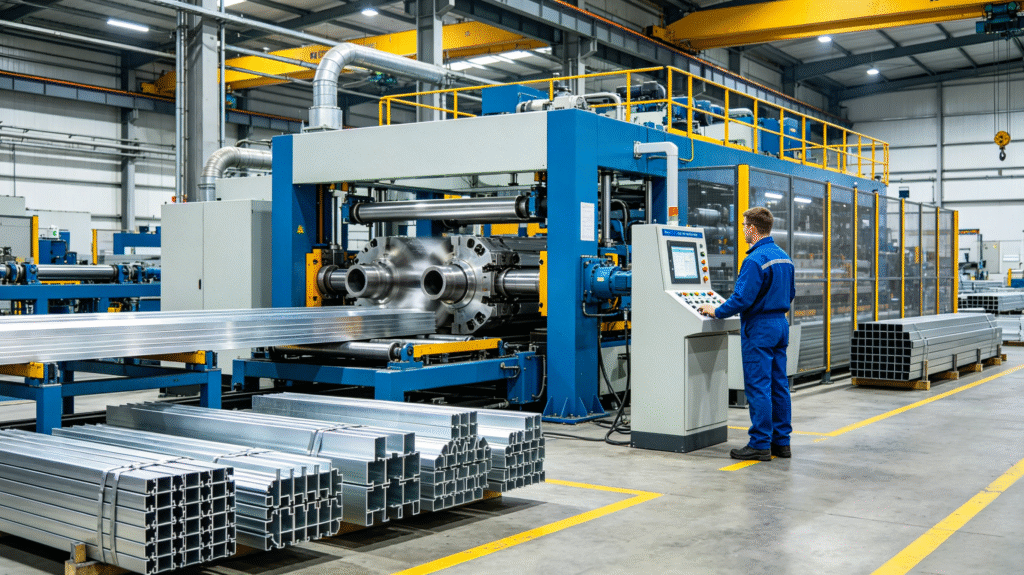
Aluminum extrusion is one of the most efficient and versatile manufacturing processes used in modern industry. From architectural systems and industrial machinery to solar energy structures and LED lighting components, aluminum extrusion enables manufacturers to create strong, lightweight, and highly customized profiles for countless applications.
For buyers, engineers, and product developers, understanding the aluminum extrusion manufacturing process can help improve project planning, product design, and supplier selection.
This guide explains every major step involved in transforming raw aluminum into high-quality finished profiles.
What Is Aluminum Extrusion?
Aluminum extrusion is a manufacturing process in which heated aluminum is forced through a specially designed die to create a continuous profile with a fixed cross-section.
The process is similar to squeezing toothpaste from a tube—the aluminum takes the shape of the die opening as it exits the extrusion press.
Because of its flexibility, extrusion can produce profiles ranging from simple bars to highly complex custom designs.
Step 1: Aluminum Billet Preparation
The process begins with an aluminum billet.
What Is a Billet?
A billet is a solid cylindrical piece of aluminum alloy that serves as the raw material for extrusion.
Common alloys include:
6063 Aluminum
6061 Aluminum
6005A Aluminum
6082 Aluminum
The alloy selected depends on the final application and performance requirements.
Step 2: Billet Heating
Before extrusion, billets are heated to a specific temperature.
Why Heating Is Necessary
Heating softens the aluminum, making it easier to flow through the die while maintaining its structural properties.
Typical billet temperatures range from:
750°F to 930°F (400°C to 500°C)
The exact temperature depends on the alloy and profile design.
Step 3: Extrusion Die Installation
The extrusion die is installed into the extrusion press.
The die contains a precisely machined opening that determines the final profile shape.
Since the die controls:
Dimensions
Geometry
Surface quality
its design is critical to successful production.
Step 4: Aluminum Extrusion
Once the billet reaches the correct temperature, it is loaded into the extrusion press.
A powerful hydraulic ram applies pressure to force the softened aluminum through the die.
What Happens During Extrusion?
As the aluminum exits the die:
It takes the shape of the profile
A continuous length is formed
Material flow must remain consistent
The extrusion press may generate thousands of tons of force depending on profile complexity.
Step 5: Cooling the Extruded Profile
After exiting the die, the aluminum profile remains hot.
The profile is cooled using:
Air cooling
Water mist cooling
Controlled cooling systems
Why Cooling Matters
Proper cooling helps achieve:
Dimensional stability
Mechanical strength
Reduced distortion
Cooling conditions vary depending on alloy type and profile geometry.
Step 6: Profile Stretching
As profiles cool, minor twisting or bowing may occur.
To correct this, the profile is stretched.
Benefits of Stretching
Improves straightness
Relieves internal stress
Enhances dimensional accuracy
This step is especially important for long architectural and industrial profiles.
Step 7: Cutting to Length
After stretching, profiles are cut according to customer specifications.
Common lengths include:
Standard stock lengths
Custom project lengths
OEM production requirements
Accurate cutting ensures consistency during installation and assembly.
Step 8: Heat Treatment and Aging
Many aluminum alloys require additional heat treatment to achieve their full mechanical properties.
Aging Process
Controlled aging improves:
Tensile strength
Hardness
Structural performance
For example, 6063-T5 and 6061-T6 tempers are achieved through specific heat treatment processes.
Step 9: Surface Finishing
Surface finishing enhances both performance and appearance.
Anodizing
Provides:
Corrosion resistance
Metallic appearance
Improved durability
Powder Coating
Offers:
Wide color selection
UV protection
Decorative flexibility
Wood Grain Finishing
Creates the appearance of natural wood while maintaining aluminum’s durability.
Brushed Finishes
Popular in modern architectural and decorative applications.
Step 10: Secondary Fabrication
Many custom aluminum profiles require additional processing.
Common fabrication services include:
CNC machining
Drilling
Tapping
Punching
Milling
Assembly preparation
These operations help reduce work required by the customer.
Step 11: Quality Inspection
Professional manufacturers implement strict quality control procedures throughout production.
Inspection Areas
Dimensional accuracy
Surface finish quality
Straightness
Mechanical properties
Color consistency
Quality assurance ensures compliance with project specifications.
Step 12: Packaging and Shipping
Finished profiles are carefully packaged to prevent damage during transportation.
Common protection methods include:
Protective films
Shrink wrapping
Carton packaging
Wooden crates
Proper packaging helps maintain product quality until delivery.
Advantages of the Aluminum Extrusion Process
Design Flexibility
Complex profile shapes can be produced efficiently.
Lightweight Performance
Aluminum provides excellent strength-to-weight ratios.
Cost Efficiency
Material utilization is highly efficient.
Scalability
Suitable for both small and large production runs.
Sustainability
Aluminum is highly recyclable and environmentally friendly.
Industries That Rely on Aluminum Extrusion
Architecture
Window systems
Curtain walls
Aluminum skirting boards
Industrial Automation
Machine frames
Conveyor systems
Workstations
LED Lighting
LED channels
Heat sinks
Lighting housings
Solar Energy
Mounting systems
Structural supports
Transportation
Rail systems
Automotive components
Electric vehicle structures
How to Choose the Right Aluminum Extrusion Manufacturer
When selecting a supplier, consider:
Manufacturing Capacity
Can the supplier handle your volume requirements?
Die Engineering Expertise
Strong tooling capability improves product quality.
Surface Finishing Services
Integrated finishing improves efficiency and consistency.
Quality Control Systems
Reliable inspection processes ensure stable production.
OEM and ODM Experience
Experienced manufacturers can support product development and long-term cooperation.
Future Trends in Aluminum Extrusion Manufacturing
The industry continues to evolve through:
Smart factory automation
Advanced extrusion simulation
Lightweight engineering
Sustainable manufacturing
AI-assisted process optimization
These innovations help improve efficiency, quality, and environmental performance.
Conclusion
The aluminum extrusion manufacturing process transforms raw aluminum into highly functional, lightweight, and durable profiles used across countless industries.
From billet preparation and extrusion to finishing and quality control, every step contributes to the performance and reliability of the final product.
By understanding how aluminum extrusion works and partnering with an experienced manufacturer, businesses can achieve better product quality, improved efficiency, and long-term success in their projects.