




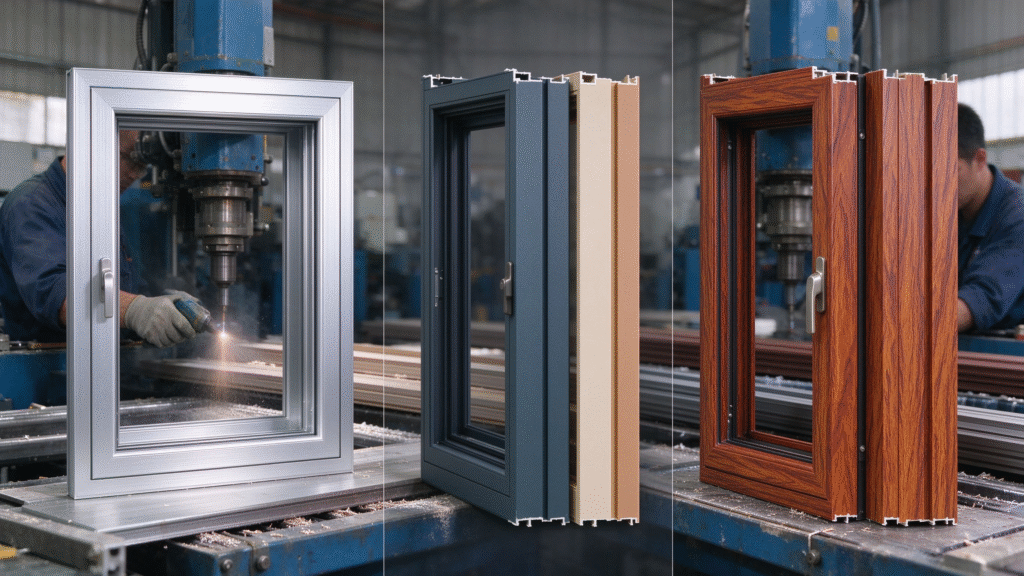
Modern commercial buildings often require exterior systems that combine structural performance, weather resistance, energy efficiency, and architectural appearance. **Aluminum curtain wall profiles** play an important role in these building systems because aluminum can be extruded into complex shapes while remaining relatively lightweight and easy to customize.
From office buildings and hotels to shopping centers and high-rise projects, aluminum extrusion provides the foundation for many curtain wall systems.
For architects, contractors, façade manufacturers, and building material distributors, understanding the design and manufacturing process can help improve product performance and project efficiency.
## What Are Aluminum Curtain Wall Profiles?
An aluminum curtain wall profile is an extruded aluminum component used as part of a building façade system.
Unlike a traditional load-bearing wall, a curtain wall generally forms the exterior building envelope while transferring its own weight and applicable external loads to the building structure through engineered connections.
A curtain wall system can include several different aluminum profiles, such as:
* Vertical mullions
* Horizontal transoms
* Pressure plates
* Cover caps
* Edge profiles
* Corner profiles
* Glass retaining profiles
* Splice components
* Structural support profiles
* Decorative aluminum trims
Each profile has a specific role within the overall façade system.
## Why Is Aluminum Widely Used for Curtain Walls?
Aluminum is particularly suitable for curtain wall applications because extrusion allows manufacturers to create complex cross-sections with integrated channels and cavities.
Important advantages include:
* Lightweight construction
* Good strength-to-weight ratio
* Corrosion resistance
* Flexible profile design
* Good dimensional stability
* Excellent surface finishing options
* Easy fabrication
* Long service life
* Recyclability
The relatively low weight of aluminum can also simplify transportation and installation compared with heavier structural materials.
## The Role of Mullions and Transoms
Two of the most important components in a curtain wall system are **mullions and transoms**.
### Mullions
Mullions are vertical profiles that provide structural support and divide the façade into sections.
Their design may need to accommodate:
* Glass loads
* Wind loads
* Building movement
* Connections
* Drainage
* Sealing systems
* Pressure plates
* Interior finishes
### Transoms
Transoms are horizontal members that connect with the vertical mullions.
They help support and divide individual glass panels while contributing to the overall rigidity of the façade.
The connection between mullions and transoms must be carefully designed to maintain alignment, sealing, and structural performance.
## Curtain Wall Profile Design
The cross-section of an aluminum curtain wall profile has a major influence on the final system.
A well-designed profile may integrate multiple functions into a single extrusion.
For example, one profile can include:
* Glass-support channels
* Screw channels
* Gasket grooves
* Drainage passages
* Pressure plate interfaces
* Decorative cover connections
This reduces the need for additional components and can simplify fabrication and assembly.
During the design stage, engineers should consider both the building requirements and extrusion manufacturability.
## Aluminum Profile Wall Thickness
Wall thickness is an important factor in curtain wall extrusion design.
The profile must provide adequate structural performance without using unnecessary amounts of aluminum.
Increasing wall thickness can increase:
* Material consumption
* Profile weight
* Production cost
* Transportation cost
However, excessive weight reduction can negatively affect rigidity, dimensional stability, and manufacturing performance.
A better approach is to optimize the entire cross-section using internal chambers, ribs, and strategically positioned material.
## Thermal Performance of Curtain Wall Systems
Modern buildings often place significant emphasis on energy efficiency.
Because aluminum conducts heat efficiently, curtain wall systems may incorporate **thermal break technology** to reduce heat transfer between the exterior and interior portions of the frame.
A thermal-break curtain wall can include:
* Exterior aluminum sections
* Interior aluminum sections
* Insulating components
* Gaskets
* Glass systems
* Sealing materials
The thermal performance of the complete façade depends on more than the aluminum extrusion itself.
Glass, gaskets, thermal barriers, installation details, and connections all contribute to the final performance.
## Glass Compatibility
Curtain wall profiles must be designed around the selected glazing system.
Depending on the project, the façade may use:
* Single glass
* Double glazing
* Insulating glass units
* Laminated glass
* Tempered glass
* Low-emissivity glass
* Other specialized glazing systems
The extrusion must provide appropriate support and space for the glass, gaskets, sealants, and associated components.
This is why glass specifications should be considered early in the profile development process.
## Water Management and Drainage
A curtain wall system must manage water effectively.
Even well-sealed façades can be exposed to rainwater, condensation, and moisture.
Aluminum extrusion profiles can be designed with internal drainage paths that direct water toward controlled drainage points.
Typical features include:
* Drainage channels
* Internal cavities
* Weep holes
* Gasket channels
* Sloped surfaces
* Pressure-equalized cavities
Proper drainage design can help reduce the risk of water entering the building interior.
## Surface Finishing for Curtain Wall Profiles
Curtain wall profiles are highly visible architectural components, so surface appearance is often an important consideration.
Common finishes include:
### Anodizing
Anodizing creates a durable oxide layer and can provide a metallic architectural appearance.
It is commonly used where the natural character of aluminum is desired.
### Powder Coating
Powder coating provides a broad selection of colors and can create a consistent architectural finish.
It is suitable for projects where specific colors need to match the building design.
### Woodgrain Finish
Woodgrain transfer printing can create a wood-like appearance while retaining the structural characteristics of aluminum.
This can be useful for architectural projects that require a warmer decorative appearance.
## CNC Machining of Curtain Wall Profiles
Extrusion creates the primary profile, but additional fabrication is often required.
Typical operations include:
* Cutting
* Drilling
* Milling
* Punching
* Slotting
* Tapping
* End machining
* Notching
Precision machining is important because curtain wall components must fit together correctly during installation.
For large projects, automated cutting and machining systems can help improve consistency across large production batches.
## Quality Control for Curtain Wall Extrusions
Quality control should cover the entire manufacturing process.
Important inspection areas include:
### Profile Dimensions
Critical dimensions should be checked against approved technical drawings.
### Straightness and Twist
Long aluminum profiles need appropriate dimensional control to ensure proper assembly.
### Surface Quality
Profiles should be inspected for scratches, dents, extrusion marks, coating defects, and other visible imperfections.
### Color Consistency
For architectural projects, finished profiles should maintain consistent color and appearance across production batches.
### Machining Accuracy
Cutting, holes, slots, and other machined features should meet the specified requirements.
## Custom Aluminum Curtain Wall Profiles
Standard curtain wall systems can meet many common applications, but custom extrusion is useful when a project has unique architectural or engineering requirements.
Custom profiles can be designed for:
* Special façade geometries
* Large glass panels
* Unique corner conditions
* Custom drainage systems
* Specialized thermal-break structures
* Decorative architectural elements
* Customized installation methods
A typical development process may include:
**Customer Drawings → Profile Engineering → CAD Development → Die Design → Extrusion → Sample Approval → Surface Treatment → Fabrication → Inspection → Mass Production**
Early engineering review can help identify problems before tooling and mass production begin.
## How to Improve Curtain Wall Profile Manufacturing Efficiency
Manufacturing efficiency should be considered during the profile design stage.
Several strategies can help:
### Optimize the Cross-Section
Use material where it contributes most to structural performance.
### Minimize Unnecessary Complexity
A profile with too many small features may increase die complexity and production difficulty.
### Consider Standard Components
Where possible, compatible standard channels, gaskets, fasteners, and hardware can simplify assembly.
### Plan Machining Early
Machining features should be reviewed together with the extrusion design.
### Standardize Profiles Across Projects
For manufacturers with multiple product lines, creating compatible profile families can reduce tooling and inventory requirements.
## Applications of Aluminum Curtain Wall Profiles
Aluminum curtain wall systems are widely used in:
* Office buildings
* Hotels
* Shopping centers
* High-rise buildings
* Commercial complexes
* Airports
* Schools
* Hospitals
* Industrial buildings
* Residential developments
Different projects require different combinations of structural performance, thermal insulation, glazing, weather resistance, and architectural appearance.
## Aluminum Curtain Wall Profiles for OEM and ODM Projects
For façade manufacturers and building product companies, custom aluminum extrusion can provide greater control over the final system.
An OEM/ODM manufacturing program can include:
* Aluminum alloy selection
* Custom extrusion
* Extrusion die development
* Profile optimization
* Anodizing
* Powder coating
* Woodgrain finishing
* Cutting
* CNC machining
* Quality inspection
* Custom packaging
This integrated approach allows customers to source multiple manufacturing processes from one supplier.
## Final Thoughts
**Aluminum curtain wall profiles** are a critical part of modern building façade systems.
Their performance depends on much more than the aluminum alloy itself. Profile geometry, wall thickness, glass compatibility, drainage, thermal-break design, surface treatment, machining accuracy, and installation all contribute to the performance of the finished system.
For architects, façade manufacturers, contractors, and distributors, working with an experienced aluminum extrusion manufacturer during the early design stage can help create profiles that are both technically suitable and efficient to manufacture.
With careful engineering and production control, custom aluminum extrusion can provide curtain wall components that balance **structural performance, appearance, durability, thermal efficiency, and manufacturing cost**.