


In today’s competitive global market, product differentiation is more important than ever. For brands, OEM manufacturers, and system developers, custom aluminum profiles play a critical role in achieving both functional performance and unique product identity.
Working with a professional OEM aluminum profile manufacturer allows businesses to transform ideas into scalable, high-quality products. From industrial systems to architectural components, custom aluminum extrusion provides the flexibility needed to meet evolving market demands.
This article explains how OEM aluminum profile manufacturing works and why it is a strategic advantage for growing brands.
What Is an OEM Aluminum Profile Manufacturer?
An OEM (Original Equipment Manufacturer) aluminum profile manufacturer produces aluminum extrusions based on a client’s specifications, designs, and branding requirements.
Unlike standard suppliers, OEM manufacturers focus on:
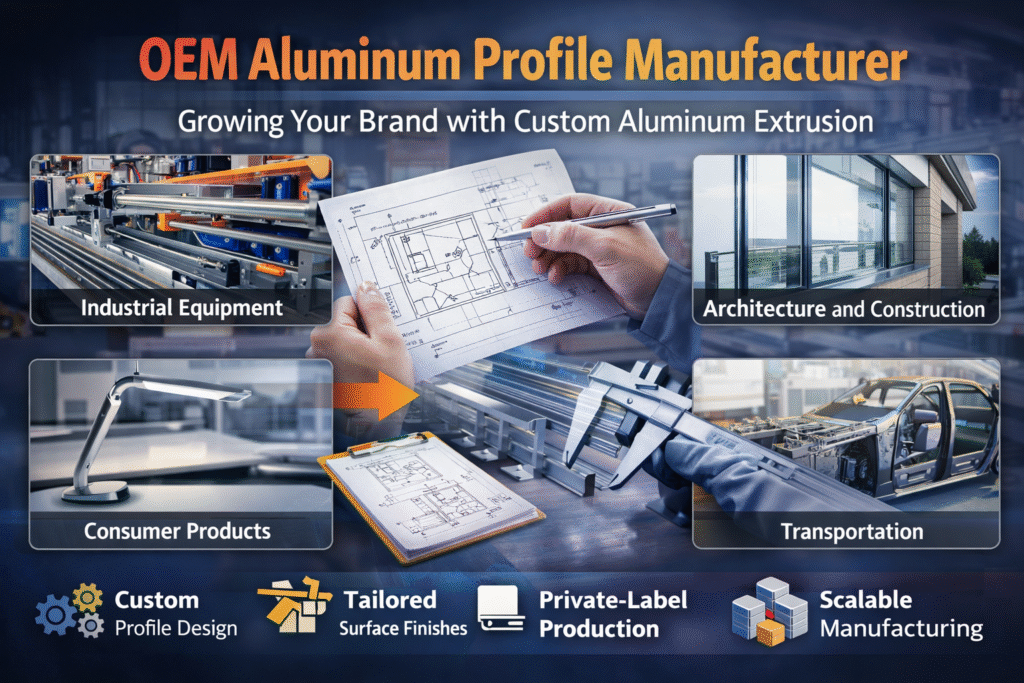
Custom profile design
Dedicated extrusion molds
Tailored surface finishes
Private-label production
Long-term supply consistency
This approach ensures that the final product aligns perfectly with the client’s technical and commercial goals.
Why OEM Custom Aluminum Profiles Matter
1. Product Differentiation
Standard aluminum profiles are widely available and used by many competitors. OEM customization allows companies to create unique profile designs that cannot be easily replicated.
This differentiation helps brands stand out in competitive markets.
2. Integrated Functional Design
Custom aluminum extrusion enables multiple functions to be integrated into a single profile, such as:
Structural support
Mounting features
Cable management
Decorative elements
This reduces part count and simplifies assembly.
3. Consistent Quality Across Production
OEM manufacturing ensures that every batch of aluminum profiles meets the same specifications.
This is essential for:
Large-scale production
Multi-location projects
Long-term product lines
Consistency builds trust with end customers.
4. Scalable Manufacturing
As demand grows, OEM aluminum profile manufacturers can scale production without changing the design or quality standards.
This supports business expansion and market growth.
OEM Aluminum Profile Development Process
Step 1: Concept and Requirement Discussion
The process begins with understanding the client’s product, application, and performance requirements.
This may include:
Drawings or sketches
Functional needs
Target market standards
Surface finish preferences
Step 2: Engineering and Profile Design
Engineers optimize the profile design for both functionality and extrusion feasibility.
This step ensures:
Structural strength
Efficient material usage
Manufacturability
Step 3: Mold Development
A custom extrusion die is produced for the profile. This mold is used for all future production, ensuring consistency.
Step 4: Sample Production
Initial samples are produced for testing and approval.
Clients can evaluate:
Dimensions
Surface quality
Fit and function
Step 5: Mass Production
Once approved, full-scale production begins with stable processes and quality control.
Surface Finishing for OEM Projects
OEM aluminum profiles often require specific surface treatments to match brand identity and application needs.
Common options include:
Anodizing for a premium metallic finish
Powder coating for custom colors
Brushed or matte finishes for modern aesthetics
Wood grain finishes for decorative applications
Customized finishes enhance both appearance and durability.
OEM Aluminum Profiles Across Industries
OEM aluminum extrusion solutions are widely used in:
Industrial Equipment
Custom profiles for machine frames, automation systems, and structural components.
Architecture and Construction
Aluminum skirting boards, window systems, and decorative profiles.
Consumer Products
Furniture, electronics housings, and branded structural components.
Transportation
Lightweight aluminum structures for vehicles and equipment.
Key Factors When Choosing an OEM Aluminum Profile Manufacturer
To ensure successful cooperation, businesses should evaluate:
Engineering Capability
A strong technical team is essential for optimizing profile design.
Production Integration
Manufacturers with in-house extrusion, machining, and finishing provide better quality control.
Quality Assurance
Look for consistent inspection processes and reliable production standards.
Communication
Clear and responsive communication is critical for international projects.
Long-Term Partnership
OEM projects benefit from stable, long-term supplier relationships.
Cost Efficiency in OEM Aluminum Extrusion
While OEM projects involve initial tooling costs, they offer long-term savings through:
Reduced assembly time
Lower material waste
Fewer components
Improved production efficiency
Over time, these benefits outweigh the initial investment.
Why OEM Aluminum Profile Manufacturing Is a Strategic Advantage
Custom aluminum profiles allow businesses to move beyond generic solutions. Instead of adapting products to standard materials, OEM customization enables materials to support product innovation.
This leads to:
Better performance
Stronger brand identity
Improved customer satisfaction
Greater market competitiveness
Conclusion
Working with a professional OEM aluminum profile manufacturer provides businesses with the tools to design, produce, and scale high-quality aluminum solutions tailored to their needs.
For brands and manufacturers seeking long-term growth, custom aluminum extrusion is not just a production method—it is a strategic investment in product development and market success.
SEO Keywords Naturally Covered:
OEM aluminum profile manufacturer · custom aluminum extrusion · aluminum profile customization · private label aluminum profiles · industrial aluminum extrusion