




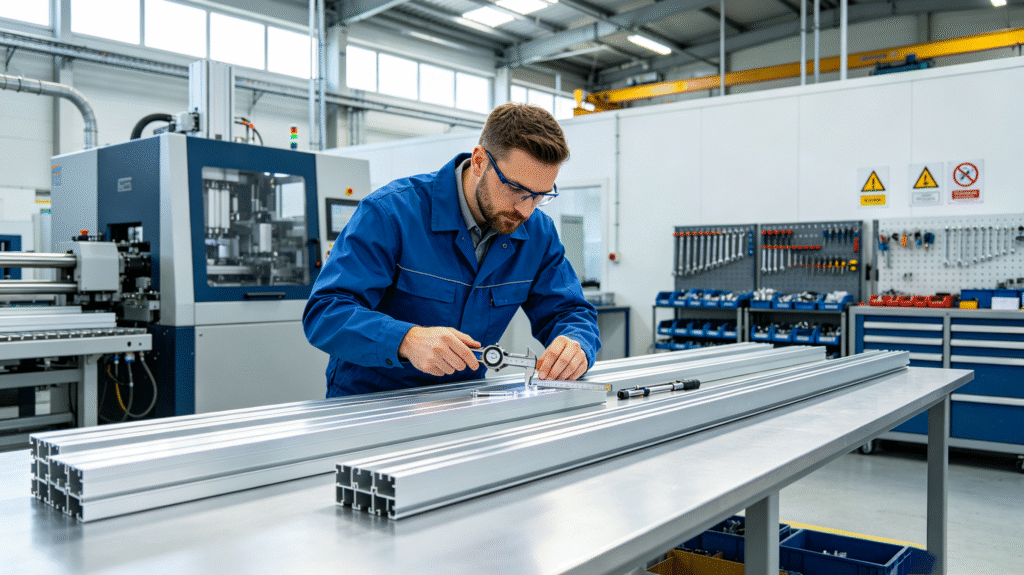
Precision is one of the most important factors in aluminum extrusion manufacturing. Whether producing architectural systems, industrial equipment, LED profiles, or custom OEM components, dimensional accuracy directly affects assembly, functionality, and overall product quality.
However, many buyers assume that aluminum extrusion can achieve perfect dimensions with zero variation. In reality, every manufacturing process has acceptable limits. Understanding aluminum extrusion tolerances helps engineers, designers, and purchasing teams set realistic expectations and avoid unnecessary production costs.
This guide explains what extrusion tolerances are, the factors that affect them, and how to optimize profile design for better precision.
What Are Aluminum Extrusion Tolerances?
Aluminum extrusion tolerance refers to the allowable dimensional variation between the actual manufactured profile and the intended design dimensions.
Because aluminum undergoes:
Heating
Material flow
Cooling
Stretching
Surface treatment
small dimensional changes naturally occur during production.
Tolerances define the acceptable range for these variations.
Why Tolerances Matter
Tolerance control affects multiple aspects of a project, including:
Assembly Performance
Poor dimensional consistency may cause:
Difficult assembly
Misalignment
Installation issues
Component interference
Product Functionality
Precision directly influences performance in applications such as:
Machine systems
Sliding components
Structural assemblies
Electronic housings
Manufacturing Cost
Extremely tight tolerances often increase:
Tooling complexity
Inspection requirements
Production time
Manufacturing cost
Finding the right balance is essential.
Types of Aluminum Extrusion Tolerances
Linear Dimension Tolerance
Controls variation in overall dimensions such as:
Width
Height
Length
Wall thickness
These are among the most commonly specified tolerances.
Straightness Tolerance
Defines how much a profile can deviate from a perfectly straight line.
Straightness is important for:
Long structural profiles
Rails
Machine frames
Window systems
Twist Tolerance
Twist refers to rotational distortion along the profile length.
Excessive twisting can create assembly problems.
Flatness Tolerance
Flatness controls surface deviation from a perfectly flat plane.
Critical applications include:
Mounting surfaces
Mechanical interfaces
Precision assemblies
Angular Tolerance
Controls variation in profile angles.
This becomes important in:
Structural joints
Architectural systems
Complex profile geometries
Factors That Affect Aluminum Extrusion Tolerances
Profile Design Complexity
Simple profiles generally achieve tighter tolerances than highly complex designs.
Features that may increase variation include:
Thin walls
Deep cavities
Multiple hollow sections
Sharp transitions
Complex geometries create more challenging material flow conditions.
Wall Thickness Variations
Uneven wall thickness can cause:
Distortion during cooling
Uneven material flow
Reduced dimensional consistency
Uniform wall thickness often improves tolerance control.
Aluminum Alloy Selection
Different alloys behave differently during extrusion.
For example:
6063 Aluminum
Excellent extrusion performance
Better dimensional consistency
6061 Aluminum
Higher strength
More difficult extrusion characteristics
The alloy selected can influence achievable tolerances.
Extrusion Die Quality
The extrusion die strongly affects dimensional accuracy.
High-quality dies improve:
Material flow balance
Surface consistency
Dimensional stability
Poor die design often causes production problems.
Extrusion Speed
Excessive production speed can lead to:
Distortion
Surface defects
Dimensional variation
Process optimization is essential for maintaining quality.
Cooling Conditions
Improper cooling may result in:
Warping
Bowing
Internal stress
Controlled cooling improves profile stability.
Standard Tolerance Guidelines
Most aluminum extrusion manufacturers follow recognized industry standards.
Common standards include:
ANSI standards
DIN standards
EN standards
ISO specifications
These standards provide recommended tolerance ranges based on:
Profile dimensions
Shape complexity
Manufacturing methods
Tight Tolerance vs Standard Tolerance
Standard Tolerances
Advantages:
Lower cost
Faster production
Better manufacturing efficiency
Suitable for:
Architectural systems
General industrial profiles
Decorative applications
Tight Tolerances
Advantages:
Improved precision
Better fit in critical assemblies
Suitable for:
Medical equipment
High-precision machinery
Electronic systems
However, tighter tolerances usually increase manufacturing cost.
How to Improve Extrusion Precision
Optimize Profile Design
Designing for manufacturability can significantly improve consistency.
Best practices include:
Uniform wall thickness
Smooth transitions
Rounded corners
Balanced geometry
Work With Experienced Manufacturers
Professional manufacturers provide:
Design recommendations
Tooling optimization
Process control expertise
Early collaboration often prevents future issues.
Define Critical Dimensions Clearly
Not every dimension requires extremely tight tolerances.
Identify:
Functional dimensions
Assembly interfaces
High-priority measurements
This approach reduces unnecessary cost.
Use Secondary Machining When Necessary
For extremely precise dimensions, manufacturers may perform:
CNC machining
Milling
Drilling
Precision cutting
Secondary processing can achieve tighter tolerances than extrusion alone.
Common Buyer Mistakes
Requesting Excessively Tight Tolerances
Many buyers assume tighter tolerances automatically mean higher quality.
In reality:
Cost increases significantly
Production becomes more difficult
Lead times may increase
Ignoring Manufacturing Limitations
Not all profile designs can achieve the same precision levels.
Realistic expectations improve project outcomes.
Waiting Too Long to Discuss Tolerances
Tolerance requirements should be addressed early during design development.
Late changes often create delays and additional cost.
Industries Requiring Precision Aluminum Extrusion
Industrial Automation
Machine frames and precision systems require consistent dimensions.
Transportation
Automotive and rail systems rely on accurate structural components.
Electronics
Electronic housings often require tight fit and alignment.
Renewable Energy
Solar systems require reliable assembly and structural consistency.
Medical Equipment
Precision components are critical for performance and safety.
Future Trends in Aluminum Extrusion Precision
The industry continues to improve precision through:
Advanced extrusion simulation
AI-assisted process control
High-precision tooling
Smart manufacturing systems
Automated inspection technology
These innovations continue to improve dimensional consistency and production efficiency.
Conclusion
Aluminum extrusion tolerances play a critical role in product quality, assembly performance, and manufacturing efficiency. Understanding the factors that affect precision helps businesses make better design and purchasing decisions.
By balancing functional requirements with manufacturing realities and working closely with experienced extrusion suppliers, companies can achieve reliable, cost-effective results for custom aluminum profile projects.