



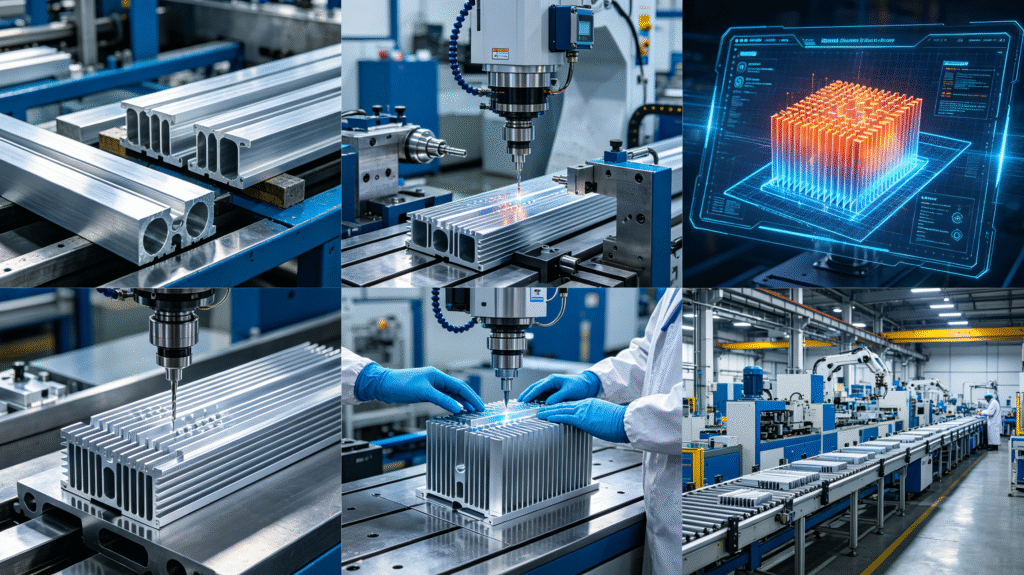
Behind every high-quality aluminum profile is a precisely engineered aluminum extrusion die. While many buyers focus on aluminum alloys, surface finishes, or machining services, the extrusion die is one of the most critical factors influencing profile quality, dimensional accuracy, surface finish, and production efficiency.
Whether manufacturing architectural aluminum systems, industrial profiles, solar mounting structures, or automotive components, the quality of the extrusion die directly impacts the success of the entire production process.
This guide explains what aluminum extrusion dies are, how they are manufactured, the different types of dies, and why choosing an experienced die manufacturer is essential for producing high-performance aluminum profiles.
What Is an Aluminum Extrusion Die?
An aluminum extrusion die is a specially designed steel tool used to shape heated aluminum billets into continuous profiles.
During the extrusion process:
-
An aluminum billet is heated to the required temperature.
-
The billet is placed inside the extrusion press.
-
High pressure forces the softened aluminum through the die opening.
-
The aluminum exits the die in the desired cross-sectional shape.
-
The profile is cooled, stretched, and cut to length.
The die determines the final shape, dimensions, and many quality characteristics of the aluminum profile.
Why Extrusion Dies Are So Important
A high-quality die does much more than create the profile shape.
It directly affects:
-
Dimensional accuracy
-
Surface quality
-
Material flow
-
Production speed
-
Die lifespan
-
Manufacturing cost
Even the most advanced extrusion press cannot produce premium aluminum profiles if the die design is poor.
Types of Aluminum Extrusion Dies
Different profile designs require different die structures.
Solid Dies
Solid dies are used to manufacture simple profiles without enclosed cavities.
Typical applications include:
-
Flat bars
-
Angles
-
Channels
-
Solid rods
Solid dies are generally easier to manufacture and maintain.
Hollow Dies
Hollow dies are designed for profiles containing enclosed spaces.
Examples include:
-
Window frames
-
Door frames
-
Structural tubing
-
Industrial aluminum profiles
Hollow dies require bridges and mandrels to create internal cavities.
Semi-Hollow Dies
Semi-hollow dies produce profiles that contain partially enclosed sections.
These profiles are commonly used in:
-
Architectural systems
-
Decorative trim
-
Specialized industrial components
They require more complex die engineering than solid profiles.
Materials Used for Extrusion Dies
Extrusion dies operate under extremely high temperatures and pressures.
Therefore, manufacturers typically use premium hot-work tool steel that provides:
-
High hardness
-
Excellent wear resistance
-
Thermal stability
-
Long service life
Proper heat treatment further improves die durability and production consistency.
The Aluminum Extrusion Die Manufacturing Process
Profile Design Analysis
The process begins with reviewing the customer’s drawings and technical requirements.
Engineers evaluate:
-
Profile geometry
-
Wall thickness
-
Hollow sections
-
Structural requirements
-
Extrusion feasibility
This stage helps optimize the design before die production begins.
Die Design
Experienced die engineers use CAD and simulation software to design the tooling.
Important considerations include:
-
Balanced material flow
-
Bearing length
-
Metal pressure
-
Cooling characteristics
-
Profile dimensional stability
Proper die design minimizes defects and improves production efficiency.
CNC Machining
After the design is finalized, CNC machines manufacture the die with extremely high precision.
Common machining operations include:
-
Milling
-
Drilling
-
EDM machining
-
Grinding
-
Precision finishing
Modern CNC equipment ensures excellent dimensional accuracy.
Heat Treatment
The die undergoes controlled heat treatment to improve:
-
Hardness
-
Wear resistance
-
Mechanical strength
Proper heat treatment significantly extends die life.
Trial Extrusion
Before mass production, manufacturers perform trial extrusion runs.
Engineers inspect:
-
Profile dimensions
-
Surface finish
-
Material flow
-
Straightness
-
Overall quality
Minor adjustments may be made to optimize performance.
Factors That Affect Die Performance
Profile Complexity
Complex profiles require more sophisticated die designs.
Features that increase design difficulty include:
-
Thin walls
-
Multiple cavities
-
Sharp corners
-
Uneven wall thickness
The more complex the profile, the greater the engineering challenge.
Aluminum Alloy
Different alloys behave differently during extrusion.
For example:
6063 Aluminum
Advantages:
-
Excellent extrusion characteristics
-
Smooth surface finish
-
Ideal for architectural applications
6061 Aluminum
Advantages:
-
Higher mechanical strength
-
Better structural performance
However, it generally requires greater extrusion pressure and more careful die design.
Extrusion Temperature
Proper temperature control affects:
-
Material flow
-
Surface quality
-
Die wear
-
Production efficiency
Maintaining stable processing conditions helps extend die life.
Bearing Design
The bearing controls the speed at which aluminum exits different areas of the die.
Correct bearing design helps:
-
Balance material flow
-
Reduce twisting
-
Improve straightness
-
Enhance dimensional accuracy
This is one of the most important aspects of die engineering.
Common Extrusion Defects Related to Die Design
Poor die design can lead to several production problems.
Examples include:
-
Surface lines
-
Twisting
-
Profile distortion
-
Uneven wall thickness
-
Dimensional inaccuracies
-
Material tearing
Most of these issues can be minimized through proper engineering and process optimization.
Advantages of High-Quality Extrusion Dies
Investing in precision tooling provides long-term benefits.
Advantages include:
-
Better profile consistency
-
Higher production efficiency
-
Lower scrap rates
-
Improved surface finish
-
Longer die service life
-
Reduced manufacturing costs over time
Although premium dies may require a higher initial investment, they often deliver significant savings during mass production.
How to Choose an Aluminum Extrusion Manufacturer
When selecting a supplier, consider whether they have strong die development capabilities.
Look for manufacturers that offer:
-
In-house die design
-
Experienced engineering teams
-
Advanced CNC machining equipment
-
Trial extrusion testing
-
Continuous die maintenance
-
Custom OEM and ODM services
Manufacturers with integrated die production often provide faster lead times and more consistent quality.
Future Trends in Extrusion Die Technology
The aluminum extrusion industry continues to adopt advanced tooling technologies.
Emerging trends include:
-
AI-assisted die design
-
Finite element flow simulation
-
High-performance tool steels
-
Automated die maintenance
-
Digital production monitoring
-
Smart manufacturing integration
These innovations help improve profile quality while reducing production costs.
Conclusion
Aluminum extrusion dies are the foundation of every successful extrusion project. Their design and manufacturing quality directly influence dimensional accuracy, surface finish, production efficiency, and long-term manufacturing costs.
Whether producing architectural systems, industrial equipment, automotive components, or custom OEM products, working with a manufacturer that possesses strong die engineering capabilities is essential for achieving reliable, high-quality aluminum profiles.
As extrusion technology continues to evolve, precision die design will remain one of the key competitive advantages for aluminum manufacturers serving global markets.