




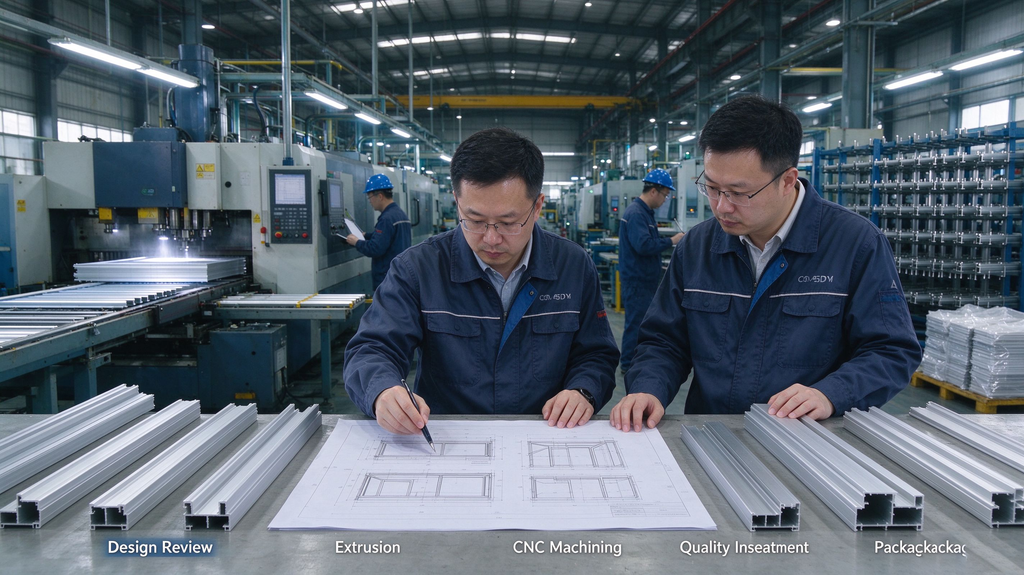
Electric vehicles (EVs) are transforming automotive manufacturing, creating new opportunities for lightweight materials and advanced component design. As automakers work to improve driving range, energy efficiency, vehicle safety, and production efficiency, aluminum extrusion has become an important manufacturing option for a wide range of EV components.
Aluminum profiles can be designed to combine structural support, thermal management, and integrated mounting features in a single component. These characteristics make them useful in battery systems, cooling assemblies, vehicle structures, and other applications where weight and space are important considerations.
However, selecting an aluminum extrusion for an electric vehicle requires careful attention to mechanical performance, dimensional accuracy, joining methods, corrosion protection, and manufacturing consistency.
This guide explores the major applications of aluminum extrusion in electric vehicles, the key design considerations for EV components, and how custom extrusion can support automotive manufacturing projects.
Why Is Aluminum Extrusion Important for Electric Vehicles?
Electric vehicles require components that balance weight, strength, durability, and efficient use of space.
Battery packs and electric drive systems add substantial mass to a vehicle. Reducing the weight of other components can help improve overall vehicle efficiency, although the actual benefit depends on the vehicle architecture, operating conditions, and engineering design.
Aluminum extrusion offers several advantages for EV applications.
1. Lightweight Construction
Aluminum has a density of approximately 2.7 g/cm³, making it significantly lighter than steel.
This lower density can help reduce the mass of structural components, housings, mounting rails, and thermal management parts.
Lightweight components may also be easier to handle during vehicle assembly and can help manufacturers optimize vehicle packaging.
However, weight reduction should never be evaluated in isolation. Engineers must ensure that each component meets its strength, stiffness, fatigue, impact, and safety requirements.
2. Design Flexibility
Extrusion allows manufacturers to produce complex cross-sections with integrated channels, ribs, cavities, and mounting features.
For EV components, these features can help simplify assembly and reduce the number of separate parts.
For example, a custom profile may combine structural support with internal passages or external mounting features, depending on the application and manufacturing process.
Reducing component count can also help streamline production, although the overall benefit depends on tooling costs, machining requirements, joining methods, and production volume.
3. Thermal Conductivity
Aluminum conducts heat effectively, making it useful in components designed to transfer heat away from electrical or electronic systems.
Applications may include battery cooling structures, power electronics housings, and electric motor cooling components.
Actual thermal performance depends on the alloy, profile geometry, contact surfaces, coolant arrangement, and operating conditions.
An aluminum profile should therefore be evaluated as part of the complete thermal management system rather than as an isolated material choice.
4. Corrosion Resistance
Aluminum naturally forms a protective oxide layer. Appropriate alloy selection, surface treatment, and joint design can help support durability in automotive environments.
EV components may encounter road moisture, salt, temperature changes, and contact with other metals.
Designers should consider the full service environment and the potential for galvanic corrosion where aluminum contacts dissimilar metals.
1. Aluminum Extrusion for EV Battery Enclosures
Battery systems are among the most important applications for aluminum components in electric vehicles.
A battery enclosure protects battery modules and related equipment while providing structural support, mounting interfaces, and environmental protection.
Aluminum extrusions can be used in selected enclosure structures, including perimeter frames, cross-members, support rails, and other structural sections.
Structural Support and Protection
Battery enclosures must withstand the loads and environmental conditions specified for the vehicle.
Depending on the design, these may include vibration, road loads, impacts, thermal cycling, and forces transmitted through vehicle mounting points.
Extruded profiles can be engineered with ribs, cavities, and tailored wall thicknesses to provide structural performance while managing weight.
However, the enclosure’s safety performance depends on the complete system, including the profile geometry, joints, fasteners, covers, seals, and connections to the vehicle structure.
A profile that performs well in an isolated mechanical test does not automatically guarantee that the complete battery enclosure meets vehicle-level safety requirements.
Integration With Battery Modules
Battery systems have strict packaging requirements. Profiles must accommodate battery modules, electrical connections, cooling components, sensors, and service access.
Important design considerations include:
-
Available installation space
-
Module mounting locations
-
Structural load paths
-
Electrical isolation requirements
-
Sealing and drainage
-
Thermal management interfaces
-
Manufacturing and assembly tolerances
Custom aluminum extrusion can help integrate mounting and locating features directly into the enclosure structure.
For high-volume automotive programs, early coordination between the extrusion supplier, battery system designer, and vehicle manufacturer can reduce costly design changes later in development.
2. Aluminum Profiles for Battery Cooling Systems
Thermal management is essential for EV battery performance and service life.
Battery cells generate heat during charging and discharging. Temperature differences across a battery pack can also affect performance and aging.
Many EV designs use liquid cooling systems, air cooling, or other thermal management approaches depending on the battery architecture.
Aluminum extrusions can contribute to these systems by providing structural support, heat transfer surfaces, or integrated cooling passages where the design and manufacturing process permit.
Cooling Channel Design
A cooling-related extrusion may incorporate internal channels or specially shaped surfaces to support heat transfer.
The design must consider more than the amount of aluminum used. Channel geometry, wall thickness, coolant flow, pressure requirements, and thermal contact resistance can all affect performance.
For components carrying coolant, engineers must also evaluate sealing, leak prevention, pressure testing, corrosion compatibility, and manufacturing repeatability.
Not every aluminum profile is suitable for use as a pressure-containing cooling component. The profile and joining method must be designed and validated for the specific operating conditions.
Thermal Performance Testing
Thermal performance should be evaluated under representative conditions.
Depending on the system, testing may include temperature distribution, flow behavior, pressure drop, leakage, and thermal cycling.
The appropriate validation plan depends on the component’s role in the cooling system and the vehicle manufacturer’s specifications.
3. Aluminum Extrusion for EV Structural Components
Beyond battery systems, aluminum extrusion can be used in selected structural components and support assemblies.
Potential applications include:
-
Cross-members and support rails
-
Mounting structures for electrical equipment
-
Structural sections in selected vehicle platforms
-
Interior support frames
-
Reinforcement components
-
Brackets and equipment mounting systems
Extrusion is particularly useful when a component requires a consistent cross-section with integrated features along its length.
Strength and Stiffness
The mechanical performance of an aluminum structural profile depends on alloy, temper, cross-sectional geometry, wall thickness, and loading conditions.
Engineers may use ribs, hollow sections, and optimized section depth to improve stiffness without adding unnecessary material.
Nevertheless, structural components must be evaluated for bending, torsion, buckling, fatigue, and joint performance as appropriate.
For safety-critical applications, material selection and component design must comply with the applicable automotive engineering requirements.
Joining and Assembly
EV structures may combine aluminum extrusions with castings, sheet metal, steel components, and composite materials.
Potential joining methods include mechanical fastening, adhesive bonding, welding, and specialized joining processes.
Each method has different requirements for joint geometry, surface preparation, production equipment, and quality control.
The joining strategy should be considered early in the design process because it can affect profile geometry, dimensional tolerances, corrosion protection, and assembly cost.
4. Aluminum Extrusion for Electric Motor and Power Electronics Systems
Electric vehicles contain several systems that manage electrical energy and convert it into mechanical power.
These systems can include electric motors, inverters, DC-DC converters, onboard chargers, and other power electronics.
Aluminum profiles may be used for housings, mounting structures, heat-dissipating components, and protective enclosures, depending on the system design.
Heat Dissipation for Power Electronics
Power electronics generate heat during operation. Effective thermal management helps keep components within their specified operating temperature ranges.
Aluminum profiles can provide heat transfer surfaces or mounting structures that connect thermal components to a larger cooling system.
For higher-power applications, the profile geometry may incorporate fins or other features that increase surface area.
The final thermal performance depends on the complete assembly, including heat sources, interface materials, airflow or coolant flow, and installation conditions.
Dimensional Accuracy and Machining
Electrical and electronic components often require precise mounting surfaces, connector openings, and fastening features.
Extruded profiles may therefore undergo CNC machining, drilling, milling, and cutting after extrusion.
Critical dimensions should be specified according to the component’s functional requirements. Excessively tight tolerances on noncritical features can increase cost without improving performance.
5. Choosing the Right Aluminum Alloy for EV Extrusions
Alloy selection influences strength, extrudability, corrosion behavior, machining, and joining performance.
Common extrusion alloys include 6063 and 6061, while automotive applications may use other alloy families depending on the required properties and manufacturing process.
6063 Aluminum Alloy
6063 is widely used for profiles requiring good extrudability and surface appearance.
It may be suitable for mounting structures, housings, and other components where its mechanical properties meet the design requirements.
6061 Aluminum Alloy
6061 is often selected for applications requiring a combination of strength, machinability, and corrosion resistance.
It may be considered for structural or machined components when the specified temper and design provide the required performance.
Alloy Selection Must Follow Engineering Requirements
The alloy designation alone does not determine the performance of the finished part.
Temper, heat treatment, profile geometry, joining processes, and manufacturing controls also matter.
For EV components, the supplier and engineering team should confirm the required material specification and verify the relevant mechanical properties.
A material that is suitable for a decorative profile may not be appropriate for a safety-critical structural component.
6. Surface Treatment and Corrosion Protection
Surface protection is an important consideration for aluminum extrusions used in automotive environments.
Components may be exposed to moisture, road salt, cleaning chemicals, temperature changes, and contact with dissimilar materials.
Depending on the application, possible surface treatments include anodizing, conversion coatings, painting, powder coating, and other specified protective systems.
The correct choice depends on the component’s location, electrical requirements, appearance, and corrosion exposure.
For example, a visible interior component may have different finish requirements from a structural part installed beneath the vehicle.
Preventing Galvanic Corrosion
When aluminum is electrically connected to certain dissimilar metals in the presence of an electrolyte, galvanic corrosion may occur.
Designers can reduce this risk through suitable material pairing, insulating interfaces, coatings, drainage, and joint design.
Fasteners, brackets, and other connected components should be considered as part of the complete corrosion protection strategy.
Surface treatment must also remain compatible with welding, bonding, electrical grounding, and other functional requirements.
7. Precision Machining of EV Aluminum Profiles
Extrusion creates the primary cross-sectional shape, but many EV components require additional machining before assembly.
Common operations include:
-
Cutting to specified lengths
-
Drilling mounting holes
-
Milling connector interfaces
-
Machining grooves and slots
-
Tapping threaded holes
-
Creating openings for cables or connectors
-
Machining sealing and locating surfaces
Precision machining can help extruded profiles interface with other components, including castings, covers, brackets, and battery modules.
Managing Tolerances
For automotive components, dimensional consistency is important for assembly efficiency and product reliability.
Critical features should be identified on the engineering drawing, and the inspection method should be selected accordingly.
Depending on the geometry, manufacturers may use calipers, micrometers, optical measurement systems, dedicated gauges, or coordinate measuring machines.
Inspection frequency and documentation should follow the agreed quality plan and the risk associated with each feature.
8. Quality Control for Automotive Aluminum Extrusions
Automotive applications can involve demanding quality, traceability, and consistency requirements.
Quality control should begin with material verification and continue through extrusion, heat treatment where applicable, machining, surface finishing, and final inspection.
Typical quality checks may include:
Material verification: Confirm alloy, temper, and required material documentation.
Dimensional inspection: Check cross-sectional dimensions, wall thickness, straightness, and critical machined features.
Mechanical testing: Verify specified mechanical properties using the applicable test methods.
Surface inspection: Identify scratches, dents, die lines, coating defects, and other unacceptable conditions.
Leak testing: Apply when the component is designed to carry coolant or requires a verified sealed enclosure.
Process traceability: Maintain appropriate production records and batch identification.
Nonconformance management: Investigate defects, implement corrective actions, and verify that the issue has been addressed.
The required inspection plan should be established with the customer. Automotive projects may also require formal approval procedures, capability studies, and customer-specific documentation.
9. Custom Aluminum Extrusion for EV OEM Projects
Electric vehicle manufacturers frequently develop components around specific vehicle platforms and system layouts.
Custom extrusion can help meet these requirements by providing a cross-section tailored to the available space, mounting interfaces, and functional needs.
A custom EV profile may incorporate:
-
Integrated mounting features
-
Optimized structural ribs
-
Cooling-related geometry
-
Cable-routing channels
-
Machining allowances
-
Sealing interfaces
-
Dedicated connection features
The design process typically begins with a drawing or engineering concept.
The extrusion manufacturer reviews the cross-section, material requirements, tooling feasibility, tolerances, surface treatment, and secondary machining requirements.
After design approval, the project may proceed through die development, sample production, inspection, validation, and mass production.
For safety-critical applications, extrusion samples alone are not sufficient to validate the complete component. The finished assembly must undergo the testing and approval required by the vehicle program.
10. How to Reduce EV Aluminum Extrusion Costs
Cost optimization is important in automotive manufacturing, particularly for components produced in large quantities.
However, cost reduction must not compromise safety, durability, or required performance.
Several strategies can help improve manufacturing efficiency.
Optimize Profile Geometry
Review wall thickness, cross-sectional complexity, and unnecessary material.
A carefully optimized profile may reduce weight and material consumption while maintaining the required mechanical performance.
Integrate Functional Features
Where technically feasible, combining mounting or connection features into the extrusion may reduce the number of separate components.
The benefit should be assessed against tooling complexity and any additional processing requirements.
Minimize Unnecessary Machining
Designing suitable features into the cross-section can reduce some downstream machining operations.
However, critical interfaces may still require precision machining to meet assembly requirements.
Set Appropriate Tolerances
Tight tolerances should be reserved for features that directly affect function, assembly, or safety.
Clear specifications can reduce inspection ambiguity and avoid unnecessary manufacturing costs.
Plan Production Early
Early coordination between the OEM, component designer, and extrusion supplier can identify tooling risks, material requirements, and process constraints before production begins.
This can reduce engineering changes and rework during later development stages.
11. How to Choose an EV Aluminum Extrusion Supplier
Selecting a supplier for automotive applications requires careful evaluation of technical capability and quality management.
Buyers should consider asking the following questions:
-
Can the supplier manufacture the required alloy and temper?
-
Does the supplier have experience with complex or hollow extrusion profiles?
-
Can the supplier support CNC machining and surface treatment?
-
What dimensional inspection equipment is available?
-
Can material and production batches be traced?
-
Are mechanical testing and inspection reports available?
-
Can the supplier support sample development and engineering revisions?
-
How are nonconforming products investigated and controlled?
-
Can production processes support the required volume and consistency?
-
What packaging methods protect finished profiles during shipment?
For automotive projects, buyers should also confirm which customer-specific quality requirements, approval processes, and documentation standards apply.
Supplier selection should be based on the complete project requirements rather than price alone.
Final Thoughts
Aluminum extrusion offers valuable design flexibility for electric vehicle components that require lightweight construction, integrated features, and effective thermal management.
Potential applications include battery enclosure structures, cooling-related components, electric motor and power electronics housings, mounting systems, and selected vehicle structural sections.
Successful implementation depends on choosing the appropriate alloy, designing the cross-section for its actual loading conditions, managing joining and corrosion risks, and maintaining consistent manufacturing quality.
For EV OEMs and component manufacturers, early collaboration with an experienced aluminum extrusion supplier can help improve manufacturability, simplify assembly, and control production costs.
The most effective solution is one that meets the complete system’s engineering and safety requirements while making efficient use of material, manufacturing processes, and production resources.