




#
Heat management is an important consideration in electronics, LED lighting, industrial equipment, power supplies, and many other products. As electronic components become smaller and more powerful, manufacturers need reliable ways to move heat away from critical components.
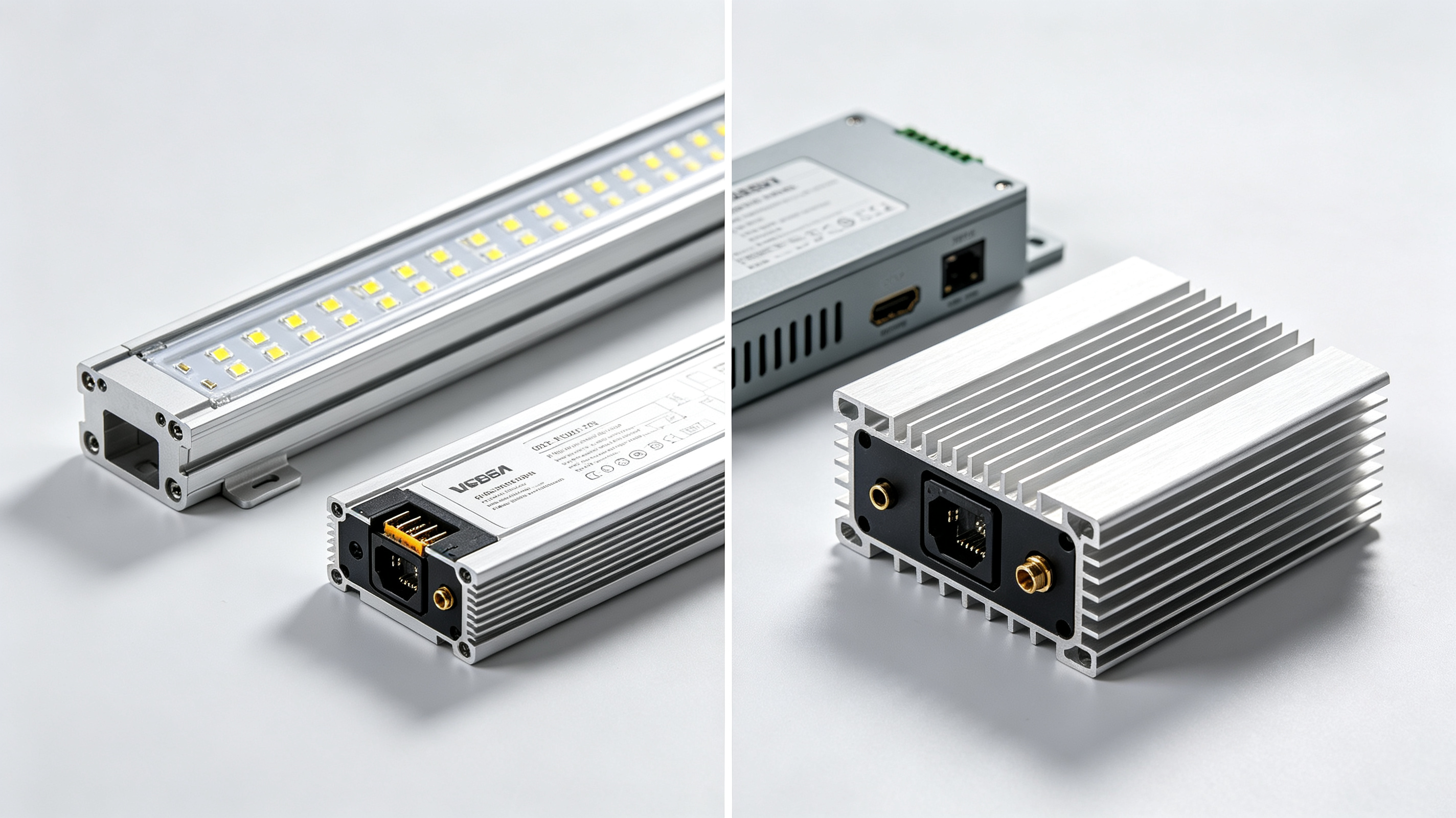
**Aluminum extrusion heat sinks** provide a practical solution by combining excellent thermal conductivity, low weight, flexible profile design, and efficient manufacturing.
Unlike machined heat sinks, extruded heat sinks can be produced with continuous fins and complex cross-sections, making them particularly suitable for medium- and high-volume applications.
## What Is an Aluminum Extrusion Heat Sink?
An aluminum extrusion heat sink is a thermal management component manufactured by forcing heated aluminum alloy through a specially designed extrusion die.
The resulting profile can include:
* Base plates
* Straight cooling fins
* Pin-style structures
* Mounting channels
* Screw slots
* Component mounting surfaces
* Integrated brackets
* Multiple functional sections
The profile is then cut to the required length and may receive additional machining or surface treatment.
The basic principle is simple: **heat is transferred from the component to the aluminum base and then dissipated into the surrounding air through the fins.**
## Why Is Aluminum Used for Heat Sinks?
Aluminum is widely used for thermal management because it offers a useful combination of thermal performance, low density, corrosion resistance, and manufacturability.
Compared with many heavier metals, aluminum allows manufacturers to create relatively large heat-dissipation surfaces without adding excessive weight.
Other advantages include:
* Good thermal conductivity
* Low weight
* Good corrosion resistance
* Easy extrusion
* Flexible profile design
* Good machinability
* Suitable for anodizing and other finishes
* Recyclability
These characteristics make aluminum a popular material for both passive and forced-air cooling systems.
## How Does an Extruded Heat Sink Work?
The performance of an aluminum heat sink depends largely on how efficiently heat can move from the heat source into the surrounding air.
The process can be simplified into three stages:
### 1. Heat Transfer to the Base
A heat-generating component is attached to the flat base of the heat sink.
Heat moves from the component into the aluminum.
### 2. Heat Spreads Through the Profile
The aluminum base distributes the heat across the heat sink.
A properly designed base helps reduce localized hot spots and allows more of the available fin area to participate in heat dissipation.
### 3. Heat Dissipates Through the Fins
The fins dramatically increase the exposed surface area.
More surface area allows heat to transfer from the aluminum into the surrounding air.
This is why fin geometry is one of the most important considerations when designing an **aluminum extrusion heat sink**.
## Heat Sink Fin Design Matters
Simply adding more fins does not always produce better cooling.
Fin height, thickness, spacing, and overall geometry must be balanced according to the application.
Important design factors include:
### Fin Height
Higher fins can provide more surface area, but extremely tall fins may become difficult to extrude or may not perform efficiently under certain airflow conditions.
### Fin Thickness
Thin fins can increase the number of fins within a given space.
However, excessively thin fins can create manufacturing challenges and may not provide the desired mechanical strength.
### Fin Spacing
The distance between fins affects airflow.
If fins are packed too closely together, airflow may become restricted, reducing the effectiveness of the additional surface area.
### Base Thickness
The base must be thick enough to distribute heat effectively while also providing sufficient mechanical strength.
A very thick base can increase material usage and weight without necessarily improving thermal performance.
## Passive vs. Active Cooling
Aluminum extrusion heat sinks are commonly used in both passive and active cooling systems.
### Passive Cooling
Passive heat sinks rely primarily on natural convection.
They are commonly used for:
* LED lighting
* Small electronic devices
* Industrial controllers
* Low-power power supplies
* Communication equipment
Passive designs generally require careful fin spacing and orientation because there is no fan forcing air through the heat sink.
### Active Cooling
Active systems use fans or other airflow mechanisms to move air through or across the fins.
They can be used when components generate larger amounts of heat.
Applications may include:
* Power electronics
* Industrial control systems
* Inverters
* High-power LED systems
* Motor controllers
* Telecommunications equipment
The heat sink profile may be optimized specifically for the expected airflow direction.
## Aluminum Extrusion vs. Machined Heat Sinks
Both extrusion and machining have their place in thermal management.
Extrusion is particularly attractive when the heat sink has a continuous cross-section and will be produced in significant quantities.
### Extrusion Advantages
* Efficient material usage
* High production efficiency
* Consistent profile dimensions
* Complex fin structures
* Suitable for long continuous profiles
* Good scalability for mass production
* Lower machining requirements
### Machining Advantages
Machining may be useful when the component requires:
* Highly customized geometry
* Complex three-dimensional features
* Precision pockets
* Irregular mounting surfaces
* Small production quantities
For many products, an effective approach is to **extrude the basic heat sink profile and then perform secondary CNC machining** where required.
## Choosing the Right Aluminum Alloy
The aluminum alloy can influence extrusion performance, surface appearance, mechanical properties, and thermal characteristics.
Common extrusion alloys include 6063 and 6061.
For many heat sink applications, the alloy selection should be evaluated together with:
* Required thermal performance
* Profile complexity
* Mechanical strength
* Surface treatment
* Machining requirements
* Production volume
The best alloy is not determined by thermal conductivity alone. Manufacturing efficiency and the final application also need to be considered.
## Surface Treatment for Aluminum Heat Sinks
Aluminum heat sinks may be used with a natural mill finish or receive additional surface treatment.
Common options include:
* Anodizing
* Powder coating
* Brushing
* Polishing
* Other decorative or protective finishes
Anodizing is frequently used when appearance, corrosion resistance, and surface durability are important.
However, thermal performance should be considered when selecting a coating or surface treatment. The final treatment should be evaluated as part of the complete thermal design rather than selected solely for appearance.
## CNC Machining After Extrusion
Extrusion creates the basic heat sink geometry, but many products require additional processing.
Typical secondary operations include:
* Cutting to length
* Drilling
* Tapping
* Countersinking
* Slot machining
* CNC milling
* End machining
* Mounting-hole production
For example, a long extruded heat sink may be cut into individual sections and then CNC-machined to create mounting holes for electronic components.
Combining extrusion with CNC machining allows manufacturers to maintain the efficiency of extrusion while achieving more customized final dimensions.
## Designing a Heat Sink for Manufacturing
Good thermal design should also consider manufacturing limitations.
Before creating an extrusion die, engineers should review:
1. Fin thickness
2. Fin height
3. Fin spacing
4. Base thickness
5. Overall profile dimensions
6. Required tolerances
7. Mounting features
8. Cutting requirements
9. CNC machining requirements
10. Surface treatment
A theoretically excellent heat sink design may not be economical if it requires an unnecessarily complicated extrusion die or difficult secondary processing.
**Design for manufacturability** can therefore be just as important as thermal optimization.
## Applications of Aluminum Extrusion Heat Sinks
Extruded aluminum heat sinks are used across many industries.
### LED Lighting
LEDs convert electrical energy into both light and heat. Effective heat dissipation can help maintain stable operating conditions.
Aluminum extrusion is particularly suitable for LED channels because the profile can combine:
* Heat dissipation
* LED mounting
* Diffuser installation
* Mechanical support
* Decorative appearance
### Power Electronics
Power supplies, inverters, converters, and industrial control equipment can generate significant heat.
Custom extruded heat sinks can be designed around the available installation space and required airflow.
### Industrial Automation
Motors, controllers, sensors, and control systems may require compact thermal management solutions.
Extruded profiles can integrate cooling fins with mounting and structural features.
### Telecommunications
Communication equipment often operates continuously, making thermal management an important design consideration.
Custom aluminum profiles can be integrated into equipment housings and cooling assemblies.
### Automotive and Transportation
Aluminum heat sinks can also be used in automotive electronics, lighting systems, control modules, and other components where low weight and thermal management are important.
## How to Improve Heat Sink Performance
Several design strategies can improve the effectiveness of an extruded heat sink.
### Increase Effective Surface Area
Increasing fin area can improve heat dissipation, provided airflow remains effective.
### Optimize Airflow
The heat sink should be designed according to whether cooling relies on natural convection or forced airflow.
### Minimize Thermal Resistance
Good contact between the heat-generating component and the heat sink is essential.
The mounting interface should be flat and properly designed.
### Optimize the Profile
Instead of simply increasing material thickness, engineers can modify the cross-section to place material where it contributes most to thermal performance.
This can improve the balance between:
**Cooling Performance + Weight + Material Cost + Manufacturing Efficiency**
## Custom Aluminum Extrusion Heat Sink Manufacturing
For OEM and ODM projects, custom extrusion allows the heat sink to be designed specifically around the customer’s product.
A typical process may include:
**Product Requirements → Profile Design → Engineering Review → Extrusion Die → Aluminum Extrusion → Cutting → CNC Machining → Surface Treatment → Inspection → Packaging**
This approach is useful when a standard off-the-shelf heat sink does not fit the required dimensions or thermal design.
A custom aluminum extrusion manufacturer can also review the profile before tooling begins and identify potential extrusion or machining issues.
## Final Thoughts
Aluminum extrusion heat sinks offer an effective combination of thermal management, lightweight construction, flexible design, and efficient production.
The final performance depends on much more than simply choosing aluminum. **Fin geometry, base thickness, airflow, mounting conditions, alloy, surface treatment, and manufacturing accuracy** all contribute to the finished product.
For engineers and purchasing teams, the most effective approach is to consider thermal requirements and manufacturing requirements at the same time.
With a properly designed extrusion profile, aluminum heat sinks can provide reliable cooling while keeping weight, material consumption, and production costs under control.