

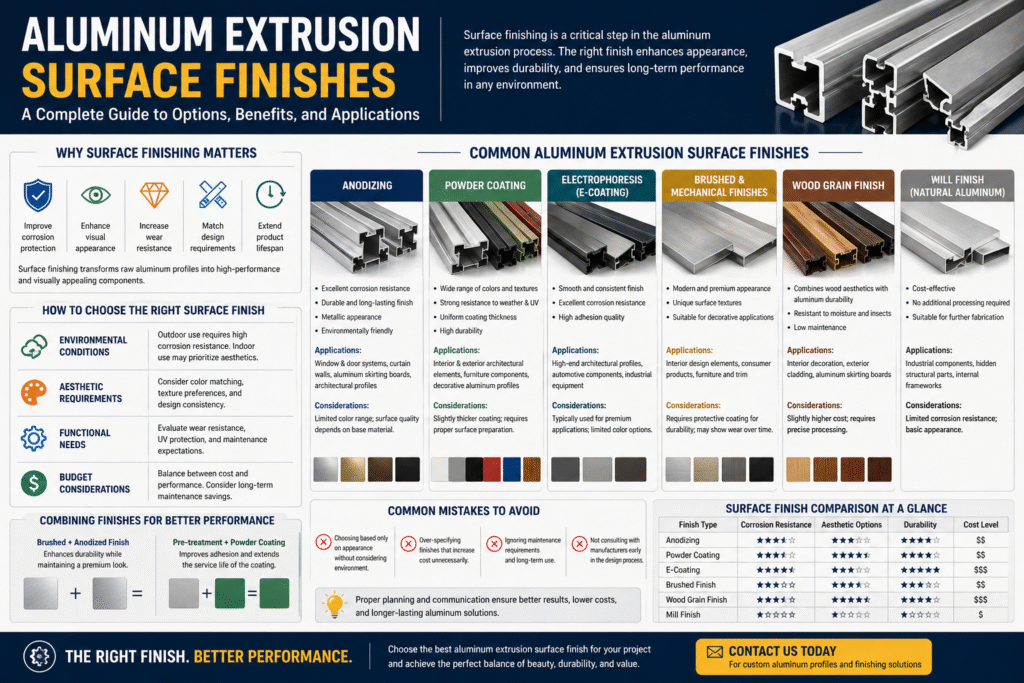
Surface finishing is a critical step in the aluminum extrusion process. It not only enhances the appearance of aluminum profiles but also improves durability, corrosion resistance, and overall performance.
For architects, designers, and industrial buyers, selecting the right aluminum extrusion surface finish is essential to achieving both functional and aesthetic goals.
This guide provides a complete overview of the most common surface finishing options, their advantages, and how to choose the best solution for your project.
Why Surface Finishing Matters
Aluminum naturally forms a thin oxide layer that offers basic corrosion resistance. However, in many applications, additional surface treatment is required to:
- Improve corrosion protection
- Enhance visual appearance
- Increase wear resistance
- Match design requirements
- Extend product lifespan
Surface finishing transforms raw aluminum profiles into high-performance and visually appealing components.
Anodizing
Overview
Anodizing is an electrochemical process that creates a controlled oxide layer on the surface of aluminum.
Key Benefits
- Excellent corrosion resistance
- Durable and long-lasting finish
- Metallic appearance
- Environmentally friendly
Applications
- Window and door systems
- Curtain walls
- Aluminum skirting boards
- Architectural profiles
Considerations
- Limited color range compared to coatings
- Surface quality depends on base material
Anodizing is one of the most widely used finishes for aluminum extrusion.
Powder Coating
Overview
Powder coating involves applying dry powder to the aluminum surface and curing it under heat to form a protective layer.
Key Benefits
- Wide range of colors and textures
- Strong resistance to weather and UV
- Uniform coating thickness
- High durability
Applications
- Interior and exterior architectural elements
- Furniture components
- Decorative aluminum profiles
Considerations
- Slightly thicker coating compared to anodizing
- Requires proper surface preparation
Powder coating is ideal for projects that require customized colors and design flexibility.
Electrophoresis (E-Coating)
Overview
Electrophoresis, also known as e-coating, uses an electric current to deposit a uniform coating on the aluminum surface.
Key Benefits
- Smooth and consistent finish
- Excellent corrosion resistance
- High adhesion quality
Applications
- High-end architectural profiles
- Automotive components
- Industrial equipment
Considerations
- Typically used for premium applications
- Limited color variations
This finish is often selected for projects requiring superior surface quality.
Brushed and Mechanical Finishes
Overview
Mechanical finishing processes such as brushing or polishing create texture on the aluminum surface.
Key Benefits
- Modern and premium appearance
- Unique surface textures
- Suitable for decorative applications
Applications
- Interior design elements
- Consumer products
- Furniture and trim
Considerations
- Requires protective coating for durability
- Surface may show wear over time
These finishes are often combined with anodizing for better protection.
Wood Grain Finish
Overview
Wood grain finishing uses heat transfer technology to replicate the appearance of natural wood on aluminum surfaces.
Key Benefits
- Combines aesthetics of wood with durability of aluminum
- Resistant to moisture and insects
- Low maintenance
Applications
- Interior decoration
- Exterior cladding
- Aluminum skirting boards
Considerations
- Slightly higher cost
- Requires precise processing
This finish is popular in modern architectural design.
Mill Finish (Natural Aluminum)
Overview
Mill finish refers to aluminum profiles in their raw, untreated state after extrusion.
Key Benefits
- Cost-effective
- No additional processing required
- Suitable for further fabrication
Applications
- Industrial components
- Hidden structural parts
- Internal frameworks
Considerations
- Limited corrosion resistance
- Basic appearance
Mill finish is typically used when aesthetics are not a priority.
Choosing the Right Surface Finish
Selecting the appropriate surface finish depends on several factors:
Environmental Conditions
- Outdoor use requires high corrosion resistance
- Indoor use may prioritize aesthetics
Aesthetic Requirements
- Color matching
- Texture preferences
- Design consistency
Functional Needs
- Wear resistance
- UV protection
- Maintenance expectations
Budget Considerations
- Balance between cost and performance
- Long-term maintenance savings
Combining Finishes for Better Performance
In some cases, multiple finishing processes are combined to achieve optimal results.
For example:
- Brushed + anodized finish for durability and aesthetics
- Pre-treatment + powder coating for enhanced adhesion
This approach improves both performance and appearance.
Common Mistakes to Avoid
When selecting surface finishes, avoid:
- Choosing based only on appearance without considering environment
- Over-specifying finishes that increase cost unnecessarily
- Ignoring maintenance requirements
- Not consulting with manufacturers early
Proper planning ensures better long-term results.
Conclusion
Aluminum extrusion surface finishes play a vital role in both performance and design. From anodizing and powder coating to wood grain and brushed finishes, each option offers unique advantages for different applications.
By understanding the characteristics of each finish and aligning them with project requirements, businesses can achieve the perfect balance of durability, aesthetics, and cost efficiency.
Choosing the right surface finish is not just a design decision—it is a strategic step toward long-lasting and high-quality aluminum solutions.