




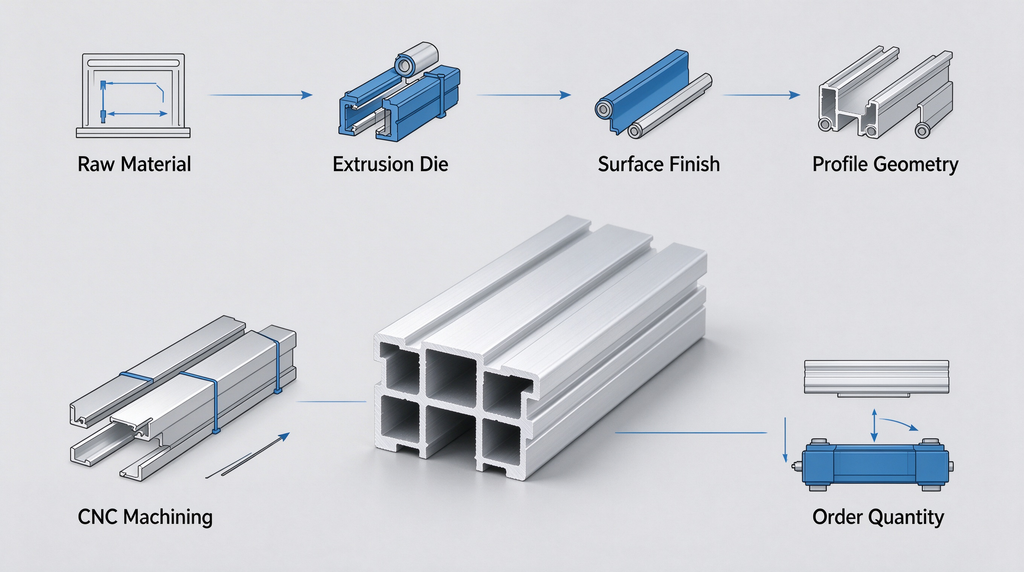
Choosing between aluminum extrusion and steel is an important decision in product design, construction, industrial equipment manufacturing, and structural engineering. Both materials offer valuable mechanical properties, but they differ significantly in weight, corrosion resistance, manufacturing flexibility, and overall project cost.
Aluminum extrusion is particularly useful when a component needs a custom cross-section, integrated mounting features, or a lightweight structure. Steel is often preferred when high strength, stiffness, wear resistance, or cost-effective heavy-duty construction is the primary requirement.
However, neither material is automatically the better choice for every project. The right decision depends on the load requirements, operating environment, manufacturing process, installation method, and expected service life.
This guide compares aluminum extrusion and steel to help engineers, product designers, and purchasing teams select the most appropriate material for their applications.
1. What Is Aluminum Extrusion?
Aluminum extrusion is a manufacturing process in which a heated aluminum billet is forced through a specially designed die to create a continuous profile with a specific cross-sectional shape.
The process allows manufacturers to produce profiles with features such as:
-
Mounting grooves and channels
-
Internal cavities
-
Integrated ribs and flanges
-
Cable-routing passages
-
Slots for fasteners
-
Custom connection features
These features can be incorporated directly into the profile, reducing the need for additional components or machining in some applications.
Common extrusion alloys include 6063 and 6061. The appropriate alloy and temper depend on the required strength, surface finish, corrosion resistance, and manufacturing conditions.
Aluminum extrusion is widely used in architectural systems, industrial frames, lighting housings, solar mounting structures, furniture, and custom equipment components.
2. What Is Steel Manufacturing?
Steel components can be produced through several manufacturing processes, including rolling, cutting, welding, stamping, casting, and machining.
Unlike aluminum extrusion, which is particularly suited to creating continuous profiles with custom cross-sections, steel manufacturing offers a broad range of options for producing plates, sheets, tubes, beams, and complex fabricated assemblies.
Common steel products include:
-
Structural beams and columns
-
Welded frames
-
Sheet-metal enclosures
-
Industrial machinery bases
-
Tubes and pipes
-
Heavy-duty brackets and supports
Different steel grades provide different combinations of strength, hardness, ductility, weldability, and corrosion resistance.
Carbon steel is commonly used in structural and industrial applications, while stainless steel may be selected when corrosion resistance or hygiene requirements are important.
The correct comparison must therefore consider the specific aluminum alloy and steel grade rather than treating either material as a single uniform category.
3. Weight: Aluminum vs. Steel
Weight is one of the most noticeable differences between aluminum and steel.
Typical densities are approximately:
| Material | Typical density |
|---|---|
| Aluminum alloys | 2.7 g/cm³ |
| Carbon steel | 7.85 g/cm³ |
| Stainless steel | Around 7.7–8.0 g/cm³ |
Aluminum has roughly one-third the density of typical steel.
For components with identical volume, aluminum therefore weighs substantially less. In practice, however, the finished components may not have identical dimensions because their designs must account for different mechanical properties.
Why Lightweight Design Matters
Reducing component weight can provide several benefits:
-
Easier handling and installation
-
Lower transportation weight
-
Reduced load on supporting structures
-
Easier movement of machine components
-
Improved portability of equipment
-
Potentially lower energy requirements for moving systems
For example, aluminum profiles are often used for modular machine frames because they can provide a practical balance of weight, stiffness, and ease of assembly.
Steel may still be preferable when a component must withstand high loads within a limited space or when its greater stiffness and strength are more important than weight reduction.
The best comparison should evaluate the complete component under its actual loading conditions.
4. Strength: Which Material Is Stronger?
Steel is often stronger than aluminum when comparing commonly used grades by tensile strength. However, the result depends on the exact alloy, temper, steel grade, and component design.
For engineering purposes, it is important to distinguish between tensile strength, yield strength, stiffness, and structural capacity.
Tensile strength describes the maximum stress a material can withstand under a tensile test before failure.
Yield strength describes the stress at which permanent deformation begins, according to the applicable test definition.
Stiffness describes resistance to elastic deformation and is closely related to the material’s elastic modulus.
These properties are not interchangeable.
Strength-to-Weight Ratio
Aluminum can provide a favorable strength-to-weight ratio in applications where reducing mass is important.
Some aluminum alloys offer substantial strength while remaining much lighter than steel. This can make them attractive for moving equipment, transportation components, and lightweight structures.
However, a high strength-to-weight ratio does not automatically mean that an aluminum component can replace a steel component with identical dimensions.
The component must still meet requirements for loading, deformation, buckling, fatigue, connection strength, and safety.
Structural Design Matters
An aluminum profile can use ribs, hollow sections, and optimized geometry to achieve useful structural performance with relatively little material.
A steel component may achieve similar structural performance using a different cross-section or fabrication method.
For a fair comparison, engineers should evaluate the complete design rather than relying only on material strength values.
5. Stiffness and Deflection
Steel has an elastic modulus of approximately 200 GPa, while common aluminum alloys have an elastic modulus of approximately 69 GPa.
This means steel is roughly three times as stiff as aluminum for the same geometry under the same elastic loading conditions.
Stiffness is particularly important for components that must limit deflection, maintain alignment, or support sensitive equipment.
Examples include:
-
Long-span beams
-
Precision machine supports
-
Heavy-duty frames
-
Structures carrying concentrated loads
-
Components where vibration affects performance
Aluminum profiles can compensate for lower material stiffness through cross-sectional design.
Increasing profile depth, adding ribs, or selecting a more suitable section can improve stiffness. However, these changes may increase material use or affect installation dimensions.
For a long aluminum extrusion, engineers should pay particular attention to span length, load distribution, support conditions, and allowable deflection.
In applications where deflection is the controlling design factor, steel may provide a more compact solution. In applications where weight and modular assembly are important, aluminum may offer a better overall balance.
6. Corrosion Resistance
Aluminum naturally forms a thin oxide layer when exposed to air. This layer helps protect the underlying metal from further oxidation under many ordinary environmental conditions.
Steel behaves differently. Many carbon steels require protective coatings or other corrosion-control measures when exposed to moisture or corrosive environments.
Common steel protection methods include:
-
Painting
-
Powder coating
-
Galvanizing
-
Protective plating
-
Corrosion-resistant alloy selection
Aluminum can also receive additional surface treatments, including anodizing and powder coating.
Aluminum in Outdoor Applications
Aluminum extrusion is frequently used in window frames, curtain walls, solar mounting systems, outdoor enclosures, and other applications exposed to weather.
Its natural oxide layer and relatively low weight can make it useful for outdoor structures.
However, aluminum is not immune to corrosion. Chlorides, certain chemicals, unsuitable cleaning agents, and contact with dissimilar metals can cause localized corrosion under unfavorable conditions.
Stainless steel also offers good corrosion resistance in many environments, although its performance depends on the grade and exposure conditions.
The correct material selection should consider humidity, salt exposure, chemicals, drainage, maintenance, and contact with other materials.
7. Manufacturing Flexibility
Aluminum extrusion and steel fabrication provide different design advantages.
Aluminum Extrusion Advantages
Extrusion is particularly useful when a product requires a consistent cross-section along its length.
It can integrate several features into one component, including mounting slots, channels, ribs, and internal cavities.
Potential benefits include:
-
Fewer separate components
-
Reduced assembly labor
-
Consistent cross-sectional geometry
-
Efficient production of repeated profile designs
-
Convenient integration with compatible fasteners and accessories
Custom extrusion is particularly attractive for products manufactured in repeated quantities.
Steel Fabrication Advantages
Steel can be fabricated using cutting, bending, welding, stamping, and other processes.
These methods are useful for large structures, welded assemblies, heavy plates, and products with shapes that are not suited to extrusion.
Steel fabrication can also be economical when standard structural sections or readily available sheet and plate materials meet the design requirements.
The choice should depend on the required geometry, production quantity, tooling investment, and downstream assembly process.
8. Machining and Assembly
Both aluminum and steel can be machined, but their machining behavior differs.
Aluminum is generally easier to machine than many steels because of its lower hardness and favorable cutting characteristics. It can be suitable for milling, drilling, tapping, and precision component production.
Steel machining requirements vary significantly by grade and hardness. Some steels are easy to machine, while high-strength or hardened grades can require more demanding tooling and processing conditions.
Assembly Advantages of Aluminum Profiles
Many industrial aluminum extrusion systems use integrated slots and standardized connectors.
This allows frames to be assembled with compatible brackets and fasteners, often without welding.
Potential benefits include:
-
Faster assembly
-
Easier adjustment
-
Convenient disassembly
-
Simplified equipment modifications
-
Reusable structural components
Steel frames often use welded joints, bolted plates, or fabricated brackets. These methods can provide strong, durable connections but may require additional fabrication and finishing operations.
Neither assembly method is universally superior. Connection strength, vibration, load direction, serviceability, and maintenance requirements must be considered.
9. Surface Finishing Options
Surface treatment influences appearance, corrosion performance, maintenance, and cost.
Aluminum Finishes
Common aluminum extrusion finishes include:
Anodizing: Creates an oxide layer and is often selected for metallic decorative finishes and improved surface durability.
Powder coating: Provides a wide range of colors and gloss levels for architectural, furniture, and industrial applications.
Mechanical finishing: Processes such as brushing can create a particular surface appearance before subsequent treatment when required.
Decorative finishes: Specialized processes may be used to achieve woodgrain or other visual effects.
Steel Finishes
Common steel finishing options include:
Painting: Provides color and a protective surface layer when the coating system is suitable for the environment.
Powder coating: Offers a durable finish for many fabricated components.
Galvanizing: Applies a zinc coating to provide corrosion protection to suitable steel products.
Stainless steel surface finishing: Brushing, polishing, and other processes can be used to achieve the desired appearance.
The most suitable finish depends on exposure conditions, appearance requirements, maintenance expectations, and the substrate.
A lower-cost finish may be sufficient for an indoor component, while an outdoor installation may require a more carefully specified protection system.
10. Aluminum Extrusion vs. Steel: Cost Comparison
The material price per kilogram is only one part of the total manufacturing cost.
Steel is often less expensive per kilogram than aluminum, although actual prices vary with grade, market conditions, processing, and purchasing volume.
Because aluminum is much lighter, comparing only price per kilogram can also be misleading.
A complete cost comparison should include:
-
Raw material consumption
-
Extrusion die or fabrication setup
-
Cutting and machining
-
Welding or assembly
-
Surface treatment
-
Fasteners and accessories
-
Packaging and transportation
-
Installation labor
-
Maintenance and replacement costs
When Aluminum May Be More Economical
Aluminum extrusion can provide cost advantages when it reduces the number of components, eliminates certain machining steps, simplifies assembly, or lowers handling and transportation costs.
For repeated production, a custom extrusion may integrate features that would otherwise require multiple steel components and additional fabrication.
The initial tooling investment must be considered alongside the expected production volume.
When Steel May Be More Economical
Steel may be a better choice when the design requires substantial strength or stiffness, uses standard structural sections, or involves heavy-duty components that can be fabricated efficiently.
If the project does not benefit from aluminum’s lower weight or extrusion flexibility, steel may provide a more economical solution.
The correct decision depends on the complete design and production process rather than a single material-price comparison.
11. Common Applications of Aluminum Extrusion and Steel
Different industries use these materials according to their performance requirements.
Industrial Equipment
Aluminum extrusion is widely used for machine frames, workstations, conveyor structures, protective guards, and modular automation systems.
Steel is frequently used for heavy machine bases, high-load supports, welded frames, and components requiring high stiffness.
Construction and Architecture
Aluminum profiles are common in windows, doors, curtain walls, decorative elements, and lightweight architectural systems.
Steel is widely used in structural beams, columns, reinforcement systems, and heavy load-bearing construction.
Solar Energy
Aluminum extrusion is commonly used for solar panel mounting rails and related structural components because of its low weight and corrosion-resistant characteristics.
Steel may be selected for ground-mounted support structures or applications where structural loads and project economics favor steel fabrication.
Furniture and Interior Design
Aluminum profiles are useful for modular furniture, lighting systems, display structures, cabinet frames, and decorative components.
Steel is often used for furniture frames, brackets, legs, and components where strength, shape, or cost favors steel fabrication.
Transportation and Mobility
Aluminum can help reduce component mass in vehicles and transportation equipment.
Steel remains widely used where strength, crash performance, cost, manufacturing infrastructure, and material availability are important.
The appropriate material depends on the component’s engineering requirements and applicable industry standards.
12. How to Choose the Right Material
Before selecting aluminum extrusion or steel, define the most important requirements for the application.
Consider the following questions:
-
How much load must the component support?
-
What level of deflection is acceptable?
-
Is weight reduction a major priority?
-
Will the component be exposed to moisture, salt, or chemicals?
-
Does the design require a custom cross-section?
-
Can integrated extrusion features reduce assembly work?
-
Is welding necessary or acceptable?
-
What surface finish is required?
-
What is the expected production quantity?
-
What are the installation, maintenance, and replacement costs?
For complex or safety-critical applications, material selection and structural design should be verified by a qualified engineer using the applicable standards and load cases.
Final Thoughts
Aluminum extrusion and steel each offer important advantages. Aluminum provides low density, flexible cross-sectional design, and convenient integration of mounting features. Steel offers higher stiffness per unit volume and can be an economical choice for many heavy-duty structures and fabricated assemblies.
The best material depends on the complete application rather than a simple comparison of strength or price per kilogram.
When weight reduction, modular assembly, corrosion resistance, and integrated profile features are important, aluminum extrusion deserves serious consideration. When compact structural stiffness, heavy loading, or standard steel fabrication offers clear advantages, steel may be the more practical solution.
By comparing mechanical requirements, manufacturing methods, surface protection, and lifecycle costs early in the design process, engineers and buyers can choose a material that delivers the right balance of performance and value.