




#
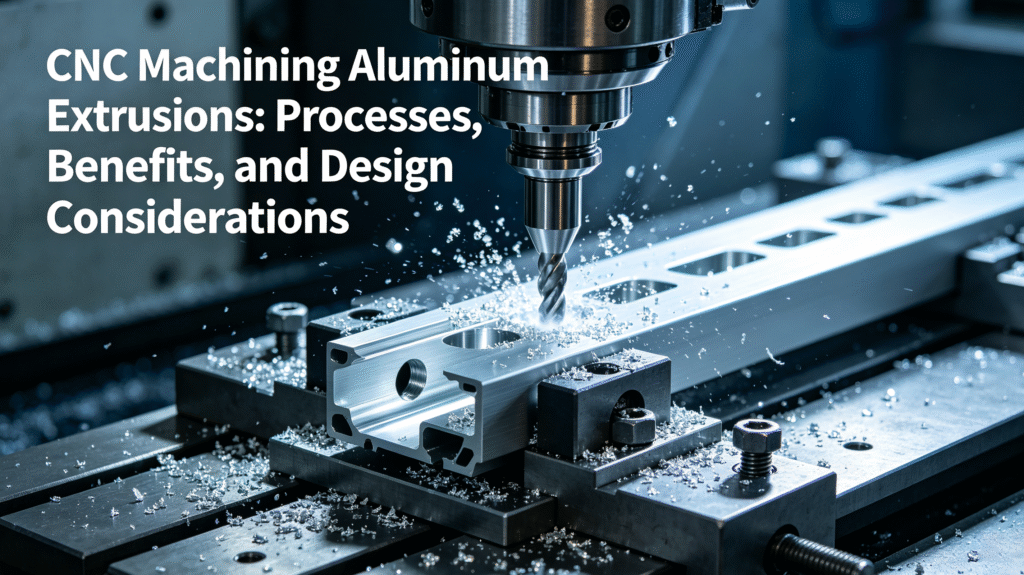
Custom aluminum extrusion can produce complex profiles efficiently, but many finished products require additional machining after extrusion. **CNC machining aluminum extrusions** allows manufacturers to transform a standard or custom-extruded profile into a finished component with precise holes, slots, pockets, threads, and other features.
By combining aluminum extrusion with CNC machining, manufacturers can reduce material waste, improve production efficiency, and create highly customized components for industrial, architectural, transportation, electronics, and other applications.
## What Is CNC Machining of Aluminum Extrusions?
CNC machining uses computer-controlled equipment to remove material from an aluminum extrusion according to a digital design.
Unlike extrusion, which creates the basic cross-sectional shape, CNC machining creates additional features that cannot easily be produced directly through the extrusion die.
Typical CNC machining operations include:
* Drilling
* Milling
* Tapping
* Countersinking
* Slot machining
* Pocket machining
* End machining
* Hole patterns
* Threading
* Cutting
* Surface preparation
The result is an aluminum component that can be ready for assembly or further surface treatment.
## Why Combine Aluminum Extrusion With CNC Machining?
Manufacturing an entire aluminum component from a solid block can require significant machining and material removal.
Extrusion provides a more efficient way to create the basic shape first.
The extrusion process produces the main geometry, while CNC machining creates the precision features afterward.
This combination can provide several advantages:
* Reduced material waste
* Lower machining time
* Faster production
* Consistent profile dimensions
* Flexible product design
* Suitable for high-volume manufacturing
* Integration of structural and mounting features
For many custom aluminum parts, **extrusion + CNC machining** is more efficient than machining the entire component from solid aluminum.
## Common CNC Machining Processes
Different applications require different machining operations.
### CNC Drilling
Drilling creates precise holes for:
* Screws
* Bolts
* Rivets
* Pins
* Electrical components
* Mounting hardware
Hole locations can be programmed according to the customer’s engineering drawings.
### CNC Milling
Milling removes material from selected areas of the aluminum profile.
It can create:
* Pockets
* Recesses
* Flat surfaces
* Channels
* Mounting areas
* Complex contours
### CNC Tapping
When threaded holes are required, tapping can be performed after drilling.
This is commonly used for mechanical assembly and equipment components.
### End Machining
Extruded profiles can be machined at the ends to create precise interfaces between components.
This can be particularly useful for frames, structural assemblies, and modular systems.
## Designing Aluminum Extrusions for CNC Machining
CNC machining should be considered during the initial extrusion design stage.
A profile may look simple in a CAD model but become difficult or expensive to manufacture if machining requirements are not considered.
Engineers should review:
* Tool access
* Wall thickness
* Hole location
* Machining depth
* Clamping requirements
* Required tolerances
* Cutting length
* Reference surfaces
* Assembly requirements
Good design coordination between extrusion and machining can significantly improve production efficiency.
## CNC Machining Tolerances
The required tolerance should match the actual function of the component.
Not every dimension needs extremely tight tolerances.
For example, a decorative aluminum profile may only require standard dimensional control, while a precision mechanical component may require tighter machining tolerances on selected features.
Over-specifying tolerances can increase:
* Machining time
* Tool wear
* Inspection requirements
* Production cost
* Scrap risk
A practical approach is to identify which dimensions are functionally critical and apply tighter control only where necessary.
## Cutting Aluminum Extrusions to Length
Before CNC machining, long extruded profiles are often cut into individual components.
Cutting requirements may include:
* Fixed-length cutting
* Multiple-length production
* Mitre cutting
* Precision end cutting
* Batch cutting
Accurate cutting is important because the final component dimensions depend on both extrusion accuracy and machining accuracy.
For products requiring assembly, cut-length tolerances should be defined together with the overall component drawing.
## Surface Treatment After CNC Machining
CNC machining and surface treatment are often combined in custom aluminum manufacturing.
Common finishing options include:
* Anodizing
* Powder coating
* Woodgrain transfer printing
* Brushing
* Polishing
* Other protective or decorative finishes
The production sequence can vary depending on the product.
For example, certain machining operations may be completed before anodizing, while other applications may require machining after surface treatment.
The correct process should be determined according to the required appearance, dimensional accuracy, corrosion resistance, and assembly requirements.
## CNC Machining Before or After Anodizing?
This is an important consideration for precision aluminum components.
Machining before anodizing allows the final surface treatment to cover the machined areas.
However, if a particular hole, thread, or contact surface must remain untreated, post-anodizing machining may be necessary.
The choice depends on:
* Required appearance
* Dimensional requirements
* Electrical contact requirements
* Thread specifications
* Assembly design
* Corrosion protection
Manufacturers should review these requirements before production rather than deciding the machining sequence after the parts are completed.
## Quality Control for CNC Machined Aluminum Profiles
Quality control should cover both the extrusion and machining stages.
Important inspection items may include:
### Profile Dimensions
The basic extrusion dimensions should conform to the approved drawing.
### Cut Length
Each machined component should have the required finished length.
### Hole Position
Hole locations are important for components that must connect with other parts.
### Thread Quality
Thread dimensions and condition should be checked when threaded holes are required.
### Surface Quality
Machined surfaces should be inspected for scratches, burrs, dents, tool marks, and other defects.
### Final Assembly
For complex components, sample assembly or functional testing can help verify that the machined profile works correctly with mating components.
## Applications of CNC Machined Aluminum Extrusions
CNC-machined aluminum profiles are used across many industries.
### Industrial Equipment
Aluminum profiles can be machined into:
* Machine frames
* Mounting brackets
* Equipment housings
* Structural components
* Conveyor components
### Electronics
Machined aluminum extrusions can be used for:
* Electronic housings
* Heat sinks
* Mounting structures
* Equipment enclosures
* LED components
### Automation
Automation equipment often requires lightweight structural components with precisely positioned mounting holes and slots.
Combining extrusion and CNC machining allows these features to be integrated directly into the profile.
### Architectural Products
Architectural aluminum profiles may require precision cutting and machining for:
* Windows
* Doors
* Curtain wall components
* Handrails
* Decorative systems
* Interior structures
### Transportation
Lightweight aluminum components are also useful in transportation equipment where weight reduction and structural performance are important.
## How to Reduce CNC Machining Costs
CNC machining costs depend on several factors, including machining time, tooling, material removal, tolerances, and production volume.
Several design strategies can help reduce cost.
### Use Extrusion to Create the Basic Shape
The more useful geometry that can be created through extrusion, the less material needs to be removed through machining.
### Avoid Unnecessary Tight Tolerances
Apply precision requirements only to dimensions that are functionally important.
### Simplify Tool Access
Designing features that can be reached using standard cutting tools can reduce machining complexity.
### Optimize Hole Patterns
Grouping machining operations efficiently can reduce setup and cycle time.
### Consider Production Volume
Prototype production and mass production may require different manufacturing strategies.
A profile that is economical for a small batch may be further optimized for large-scale production.
## From CAD Drawing to Finished Component
A typical custom aluminum extrusion and CNC machining project may follow this workflow:
**Customer Drawing → Engineering Review → Alloy Selection → Extrusion Die Design → Aluminum Extrusion → Profile Inspection → Cutting → CNC Machining → Surface Treatment → Final Inspection → Packaging**
Each stage affects the final product.
Early engineering review is especially important because changes to the extrusion die, machining program, or surface treatment process can become more expensive after mass production begins.
## Custom Aluminum Extrusion and CNC Machining
For OEM and ODM customers, combining extrusion and CNC machining provides a complete manufacturing solution.
Instead of purchasing a long aluminum profile and arranging machining separately, customers can receive finished components produced according to their drawings and specifications.
A custom manufacturing program can include:
* Aluminum alloy selection
* Custom extrusion
* Die development
* Precision cutting
* CNC machining
* Surface treatment
* Quality inspection
* Packaging
* OEM/ODM production
This integrated approach can simplify supply-chain management and provide more consistent production control.
## Final Thoughts
**CNC machining aluminum extrusions** combines the efficiency of extrusion with the precision of computer-controlled machining.
Extrusion creates the primary profile geometry, while CNC machining adds the holes, slots, threads, pockets, and other features required for the final product.
For engineers and purchasing teams, the most important step is to consider extrusion and machining as one manufacturing process rather than treating them as completely separate operations.
With proper profile design, machining planning, tolerance control, and quality inspection, custom aluminum extrusion can provide an efficient solution for producing accurate, lightweight, and durable components.