


Industrial manufacturers are constantly looking for materials that combine strength, low weight, durability, and manufacturing flexibility. Industrial aluminum profiles have become a popular solution because aluminum extrusion can create complex structural components while reducing material usage and assembly requirements.
From automated production lines and machine frames to robotics, conveyor systems, solar equipment, and electronic enclosures, custom aluminum profiles can be designed around the exact requirements of a machine or system.
This guide explains what industrial aluminum profiles are, their advantages, common applications, and the key factors to consider when selecting a custom aluminum extrusion manufacturer.
What Are Industrial Aluminum Profiles?
Industrial aluminum profiles are extruded aluminum components designed primarily for machinery, equipment, structural systems, and industrial applications.
Unlike standard architectural profiles, industrial extrusions are often designed around specific engineering requirements.
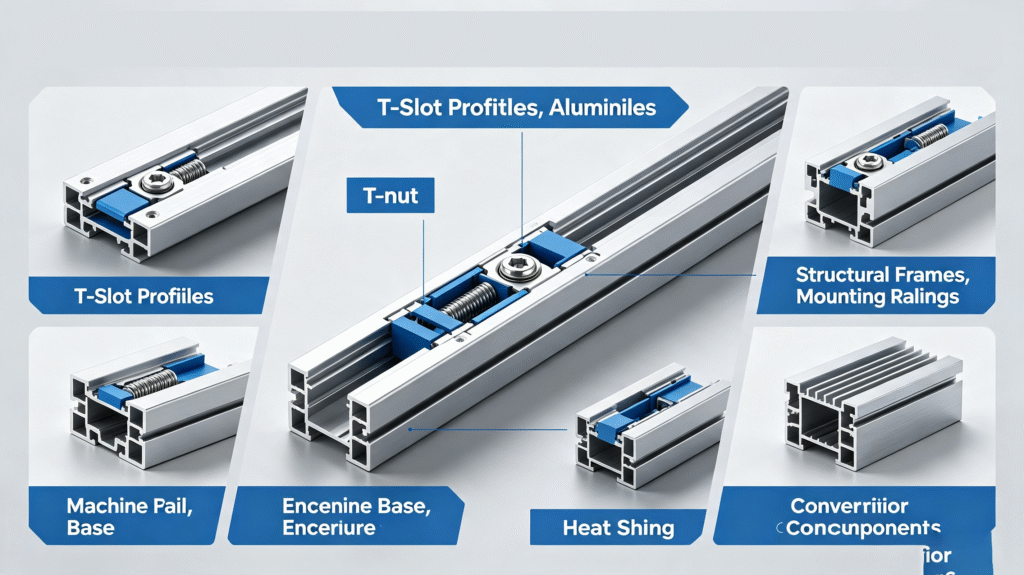
They can include:
-
Structural frames
-
T-slotted profiles
-
Mounting rails
-
Machine bases
-
Enclosures
-
Conveyor components
-
Heat sinks
-
Equipment brackets
-
Protective guards
The extrusion process allows manufacturers to integrate multiple functional features directly into the profile.
Why Use Aluminum for Industrial Profiles?
Lightweight Construction
Aluminum has a significantly lower density than steel, allowing manufacturers to reduce the weight of equipment and structures.
Lower weight can simplify:
-
Transportation
-
Installation
-
Assembly
-
Equipment movement
-
Structural design
This is especially useful for modular machinery and automated production systems.
High Strength-to-Weight Ratio
Although aluminum is lightweight, properly designed profiles can provide substantial structural performance.
Engineers can improve rigidity through:
-
Larger profile dimensions
-
Internal ribs
-
Reinforced sections
-
Optimized wall thickness
-
Integrated support structures
The result is a lightweight structure without unnecessarily using large amounts of material.
Excellent Corrosion Resistance
Industrial equipment may operate in environments where moisture, chemicals, or temperature changes are present.
Aluminum naturally forms a protective oxide layer, providing good corrosion resistance.
Anodizing or powder coating can provide additional surface protection when required.
T-Slot Aluminum Profiles
T-slot aluminum extrusion is one of the most widely used industrial profile systems.
The T-shaped slots allow components to be connected using:
-
T-nuts
-
Bolts
-
Brackets
-
Connectors
-
Hinges
One of the biggest advantages is that structures can often be assembled without welding.
This makes T-slot profiles particularly useful for modular equipment.
Common T-Slot Applications
They are frequently used for:
-
Machine frames
-
Workstations
-
Conveyor systems
-
Safety guards
-
Laboratory equipment
-
Robotics
-
3D printer frames
-
Automation systems
Components can also be disassembled and reconfigured as production requirements change.
Custom Industrial Aluminum Extrusions
Standard profiles are convenient, but custom extrusion can provide better performance for specialized applications.
A custom profile can integrate features such as:
-
Mounting channels
-
Cable passages
-
Reinforcing ribs
-
Sliding tracks
-
Snap-fit connections
-
Heat-dissipation fins
Integrating these features directly into the extrusion can reduce the need for additional parts.
Industrial Aluminum Profiles for Automation
Automation equipment requires structures that are rigid, accurate, and easy to modify.
Aluminum extrusion is widely used in:
-
Robotic cells
-
Automated assembly lines
-
Pick-and-place systems
-
Inspection machines
-
Packaging equipment
-
Material handling systems
The modular nature of aluminum profiles allows engineers to modify machine structures without completely redesigning the frame.
Aluminum Machine Frames
Machine frames provide the structural foundation for industrial equipment.
Aluminum extrusion frames can support:
-
Motors
-
Sensors
-
Controllers
-
Conveyors
-
Pneumatic systems
-
Safety panels
Compared with welded steel frames, modular aluminum structures can often be assembled and modified more efficiently.
Conveyor Systems
Aluminum profiles are commonly used for conveyor structures because they provide a good combination of rigidity, low weight, and modularity.
They can be used for:
-
Conveyor frames
-
Side rails
-
Support structures
-
Guide systems
-
Mounting brackets
Custom profiles can incorporate channels for cables and other components, creating a cleaner finished system.
Aluminum Profiles for Machine Guards
Industrial safety systems often require protective frames around moving machinery.
Aluminum profiles provide a convenient structure for mounting:
-
Polycarbonate panels
-
Acrylic panels
-
Wire mesh
-
Safety doors
Integrated slots simplify panel installation and future maintenance.
Aluminum Heat Sink Profiles
Industrial electronics frequently require effective thermal management.
Extruded aluminum heat sinks can be designed with:
-
Thin fins
-
Deep channels
-
Multiple cooling surfaces
-
Integrated mounting points
This allows the extrusion to function as both a structural component and a thermal management solution.
Common applications include:
-
Power supplies
-
Industrial controllers
-
LED systems
-
Inverters
-
Motor drives
-
Communication equipment
Surface Finishes for Industrial Profiles
Industrial aluminum profiles can receive different surface treatments depending on their environment and appearance requirements.
Anodizing
Anodizing provides a durable oxide layer with good corrosion and wear resistance.
It is commonly used for:
-
Machine frames
-
Equipment structures
-
Industrial rails
Powder Coating
Powder coating provides a wide range of colors and textures.
It can also help protect profiles from environmental exposure.
Mill Finish
For some internal industrial applications, a standard mill finish may be sufficient.
Choosing a simpler finish can help reduce unnecessary production costs.
Aluminum Alloy Selection
The alloy should be selected according to the application’s requirements.
6063 Aluminum
6063 is widely used for extrusion because it offers:
-
Excellent extrudability
-
Good surface quality
-
Good corrosion resistance
-
Suitable mechanical properties
It is a common choice for general industrial profiles.
6061 Aluminum
6061 is often selected when higher strength and machining performance are more important.
The best alloy depends on the required mechanical properties, profile complexity, and manufacturing process.
Designing Industrial Aluminum Profiles
Good profile design can significantly improve both performance and manufacturing efficiency.
Wall Thickness
Uniform wall thickness generally helps create more consistent material flow during extrusion.
Large variations in wall thickness can make extrusion more difficult and may affect dimensional stability.
Profile Geometry
Engineers should consider:
-
Structural loads
-
Bending forces
-
Connection methods
-
Machining requirements
-
Available extrusion capacity
Integrated Features
Adding functional features directly into the extrusion can reduce secondary operations.
For example, a profile can incorporate a mounting channel instead of requiring a separate bracket.
Advantages of Custom Industrial Aluminum Extrusion
Custom extrusion provides several important benefits.
Reduced Component Count
Integrated features can eliminate additional brackets and fasteners.
Faster Assembly
Profiles designed for modular connections can significantly reduce assembly time.
Lower Weight
Optimized cross-sections can reduce material consumption while maintaining structural performance.
Improved Appearance
Clean extruded geometry creates a professional appearance for modern industrial equipment.
Easier Modification
Modular profiles allow machines and workstations to be expanded or reconfigured.
How to Choose an Industrial Aluminum Profile Manufacturer
When selecting a supplier, consider the manufacturer’s complete capabilities.
A reliable supplier should ideally offer:
-
Custom extrusion die design
-
Aluminum extrusion
-
CNC machining
-
Precision cutting
-
Drilling and tapping
-
Anodizing
-
Powder coating
-
Assembly
-
Quality inspection
A manufacturer capable of handling multiple processes can simplify procurement and improve production consistency.
Quality Control
Industrial applications often require tighter dimensional control than general-purpose products.
Quality inspection may include:
-
Profile dimensions
-
Wall thickness
-
Straightness
-
Surface quality
-
Cut length
-
Hole position
-
Thread accuracy
-
Coating thickness
For critical components, detailed inspection reports can help customers verify compliance with their specifications.
Sustainable Industrial Aluminum Profiles
Aluminum is highly recyclable, making it an attractive material for manufacturers seeking more sustainable production solutions.
The long service life of aluminum profiles can also reduce the need for frequent replacement.
Modern extrusion manufacturers are increasingly focusing on:
-
Recycled aluminum
-
Efficient extrusion processes
-
Reduced material waste
-
Energy-efficient production
-
Recyclable packaging
Sustainable material selection can therefore become part of a company’s broader environmental strategy.
Conclusion
Industrial aluminum profiles provide an effective combination of lightweight construction, structural performance, corrosion resistance, and modular design flexibility.
From machine frames and automation equipment to conveyor systems, robotics, safety guards, and heat sinks, aluminum extrusion can be customized to meet a wide range of industrial requirements.
The most effective solution begins with proper profile design and material selection. Working with an experienced aluminum extrusion manufacturer can help optimize the extrusion geometry, tooling, machining, finishing, and overall production process.
Whether you need standard T-slot profiles or completely custom industrial aluminum extrusions, choosing the right manufacturing partner can improve product performance, simplify assembly, reduce costs, and support reliable long-term production.