


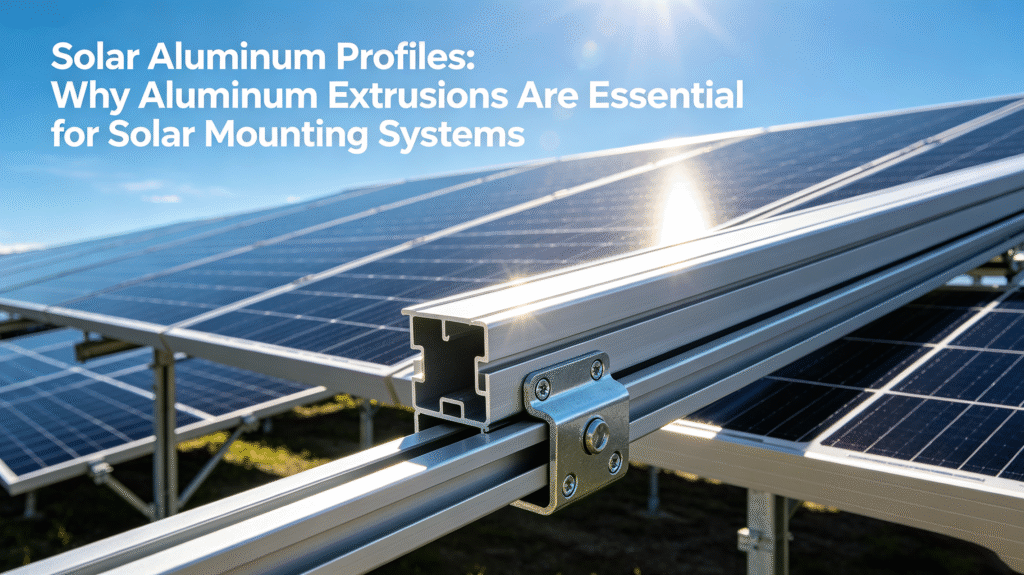
The rapid growth of solar energy has created increasing demand for lightweight, durable, and cost-effective structural components. Among these components, solar aluminum profiles play an important role in supporting photovoltaic panels and creating reliable solar mounting systems.
Aluminum extrusion is particularly well suited to solar applications because it combines low weight, corrosion resistance, structural performance, and design flexibility. Custom extruded profiles can be developed for rooftop solar systems, ground-mounted installations, solar carports, and other photovoltaic structures.
This guide explains the role of aluminum extrusion in solar mounting systems, common profile designs, material considerations, surface finishes, and how to select a reliable solar aluminum profile manufacturer.
What Are Solar Aluminum Profiles?
Solar aluminum profiles are extruded aluminum components specifically designed for photovoltaic mounting and support systems.
Depending on the application, they may be used as:
-
Solar mounting rails
-
Panel frames
-
Roof mounting profiles
-
Structural support channels
-
End clamps and connection components
-
Solar carport components
-
Ground-mount support profiles
-
Cable management channels
Custom extrusion allows manufacturers to integrate mounting slots, connection channels, and other functional features directly into the aluminum profile.
Why Is Aluminum Widely Used in Solar Mounting Systems?
Lightweight Construction
Solar installations often cover large areas, so reducing structural weight can simplify transportation, handling, and installation.
Aluminum provides a strong combination of low density and structural performance.
This is particularly useful for:
-
Rooftop solar systems
-
Residential installations
-
Commercial buildings
-
Solar carports
Lighter components can also make installation easier for workers.
Excellent Corrosion Resistance
Solar mounting systems are exposed to outdoor conditions for many years.
They may encounter:
-
Rain
-
Humidity
-
Snow
-
Sunlight
-
Temperature changes
-
Coastal environments
Aluminum’s naturally protective oxide layer provides good corrosion resistance, making it well suited for long-term outdoor applications.
Additional anodizing or other surface treatments can provide further protection where required.
Easy Extrusion
Aluminum can be extruded into complex cross-sections with integrated functional features.
For example, a solar mounting rail can be designed with channels that allow fasteners to slide into position.
This can reduce the number of separate components required during installation.
Common Solar Aluminum Extrusion Profiles
Solar Mounting Rails
Mounting rails are among the most common aluminum extrusion products used in photovoltaic systems.
They provide a structural connection between solar panels and the supporting roof or ground structure.
A well-designed rail may include:
-
T-slots
-
Fastener channels
-
Reinforcing ribs
-
Cable management channels
-
Connection features
Custom rail dimensions can be developed according to panel size and system requirements.
Solar Panel Frames
Aluminum is also widely used around the perimeter of photovoltaic modules.
The frame provides structural support while protecting the edges of the panel.
Extruded aluminum frames can be designed for:
-
Different panel dimensions
-
Various glass thicknesses
-
Different connection methods
-
Specific installation environments
Solar Carport Profiles
Solar carports require larger structural components because the system must support photovoltaic panels while providing space for vehicles underneath.
Aluminum extrusion can be used for:
-
Panel support structures
-
Roof components
-
Drainage channels
-
Decorative covers
-
Cable management
For larger structural applications, alloy selection and engineering calculations should be based on the project’s actual loads and local requirements.
Benefits of Custom Solar Aluminum Extrusion
Optimized Profile Geometry
Custom extrusion allows engineers to design the cross-section around the required load and connection method.
Instead of using an oversized standard profile, manufacturers can optimize:
-
Wall thickness
-
Profile height
-
Internal ribs
-
Mounting channels
-
Weight
This can reduce unnecessary material consumption.
Faster Installation
Integrated slots and connection features can simplify installation.
Installers can position fasteners directly within the extrusion rather than drilling numerous holes on-site.
This can help reduce:
-
Installation time
-
Labor requirements
-
On-site fabrication
-
Assembly complexity
Easy System Expansion
Modular aluminum mounting systems can be designed so that additional panels or structural components can be added when necessary.
This is particularly useful for commercial and industrial solar projects.
Aluminum Alloy Selection for Solar Profiles
Material selection should be based on the structural requirements and extrusion geometry.
6063 Aluminum
6063 is widely used for aluminum extrusion because of its:
-
Excellent extrudability
-
Good surface quality
-
Corrosion resistance
-
Suitable mechanical properties
It can be a good choice for many solar mounting and architectural components.
6061 Aluminum
6061 provides higher mechanical strength and is often considered when structural performance is a major requirement.
It may be suitable for components exposed to higher mechanical loads or requiring additional machining.
The final alloy and temper should be selected according to engineering requirements rather than simply choosing the strongest available material.
Surface Finishing for Solar Aluminum Profiles
Anodizing
Anodizing increases the thickness of the natural oxide layer on aluminum.
Advantages include:
-
Improved corrosion resistance
-
Better surface hardness
-
Durable appearance
-
Good outdoor performance
Anodized finishes are widely used for solar mounting rails and related components.
Powder Coating
Powder coating provides a wider range of colors and surface textures.
It may be selected when:
-
Appearance is important
-
Specific colors are required
-
Additional surface protection is desired
For many solar mounting systems, however, the finish should be selected primarily according to the environmental and technical requirements of the installation.
Solar Aluminum Profiles for Different Installation Environments
Residential Rooftops
Residential systems often prioritize:
-
Lightweight components
-
Easy installation
-
Compact profile designs
-
Corrosion resistance
Aluminum extrusion is particularly suitable where minimizing roof load and installation complexity is important.
Commercial Rooftops
Commercial installations may require longer rails and larger quantities of mounting components.
Consistent extrusion quality becomes particularly important for high-volume projects.
Ground-Mounted Solar Systems
Ground-mounted systems can involve larger structural loads and longer support structures.
Profile design should account for factors such as:
-
Wind loads
-
Snow loads
-
Span length
-
Panel weight
-
Local environmental conditions
Engineering calculations should be completed before finalizing the extrusion design.
Coastal Solar Installations
Coastal environments can be more challenging because of salt exposure and humidity.
Material selection, surface treatment, fastener compatibility, and overall system design should be considered together to reduce corrosion risks.
Preventing Galvanic Corrosion
Solar mounting systems often combine aluminum with stainless steel or other metals.
Direct contact between dissimilar metals in the presence of moisture can create galvanic corrosion under certain conditions.
Proper system design may therefore require:
-
Compatible fasteners
-
Isolation materials
-
Appropriate coatings
-
Proper drainage
-
Careful material selection
A qualified manufacturer can help evaluate material compatibility during product development.
Manufacturing Process for Solar Aluminum Profiles
A typical production process includes:
1. Die Design
Engineers create an extrusion die based on the required profile geometry.
2. Aluminum Extrusion
Heated aluminum billets are pushed through the die to create the continuous profile.
3. Cooling and Straightening
The extruded material is cooled and straightened to maintain dimensional accuracy.
4. Cutting
Profiles are cut to specified lengths.
5. Machining
Additional drilling, milling, punching, or tapping can be performed when required.
6. Surface Finishing
Anodizing or powder coating can be applied according to the application.
7. Quality Inspection
Finished profiles are inspected for dimensions, surface quality, straightness, and other specified requirements.
Quality Control for Solar Aluminum Profiles
Consistent quality is especially important for large solar projects because thousands of components may be installed at one site.
A professional manufacturer may inspect:
-
Profile dimensions
-
Wall thickness
-
Straightness
-
Cut length
-
Surface finish
-
Hole position
-
Alloy and temper
-
Coating thickness
For OEM projects, inspection requirements should be agreed upon before mass production.
Why Work With an Integrated Aluminum Extrusion Manufacturer?
Solar mounting systems often require multiple manufacturing processes.
An integrated supplier can provide:
-
Custom profile design
-
Extrusion die development
-
Aluminum extrusion
-
Precision cutting
-
CNC machining
-
Anodizing
-
Powder coating
-
Assembly
-
Packaging
Managing these processes through one supplier can simplify procurement and improve production consistency.
For international buyers, it can also reduce the complexity of coordinating multiple factories.
Sustainable Advantages of Aluminum Solar Profiles
Aluminum and solar energy are naturally complementary from a sustainability perspective.
Aluminum can be recycled repeatedly, while well-designed solar mounting components can provide long service life.
Manufacturers can further improve sustainability through:
-
Recycled aluminum
-
Efficient profile design
-
Reduced material waste
-
Energy-efficient production
-
Recyclable packaging
Lightweight aluminum structures can also reduce transportation requirements compared with heavier structural materials.
How to Choose a Solar Aluminum Profile Manufacturer
Before selecting a supplier, consider:
Extrusion Capability
Can the manufacturer produce the required profile dimensions and complexity?
Tooling Expertise
Does the supplier have experienced die engineers capable of optimizing material flow and profile geometry?
Surface Treatment
Can the manufacturer provide the required anodizing or powder coating specifications?
Fabrication
Can the supplier perform cutting, drilling, CNC machining, and other secondary operations?
Production Capacity
Can the manufacturer support both prototype development and long-term mass production?
Quality Management
Does the supplier have reliable material traceability and dimensional inspection procedures?
These factors can make a significant difference in the consistency and reliability of a solar mounting project.
Conclusion
Solar aluminum profiles provide an effective combination of lightweight construction, corrosion resistance, structural performance, and manufacturing flexibility. Through aluminum extrusion, manufacturers can create mounting rails, panel frames, support structures, solar carport components, and other customized parts for photovoltaic systems.
The most effective solar profiles are not simply strong—they are engineered around the installation environment, required loads, connection methods, manufacturing process, and long-term maintenance requirements.
By working with an experienced aluminum extrusion manufacturer, solar companies and system integrators can develop customized profiles, optimize material usage, simplify installation, and maintain consistent quality across large production orders.
As global demand for renewable energy continues to grow, custom aluminum extrusion will remain an important manufacturing solution for the next generation of solar mounting systems.