



# Aluminum Extrusion for Solar Panel Mounting Systems: Design, Materials, and Installation
As the solar energy industry continues to expand, manufacturers and installers are looking for mounting systems that are lightweight, durable, and easy to install. Aluminum extrusion has become an important material solution for solar panel mounting systems because it combines corrosion resistance, structural performance, and flexible design possibilities.
From residential rooftop installations to large commercial and utility-scale solar projects, aluminum profiles are used in mounting rails, support brackets, connectors, and structural components.
However, choosing the right aluminum extrusion involves more than selecting a suitable profile shape. Engineers must consider structural loads, environmental conditions, alloy properties, installation methods, and long-term durability.
In this guide, we explore how aluminum extrusions are used in solar panel mounting systems, which materials are commonly selected, and what buyers should consider when designing or sourcing custom solar aluminum profiles.
## 1. Why Aluminum Extrusion Is Ideal for Solar Mounting Systems
Solar mounting systems must support photovoltaic modules while remaining stable under changing weather conditions. Aluminum extrusion offers several advantages that make it suitable for these applications.
### Lightweight and Easy to Handle
Aluminum is significantly lighter than steel, making it easier to transport, lift, and install.
For rooftop solar projects, reducing the weight of mounting components can help simplify installation and reduce additional loads on the building structure. However, the complete system must still be evaluated by a qualified structural engineer.
### Corrosion Resistance
Solar mounting systems are often installed outdoors and exposed to rain, humidity, UV radiation, and temperature changes.
Aluminum naturally develops a protective oxide layer that helps resist corrosion. With appropriate alloy selection and surface treatment, aluminum profiles can provide reliable performance in many outdoor environments.
For coastal or industrial locations, additional corrosion protection and careful connection design may be necessary.
### Flexible Profile Design
Extrusion manufacturing allows aluminum profiles to be produced in a wide range of cross-sectional shapes.
A single profile can incorporate:
– T-slots for mounting accessories.
– Channels for bolts and sliding nuts.
– Reinforcement ribs for structural support.
– Grooves for panel clamps.
– Integrated drainage features.
This design flexibility can reduce the number of separate components and simplify installation.
### Long-Term Durability
Aluminum profiles do not rust in the same way as ordinary carbon steel. They can maintain their structural function for many years when correctly designed, manufactured, installed, and maintained.
Their durability makes them attractive for solar projects where mounting systems are expected to remain in service for extended periods.
## 2. Common Aluminum Alloys for Solar Mounting Profiles
The aluminum alloy affects strength, extrudability, corrosion resistance, and manufacturing cost.
Several alloys are commonly considered for solar mounting applications.
### 6063 Aluminum
6063 is one of the most widely used aluminum extrusion alloys.
Its advantages include:
– Excellent extrudability.
– Good surface finish.
– Good corrosion resistance.
– Suitable mechanical properties for many mounting components.
– Compatibility with anodizing and other surface treatments.
It is commonly used for solar mounting rails, support channels, and architectural-style structural profiles.
### 6061 Aluminum
6061 offers higher strength in many commonly used tempers compared with 6063.
It is suitable for applications requiring greater mechanical performance, machining, or structural support.
However, its extrusion characteristics and surface finish may differ from those of 6063. The best option depends on the profile geometry and project requirements.
### 6005A Aluminum
6005A is another alloy used in structural aluminum applications.
It offers a combination of strength, extrudability, and corrosion resistance that can make it suitable for certain solar mounting components.
Its suitability should be evaluated according to the specified temper, applicable product standards, and structural design requirements.
### Alloy Selection Comparison
| Alloy | Main Advantages | Potential Applications |
|—|—|—|
| 6063 | Excellent extrudability and surface finish | Rails, channels, mounting accessories |
| 6061 | Good strength and machinability | Structural brackets and components |
| 6005A | Strength and structural performance | Load-bearing mounting profiles |
The correct alloy should be selected based on engineering calculations rather than strength comparisons alone.
## 3. Common Aluminum Profiles Used in Solar Mounting Systems
A photovoltaic mounting system consists of multiple components that work together to secure solar panels.
Aluminum extrusion can be used in several key parts.
### Solar Mounting Rails
<AsyncImage query=”aluminum solar panel mounting rails extruded T slot profiles close up” aspectRatio=”16:9″ width=”100%”/>
Mounting rails provide the main support for solar panels.
They are typically designed with channels or slots that allow installers to attach panel clamps, connectors, and brackets.
A well-designed rail should provide sufficient bending strength, appropriate stiffness, and compatibility with the selected mounting hardware.
### Mid Clamps and End Clamps
<AsyncImage query=”aluminum solar panel mounting mid clamps and end clamps photovoltaic installation” aspectRatio=”16:9″ width=”100%”/>
Clamps secure solar modules to the mounting rails.
Mid clamps are positioned between adjacent panels, while end clamps secure the outer edges of a panel row.
These components must provide reliable holding force without damaging the photovoltaic module frame.
### Roof Mounting Brackets
<AsyncImage query=”solar panel aluminum roof mounting brackets photovoltaic mounting hardware” aspectRatio=”16:9″ width=”100%”/>
Roof mounting brackets connect the rail system to the roof structure.
Their design depends on the roof type, installation method, wind loads, and waterproofing requirements.
### Ground-Mount Support Profiles
<AsyncImage query=”ground mounted solar photovoltaic aluminum support structure rails” aspectRatio=”16:9″ width=”100%”/>
Ground-mounted solar systems may use aluminum profiles for selected rails, cross-members, and support components.
The structure must be designed for wind, snow, soil conditions, and other project-specific loads.
For large installations, the complete support system may combine aluminum and galvanized or coated steel components.
## 4. Structural Design Considerations for Solar Aluminum Profiles
Solar mounting profiles must maintain structural stability under different environmental conditions.
Several factors should be considered during the design process.
### Wind Loads
Wind can create significant pressure and uplift forces on solar panels.
The mounting rails, clamps, brackets, and connections must work together to resist these loads.
Wind design should account for:
– Local wind speed.
– Building height.
– Roof shape and slope.
– Panel orientation.
– Installation location.
– Edge and corner pressure zones.
A profile that performs adequately in one location may require a different design in another.
### Snow Loads
In regions with heavy snowfall, solar mounting systems must support additional weight from accumulated snow.
Rail spacing, support locations, profile geometry, and connection strength all influence structural performance.
### Profile Deflection
Deflection refers to the amount a profile bends under an applied load.
Excessive deflection can affect panel alignment, connection performance, and overall system reliability.
Engineers should evaluate both strength and stiffness when selecting a rail profile.
### Wall Thickness and Reinforcement
Wall thickness affects the strength, weight, and manufacturing cost of an aluminum extrusion.
Adding internal ribs or modifying the cross-sectional geometry may improve structural performance without unnecessarily increasing material consumption.
However, thin-wall designs must also consider extrusion feasibility, dimensional tolerances, and local buckling.
## 5. Surface Treatments for Outdoor Solar Aluminum Profiles
Solar mounting systems are exposed to outdoor conditions for long periods. Surface treatment can help maintain appearance and provide additional protection.
### Anodizing
Anodizing forms a controlled oxide layer on the aluminum surface.
Common benefits include:
– Improved surface hardness.
– Better resistance to environmental exposure.
– Consistent metallic appearance.
– Additional protection against surface deterioration.
Anodizing thickness should be specified according to the operating environment and applicable requirements.
### Powder Coating
Powder coating creates a durable decorative and protective finish.
It is available in various colors and surface textures.
For solar mounting systems, powder coating may be selected when appearance or a particular protective coating specification is required.
However, many standard solar rail systems use natural or anodized aluminum finishes rather than decorative powder coating.
### Choosing the Right Finish
| Finish | Main Benefit | Typical Consideration |
|—|—|—|
| Natural aluminum | Economical and simple | Depends on alloy and environment |
| Anodizing | Surface durability and appearance | Film thickness and sealing |
| Powder coating | Color options and protective finish | Pretreatment and coating quality |
For coastal installations, designers should also consider galvanic corrosion at connection points and the compatibility of fasteners and accessories.
## 6. Installation Methods for Aluminum Solar Mounting Profiles
Installation design directly affects the performance and efficiency of a solar mounting system.
A well-designed aluminum profile should be easy to position, connect, and secure.
### Rail Connection Systems
Solar rails often use specially designed connectors to join two profile sections.
These connectors should maintain alignment and provide the required mechanical strength.
The connection method should follow the mounting system manufacturer’s installation instructions.
### T-Slot and Sliding Nut Systems
Many aluminum solar profiles include T-slots that allow sliding nuts or bolts to be positioned along the rail.
This design offers flexibility during installation because components can be adjusted without drilling new holes in every location.
### Panel Clamping
Mid clamps and end clamps must be compatible with the photovoltaic module frame thickness and the mounting rail design.
Incorrect clamp positioning or excessive tightening can damage panels or compromise the mounting system.
Installers should follow the specified torque values and approved installation procedures.
### Roof Waterproofing
For rooftop solar installations, mounting brackets and roof penetrations must be designed to prevent water intrusion.
The waterproofing solution depends on the roofing material and mounting method.
This is an important part of the complete installation system, not simply an aluminum profile manufacturing issue.
## 7. How Custom Aluminum Extrusion Improves Solar Mounting Systems
Custom aluminum extrusion allows manufacturers to develop profiles that match specific mounting requirements.
Instead of adapting a standard profile to every project, buyers can work with an extrusion manufacturer to optimize the cross-section.
Potential benefits include:
**Integrated functions:** T-slots, grooves, reinforcement ribs, and mounting channels can be incorporated into one profile.
**Reduced component count:** Combining several functions into one extrusion may simplify assembly.
**Material optimization:** Profile geometry can be adjusted to balance structural performance and weight.
**Installation efficiency:** Standardized connection features can reduce installation complexity.
**Product differentiation:** Custom profile designs can help solar mounting system manufacturers develop proprietary products.
Custom extrusion is particularly useful for OEM and ODM projects involving specialized mounting systems.
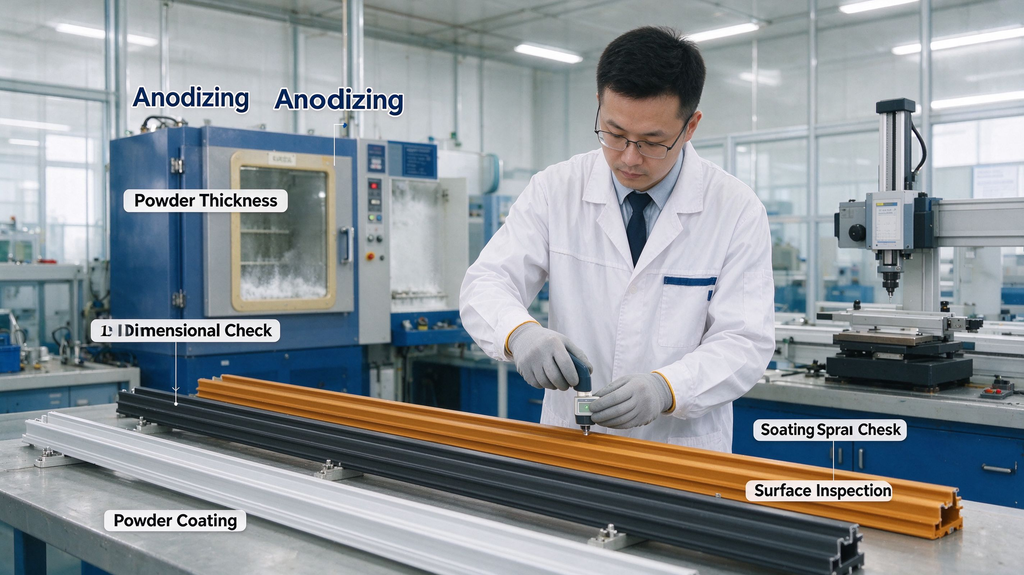
## 8. Quality Control for Solar Aluminum Extrusions
Consistent quality is essential because mounting profiles form part of the structural support system for photovoltaic modules.
Important inspection procedures include:
### Dimensional Inspection
Verify profile width, height, wall thickness, slot dimensions, and other critical measurements.
### Mechanical Testing
Check the required tensile strength, yield strength, and elongation of the specified alloy and temper.
### Surface Inspection
Inspect for scratches, dents, extrusion defects, coating inconsistencies, and other visible imperfections.
### Corrosion Testing
Where required, evaluate corrosion resistance using suitable test methods based on the project specification.
### Assembly Testing
Check compatibility between rails, clamps, connectors, and other mounting accessories.
For large projects, buyers may also require batch traceability and inspection documentation.
## 9. How to Reduce Costs in Solar Aluminum Extrusion Projects
Solar mounting manufacturers operate in a competitive market, making cost optimization important.
However, reducing costs should not compromise structural safety or product reliability.
Here are several practical strategies.
### Optimize Profile Geometry
A carefully designed cross-section can reduce unnecessary material while maintaining the required structural properties.
### Standardize Profile Dimensions
Using common rail dimensions and connection features across multiple products may reduce tooling complexity and inventory costs.
### Reduce Secondary Machining
Integrating functional features into the extrusion design may reduce drilling, milling, and other additional manufacturing operations.
### Choose Appropriate Surface Treatments
Not every solar mounting profile requires the same finish.
Selecting a surface treatment based on actual environmental and performance requirements can help control costs.
### Plan Production Volumes
For custom extrusion projects, production quantities influence tooling costs, material purchasing, and manufacturing efficiency.
Discussing expected annual demand with the supplier can help identify more economical production arrangements.
## 10. Final Thoughts
Aluminum extrusion is an important manufacturing solution for modern solar panel mounting systems. Its lightweight properties, corrosion resistance, structural flexibility, and compatibility with custom designs make it suitable for a wide range of photovoltaic applications.
Choosing the right alloy, optimizing profile geometry, selecting appropriate surface treatments, and controlling manufacturing quality are all essential for long-term performance.
For solar mounting system manufacturers, working with an experienced aluminum extrusion supplier can help improve product design, simplify installation, and achieve better cost efficiency.
Whether you are developing rooftop mounting rails, ground-mounted solar structures, or customized photovoltaic support systems, high-quality aluminum profiles provide a reliable foundation for your product development.
## SEO Keywords Naturally Covered
– Aluminum extrusion for solar mounting systems
– Solar panel aluminum profiles
– Aluminum solar mounting rails
– Solar panel mounting system components
– Aluminum extrusion for solar panels
– 6063 aluminum solar profiles
– 6061 aluminum extrusion
– 6005A aluminum profiles
– Solar mounting rail design
– Photovoltaic aluminum extrusion
– Custom solar aluminum profiles
– Aluminum solar panel brackets
– Anodized aluminum solar mounting rails
– Aluminum extrusion manufacturer
– OEM aluminum extrusion for solar systems