




Aluminum Extrusion Quality Standards: Tolerances, Testing, and Certification
Aluminum extrusion quality plays a critical role in the performance, durability, and reliability of finished products. Whether aluminum profiles are used in construction, industrial machinery, transportation, solar energy systems, or furniture manufacturing, buyers need to ensure that every profile meets the required technical specifications.
Choosing an aluminum extrusion supplier is not just about comparing prices and production capabilities. It is also important to understand how product quality is measured, which standards apply, and what inspection documents should be provided.
In this guide, we explain the key aluminum extrusion quality standards, dimensional tolerances, testing methods, certifications, and supplier evaluation practices that help buyers make informed purchasing decisions.
1. Why Aluminum Extrusion Quality Standards Matter
Quality standards establish consistent requirements for aluminum materials, manufacturing processes, and finished products. They help manufacturers and buyers communicate technical expectations and reduce the risk of inconsistent production.
For aluminum extrusion projects, quality standards are particularly important for several reasons:
-
Product consistency: Standardized requirements help maintain consistent dimensions and material properties across production batches.
-
Assembly accuracy: Proper dimensional control ensures that aluminum profiles fit with connectors, brackets, fasteners, and other components.
-
Mechanical performance: Material testing helps verify that the selected alloy and temper meet the required strength and hardness.
-
Surface appearance: Inspection requirements help maintain consistent colors, finishes, and surface conditions.
-
Long-term reliability: Appropriate testing and process control reduce the possibility of premature product failure.
For OEM and ODM projects, clearly defined quality requirements are especially important because custom profiles may have unique dimensions, surface treatments, and functional requirements.
2. Common Aluminum Extrusion Standards
Different countries and industries use different standards to specify aluminum extrusion requirements. Buyers should identify the applicable standards before placing an order.
ASTM Standards
ASTM International publishes widely used standards covering aluminum materials, mechanical properties, and testing methods.
Examples include:
-
ASTM B221: Standard Specification for Aluminum and Aluminum-Alloy Extruded Bars, Rods, Wire, Profiles, and Tubes.
-
ASTM B557: Standard Test Methods for Tension Testing Wrought and Cast Aluminum- and Magnesium-Alloy Products.
-
ASTM B117: Standard Practice for Operating Salt Spray (Fog) Apparatus.
These standards are commonly referenced in engineering specifications and international purchasing agreements.
EN Standards
European standards are widely used in architectural and industrial aluminum applications.
Examples include:
-
EN 755: Standards covering aluminum extruded rod, bar, tube, and profiles.
-
EN 12020: Standards covering the tolerances of precision extruded profiles made from specified aluminum alloys.
-
EN 573: Standards covering the chemical composition and designation of aluminum alloys.
These standards help establish requirements for dimensions, material composition, and product characteristics.
ISO Standards
ISO standards provide internationally recognized frameworks for quality management and testing.
Examples include:
-
ISO 9001: Quality management systems.
-
ISO 6892-1: Tensile testing of metallic materials at room temperature.
-
ISO 9227: Corrosion tests in artificial atmospheres using salt spray.
It is important to distinguish between a product standard and a management-system certification. ISO 9001, for example, demonstrates that an organization operates a quality management system; it does not automatically certify that every aluminum profile meets a particular product specification.
3. Understanding Aluminum Extrusion Dimensional Tolerances
Dimensional tolerance refers to the permitted variation between a profile’s specified dimensions and its actual measurements.
It is one of the most important quality factors in custom aluminum extrusion because even small dimensional differences can affect installation and assembly.
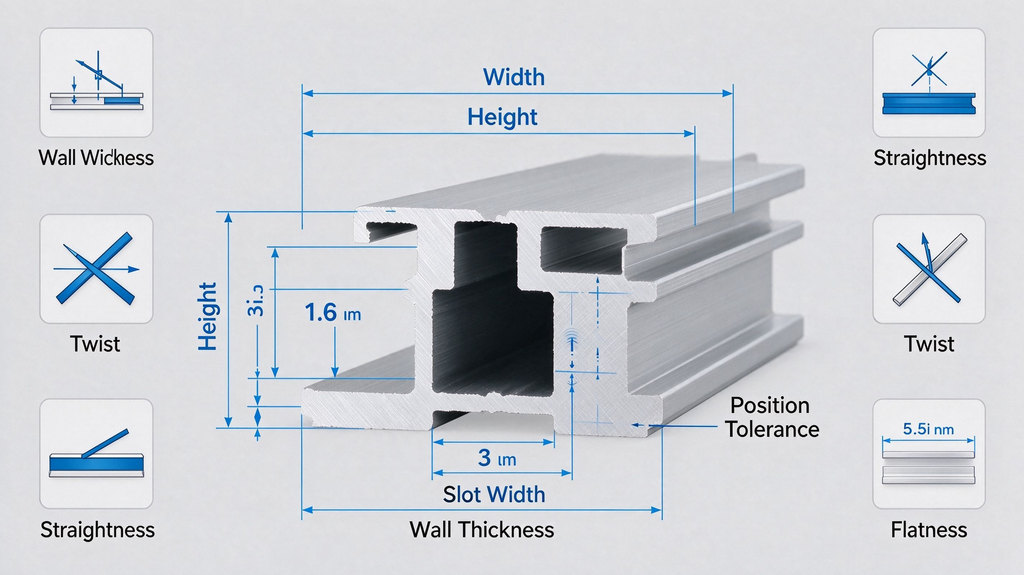
Common dimensions that require inspection include:
-
Overall profile width and height.
-
Wall thickness.
-
Slot and groove dimensions.
-
Hole diameter and position.
-
Profile straightness.
-
Twist and flatness.
-
Length and cutting accuracy.
Why Tolerances Vary
Not all aluminum profiles can use the same tolerance requirements. Tolerances depend on several factors:
Profile complexity: Simple solid profiles are generally easier to control than complex hollow profiles with multiple thin walls.
Wall thickness: Thin sections may be more sensitive to deformation during extrusion, cooling, stretching, and handling.
Profile size: Larger profiles may require different tolerance considerations than small precision components.
Alloy and temper: Material characteristics and heat-treatment conditions can influence dimensional stability.
Manufacturing process: Die design, extrusion conditions, cooling methods, stretching, and finishing processes all affect final dimensions.
Buyers should specify critical dimensions clearly and avoid requiring unnecessarily tight tolerances on every feature. This helps manufacturers select appropriate tooling and production processes while controlling costs.
4. Material Testing for Aluminum Profiles
Dimensional accuracy alone does not guarantee product quality. Aluminum profiles must also meet the mechanical and chemical requirements of their intended applications.
Chemical Composition Analysis
Chemical composition testing verifies the percentage of alloying elements such as magnesium, silicon, copper, and manganese.
For example, 6063 and 6061 aluminum alloys have different chemical compositions and performance characteristics.
A spectrometer can be used to analyze the material composition and confirm whether the alloy meets the specified requirements.
Tensile Strength Testing
Tensile testing measures how a material responds to a pulling force.
Common results include:
-
Ultimate tensile strength.
-
Yield strength.
-
Elongation.
These values help engineers determine whether an aluminum profile can withstand the expected mechanical loads.
Hardness Testing
Hardness testing evaluates a material’s resistance to indentation or deformation.
For aluminum extrusions, hardness can help assess whether the material has achieved the expected temper condition. However, hardness measurements should not automatically replace tensile testing when tensile properties are specified.
Metallographic Examination
Metallographic inspection examines the internal microstructure of aluminum materials.
Depending on the application, it can help identify structural inconsistencies, grain characteristics, and certain manufacturing-related issues.
Not every order requires metallographic testing, but it may be useful for demanding industrial applications or quality investigations.
5. Surface Quality Inspection and Coating Tests
Surface appearance is especially important for architectural aluminum, decorative profiles, furniture components, and visible industrial products.
Different surface treatments require different inspection methods.
Anodizing Quality Inspection
Anodizing creates a protective oxide layer on the aluminum surface.
Important inspection items include:
-
Oxide film thickness.
-
Color consistency.
-
Surface uniformity.
-
Sealing quality.
-
Resistance to corrosion.
Film thickness can be measured using suitable coating-thickness instruments. Sealing performance and corrosion resistance should be evaluated according to the applicable specification and test method.
Powder Coating Inspection
Powder coating is widely used for architectural and industrial aluminum profiles.
Typical inspection items include:
-
Coating thickness.
-
Color consistency.
-
Gloss level.
-
Adhesion.
-
Surface defects.
-
Resistance to environmental exposure.
Cross-cut adhesion testing, for example, can help evaluate how well a coating adheres to the aluminum substrate.
Wood Grain Transfer Printing
Wood grain finishes are often selected for decorative aluminum products.
Inspection should focus on:
-
Pattern consistency.
-
Color matching.
-
Print clarity.
-
Surface defects.
-
Adhesion and durability of the decorative finish.
For projects involving multiple production batches, approved color samples and reference panels can help maintain consistency.
6. Corrosion Resistance and Environmental Testing
Aluminum naturally forms a protective oxide layer, but the actual corrosion performance of an aluminum product depends on its alloy, surface treatment, environment, and installation conditions.
For outdoor applications, buyers may request additional corrosion-resistance testing.
Salt Spray Testing
Salt spray testing exposes samples to a controlled salt-containing environment.
It is commonly used to evaluate the corrosion resistance of coated or treated metal products.
However, salt spray test results should be interpreted carefully. They do not directly predict the exact number of years a product will last outdoors.
Weathering Tests
For exterior architectural products, weathering tests can evaluate changes in color, gloss, and coating condition after controlled exposure.
These tests are particularly relevant for powder-coated and decorative aluminum profiles used in outdoor environments.
Choosing the Right Test
The correct test depends on the product’s intended application.
For example:
-
Indoor furniture profiles may prioritize appearance and dimensional accuracy.
-
Solar mounting profiles may require mechanical performance and outdoor corrosion resistance.
-
Window and door profiles may require dimensional accuracy, coating durability, and compatibility with the complete system.
-
Industrial machine profiles may prioritize strength, machining accuracy, and assembly consistency.
Testing requirements should be agreed upon before production begins.
7. Quality Documents Buyers Should Request
Reliable documentation helps buyers verify that products have been manufactured and inspected according to agreed requirements.
Depending on the project, useful documents may include:
Material Test Certificate: Provides information about the aluminum alloy, chemical composition, and relevant mechanical properties.
Dimensional Inspection Report: Records actual measurements of selected profile dimensions and compares them with specified tolerances.
Surface Treatment Inspection Report: Documents coating thickness, anodizing thickness, color, adhesion, or other agreed surface-quality results.
Certificate of Conformity (CoC): Confirms that supplied products comply with the specified requirements, based on the manufacturer’s stated verification process.
Quality Management Certification: Demonstrates that the supplier operates a certified quality management system, such as ISO 9001, within the stated certification scope.
Buyers should check that certificates are valid, relevant to the manufacturing facility, and applicable to the products being purchased.
8. How to Evaluate an Aluminum Extrusion Supplier
A supplier’s quality capability should be evaluated through more than a price quotation or company profile.
Here are several practical points to consider.
Review Manufacturing Capabilities
Ask whether the supplier controls the main production stages, including extrusion, aging, surface treatment, cutting, machining, and final inspection.
Understanding the production process helps identify potential quality-control gaps.
Check Inspection Equipment
A professional manufacturer should have suitable equipment for its products and quality requirements.
Examples include:
-
Vernier calipers and micrometers.
-
Profile measuring instruments.
-
Hardness testers.
-
Coating thickness gauges.
-
Spectrometers.
-
Tensile testing equipment, where applicable.
Equipment availability alone is not sufficient. Buyers should also consider calibration, inspection procedures, and personnel competence.
Request Samples Before Mass Production
Samples allow buyers to evaluate dimensions, surface quality, color, and assembly compatibility before committing to a large order.
For custom extrusion projects, it is useful to approve a production sample or reference sample and document the acceptance criteria.
Establish a Quality Inspection Plan
A quality inspection plan should define:
-
Inspection items.
-
Applicable standards.
-
Sampling frequency.
-
Acceptance criteria.
-
Testing responsibilities.
-
Procedures for handling nonconforming products.
For repeat orders, consistent inspection requirements help maintain quality across different production batches.
9. How to Reduce Quality Risks in Custom Aluminum Extrusion
Quality problems are often easier and less expensive to prevent than to correct after mass production.
Buyers can reduce risks through several practical steps.
Provide clear technical drawings. Include dimensions, tolerances, alloy, temper, surface finish, and other important specifications.
Identify critical dimensions. Highlight features that directly affect assembly or product performance.
Approve samples and colors. Use signed drawings, physical samples, or approved color references to avoid misunderstandings.
Confirm testing requirements. Agree on inspection methods and acceptance criteria before manufacturing.
Maintain batch traceability. Where required, identify production batches and link them to relevant material and inspection records.
Communicate changes in writing. Any modification to dimensions, materials, surface treatment, or packaging should be documented and approved.
A clear quality agreement creates a common understanding between the manufacturer and buyer, reducing disputes and unnecessary production delays.
10. Final Thoughts
Aluminum extrusion quality standards are essential for ensuring that profiles meet their intended design and performance requirements. From dimensional tolerances and mechanical testing to surface inspection and certification, every stage contributes to the reliability of the finished product.
For buyers, the best approach is to define technical requirements clearly, select applicable standards, review inspection documents, and evaluate the supplier’s manufacturing and quality-control capabilities.
A dependable aluminum extrusion partner should be able to explain its production processes, provide relevant test reports, and maintain consistent quality throughout the project.
Whether you need architectural profiles, industrial aluminum components, furniture systems, or custom OEM/ODM products, a well-defined quality standard is an important foundation for long-term cooperation.
SEO Keywords Naturally Covered
-
Aluminum extrusion quality standards
-
Aluminum extrusion tolerances
-
Aluminum profile inspection
-
Aluminum extrusion testing
-
Aluminum alloy material testing
-
ASTM aluminum extrusion standards
-
EN 755 aluminum profiles
-
EN 12020 tolerances
-
Aluminum anodizing quality inspection
-
Powder coating quality testing
-
Aluminum extrusion supplier
-
Custom aluminum extrusion manufacturing
-
Aluminum profile quality control
-
Aluminum material test certificate