




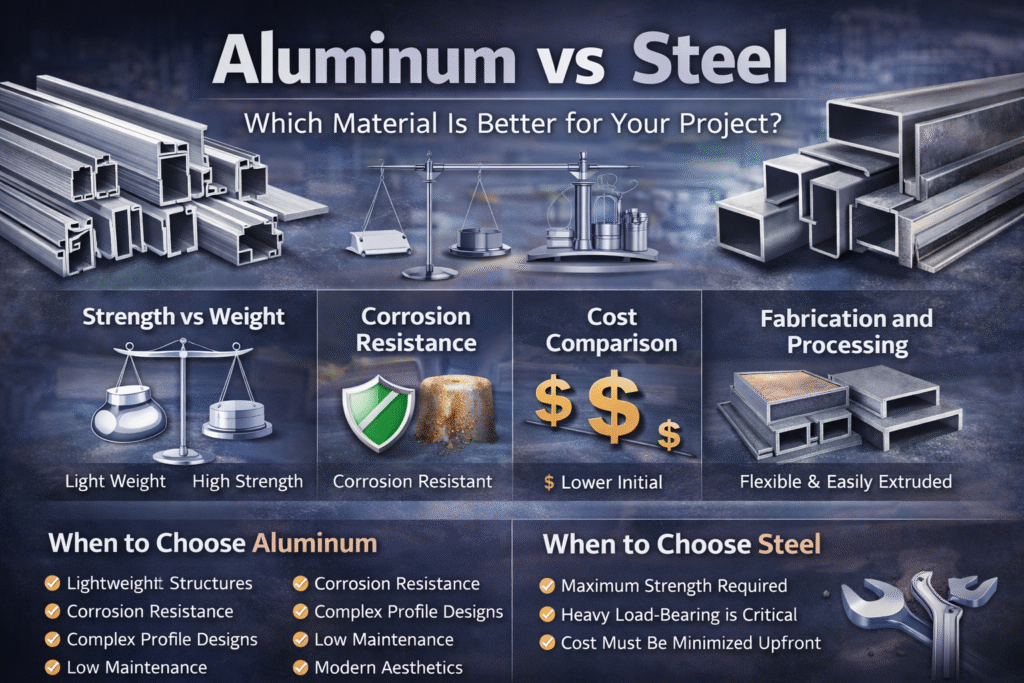
When selecting materials for construction, manufacturing, or product design, one of the most common comparisons is aluminum vs steel. Both materials are widely used across industries, but they offer different advantages depending on the application.
Choosing the right material can significantly impact performance, cost, durability, and long-term efficiency. This guide compares aluminum and steel in key areas to help engineers, designers, and buyers make informed decisions.
Overview of Aluminum and Steel
Aluminum is a lightweight, corrosion-resistant metal commonly used in extrusion, transportation, and architectural applications.
Steel is a strong and durable material widely used in construction, heavy machinery, and structural frameworks.
While both materials are essential in modern manufacturing, their properties make them suitable for different purposes.
Strength vs Weight
One of the most important differences between aluminum and steel is their strength-to-weight ratio.
Steel is stronger in absolute terms and can تحمل heavier loads.
Aluminum, however, is much lighter—typically about one-third the weight of steel.
This means aluminum can provide excellent structural performance while significantly reducing overall weight.
Why It Matters
In transportation, lighter weight improves fuel efficiency
In construction, lighter materials simplify installation
In product design, reduced weight enhances usability
For many applications, aluminum offers a better balance between strength and weight.
Corrosion Resistance
Corrosion resistance is another key factor in material selection.
Aluminum naturally forms a protective oxide layer, making it highly resistant to corrosion.
Steel is prone to rust and usually requires coatings, painting, or galvanizing for protection.
Best Use Cases
Aluminum is ideal for outdoor, marine, and humid environments
Steel may require additional treatment in such conditions
This makes aluminum a preferred choice for long-term durability with minimal maintenance.
Cost Comparison
Cost is often a deciding factor for buyers.
Steel generally has a lower raw material cost
Aluminum may have a higher upfront cost
However, total cost depends on more than just material price.
Total Cost Considerations
Transportation costs (aluminum is lighter)
Installation labor (aluminum is easier to handle)
Maintenance costs (aluminum requires less upkeep)
In many cases, aluminum can be more cost-effective over the full lifecycle of a project.
Fabrication and Processing
Both materials can be fabricated, but their processes differ.
Aluminum
Easily extruded into complex shapes
Suitable for custom profiles
Requires less machining in many cases
Steel
Typically fabricated through welding, cutting, and forming
Less flexible for complex cross-sections
Aluminum extrusion allows for integrated designs that reduce the need for multiple components.
Design Flexibility
Aluminum offers greater design flexibility, especially for custom applications.
With aluminum extrusion, manufacturers can create:
Complex cross-sections
Hollow structures
Integrated functional features
Steel, while strong, is less adaptable for intricate profile designs.
This makes aluminum ideal for modern engineering solutions where efficiency and integration are important.
Maintenance Requirements
Maintenance is an important long-term consideration.
Aluminum requires minimal maintenance and does not rust
Steel often requires regular maintenance to prevent corrosion
For projects with long lifespans, aluminum can reduce ongoing maintenance costs.
Sustainability and Environmental Impact
Both aluminum and steel are recyclable, but aluminum has a unique advantage.
Aluminum can be recycled repeatedly without losing its properties
Recycling aluminum uses significantly less energy than producing new material
This makes aluminum an environmentally friendly option for sustainable projects.
Common Applications
Aluminum Applications
Custom aluminum extrusion profiles
Window and door systems
Aluminum skirting boards
Transportation components
Industrial frameworks
Steel Applications
Heavy structural construction
Bridges and large infrastructure
Heavy machinery
Load-bearing frameworks
When to Choose Aluminum
Aluminum is the better choice when you need:
Lightweight structures
Corrosion resistance
Complex profile designs
Low maintenance
Modern aesthetics
When to Choose Steel
Steel is more suitable when:
Maximum strength is required
Heavy load-bearing is critical
Cost must be minimized upfront
Design complexity is not a priority
Conclusion
Both aluminum and steel are essential materials, but they serve different purposes. Steel offers higher absolute strength and lower upfront cost, while aluminum provides superior weight efficiency, corrosion resistance, and design flexibility.
For modern applications that prioritize efficiency, customization, and long-term performance, aluminum is often the preferred choice.
By understanding the strengths and limitations of each material, businesses can select the best option for their specific needs and achieve better overall results.