



Aluminum extrusion is one of the most versatile manufacturing processes, allowing for the creation of a wide range of profile shapes and structures. Understanding the different types of aluminum extrusion profiles is essential for engineers, designers, and buyers who want to select the most suitable solution for their projects.
From simple solid bars to complex hollow structures, aluminum profiles can be customized to meet various functional and aesthetic requirements. This guide provides a complete overview of the main types of aluminum extrusion profiles and their applications.
What Are Aluminum Extrusion Profiles?
Aluminum extrusion profiles are shapes produced by forcing heated aluminum through a die. The resulting profile has a consistent cross-section along its length.
These profiles can be designed for:
- Structural support
- Decorative applications
- Functional integration
- Mechanical systems
Depending on the design, aluminum profiles can range from simple to highly complex geometries.
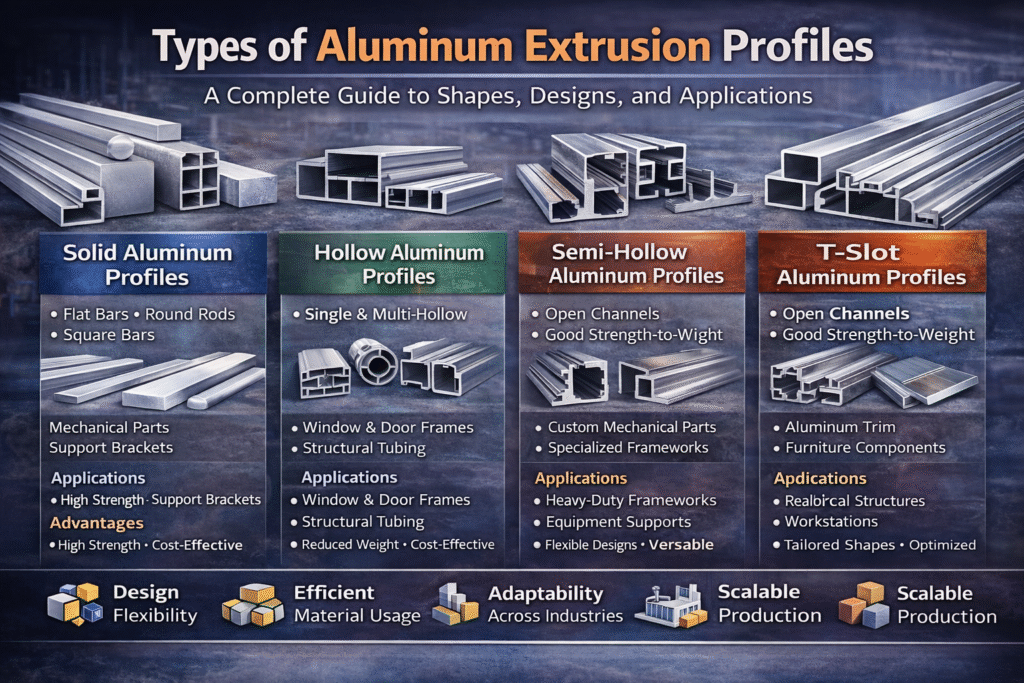
Solid Aluminum Profiles
Overview
Solid aluminum profiles are the simplest type of extrusion, consisting of a fully filled cross-section with no internal cavities.
Common Shapes
- Flat bars
- Round rods
- Square bars
- Rectangular sections
Applications
- Structural components
- Mechanical parts
- Support brackets
Advantages
- High strength
- Easy to manufacture
- Cost-effective for simple designs
Solid profiles are ideal for applications requiring durability and straightforward geometry.
Hollow Aluminum Profiles
Overview
Hollow aluminum profiles contain one or more enclosed voids within the cross-section.
Types of Hollow Profiles
- Single hollow (one cavity)
- Multi-hollow (multiple internal chambers)
Applications
- Window and door frames
- Curtain wall systems
- Structural tubing
- Lightweight frameworks
Advantages
- Reduced weight
- Efficient material usage
- Good strength-to-weight ratio
Hollow profiles are widely used in construction and architectural systems.
Semi-Hollow Aluminum Profiles
Overview
Semi-hollow profiles are partially enclosed shapes that do not form a fully closed cavity.
Characteristics
- Complex cross-sections
- Open channels or slots
- Partial internal voids
Applications
- Industrial components
- Custom mechanical parts
- Specialized structural designs
Advantages
- Greater design flexibility
- Balance between strength and manufacturability
These profiles are often used in custom aluminum extrusion projects.
T-Slot Aluminum Profiles
Overview
T-slot aluminum profiles are modular extrusions with slots that allow easy connection of components.
Features
- Standardized slot dimensions
- Compatible with fasteners and accessories
- Easy assembly and disassembly
Applications
- Industrial automation systems
- Workstations
- Machine frames
- Modular structures
Advantages
- Flexible and reusable
- Fast installation
- No welding required
T-slot profiles are widely used in industrial and manufacturing environments.
Structural Aluminum Profiles
Overview
Structural profiles are designed for load-bearing applications where strength and stability are critical.
Features
- Reinforced cross-sections
- Thick walls
- High-strength alloys
Applications
- Heavy-duty frameworks
- Equipment support structures
- Transportation systems
Advantages
- High load capacity
- Long-term durability
- Reliable performance
These profiles are often made from stronger alloys such as 6061 or 6005A.
Decorative Aluminum Profiles
Overview
Decorative profiles are designed for visual appeal as well as function.
Applications
- Aluminum skirting boards
- Interior trims
- Furniture components
- Wall panels
Surface Finishes
- Anodized finishes
- Powder-coated colors
- Brushed textures
- Wood grain effects
Advantages
- Modern appearance
- High customization potential
- Durable surface quality
These profiles are commonly used in architectural and interior design projects.
Custom Aluminum Profiles
Overview
Custom aluminum profiles are designed specifically for a particular application.
Features
- Unique cross-sections
- Integrated functions
- Tailored dimensions
Applications
- OEM products
- Industrial systems
- Specialized equipment
- Branded components
Advantages
- Optimized performance
- Reduced assembly complexity
- Product differentiation
Custom profiles represent the most advanced use of aluminum extrusion.
Choosing the Right Type of Aluminum Profile
Selecting the correct profile type depends on several factors:
Application Requirements
- Structural vs decorative
- Load-bearing vs lightweight
Design Complexity
- Simple shapes vs complex geometries
Weight Considerations
- Solid vs hollow structures
Cost Efficiency
- Standard vs custom profiles
Surface Finish Needs
- Functional vs aesthetic requirements
Understanding these factors helps ensure the best choice for your project.
Why Aluminum Profile Variety Matters
The wide range of aluminum extrusion profile types allows manufacturers to meet diverse industry needs.
Key benefits include:
- Design flexibility
- Efficient material usage
- Adaptability across industries
- Scalable production
This versatility is one of the main reasons aluminum extrusion is widely used worldwide.
Conclusion
Aluminum extrusion profiles come in many forms, from simple solid bars to complex custom designs. Each type serves a specific purpose, offering different advantages in strength, weight, cost, and functionality.
By understanding the various types of aluminum profiles, businesses and engineers can select the most suitable solution for their applications and achieve better performance and efficiency.