



Curtain wall systems have become a defining feature of modern architecture. From commercial skyscrapers and office buildings to hotels, airports, and shopping centers, aluminum curtain wall profiles provide the structural framework that supports today’s sleek, energy-efficient building envelopes.
Thanks to their lightweight construction, excellent corrosion resistance, and outstanding design flexibility, aluminum profiles have become the industry standard for curtain wall systems. Whether for unitized curtain walls, stick-built systems, or custom architectural facades, aluminum extrusion enables architects and engineers to create durable, visually striking buildings that meet modern performance requirements.
This guide explores the advantages, types, manufacturing process, and selection criteria for aluminum profiles used in curtain wall systems.
What Is a Curtain Wall System?
A curtain wall is a non-load-bearing exterior wall attached to a building’s structural frame.
Unlike traditional walls, curtain walls are designed primarily to:
-
Protect the building from weather
-
Improve thermal performance
-
Maximize natural daylight
-
Enhance architectural appearance
Most curtain wall systems use aluminum frames combined with glass panels, composite panels, or stone cladding.
Because aluminum offers high strength with relatively low weight, it is the preferred framing material for modern curtain wall construction.
Why Aluminum Is the Preferred Material
Lightweight Construction
Compared with steel, aluminum significantly reduces the overall weight of the building envelope.
Advantages include:
-
Lower structural loads
-
Easier transportation
-
Faster installation
-
Reduced labor costs
This is particularly beneficial for high-rise buildings where weight plays a major role in structural design.
Outstanding Corrosion Resistance
Exterior building facades remain exposed to:
-
Rain
-
UV radiation
-
Humidity
-
Wind
-
Air pollution
-
Salt spray in coastal regions
Aluminum naturally forms a protective oxide layer that resists corrosion and helps maintain long-term performance with minimal maintenance.
Excellent Structural Performance
Modern aluminum alloys provide excellent strength while maintaining lightweight characteristics.
Curtain wall profiles are engineered to withstand:
-
Wind pressure
-
Thermal expansion
-
Building movement
-
Seismic activity
-
Long-term environmental exposure
Proper profile design ensures both safety and durability.
Superior Design Flexibility
Aluminum extrusion makes it possible to manufacture highly customized profile shapes.
Engineers can integrate multiple functions into a single extrusion, including:
-
Glass retention channels
-
Drainage paths
-
Thermal barriers
-
Hardware mounting features
This reduces the number of separate components while simplifying fabrication and installation.
Types of Aluminum Curtain Wall Systems
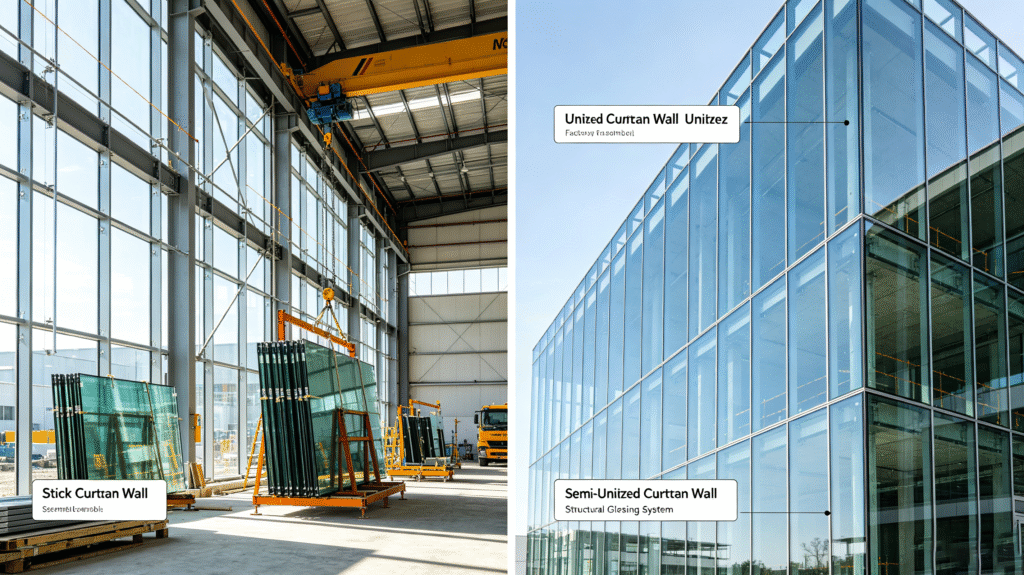
Stick Curtain Wall Systems
Stick systems are assembled on-site using individual aluminum members.
Advantages include:
-
Flexible installation
-
Suitable for smaller projects
-
Easier transportation
-
Lower initial fabrication costs
They remain one of the most widely used curtain wall systems worldwide.
Unitized Curtain Wall Systems
Unitized systems are pre-assembled in the factory before shipment.
Benefits include:
-
Faster installation
-
Better quality control
-
Reduced on-site labor
-
Improved construction efficiency
Large commercial buildings increasingly favor unitized curtain wall systems.
Semi-Unitized Curtain Walls
These systems combine factory assembly with limited on-site installation.
They provide a balance between flexibility and installation speed.
Structural Glazing Systems
Structural glazing uses specialized silicone bonding to minimize visible framing.
Advantages include:
-
Clean architectural appearance
-
Larger uninterrupted glass surfaces
-
Contemporary building aesthetics
These systems are popular in premium commercial developments.
Components of an Aluminum Curtain Wall
A complete curtain wall system includes several aluminum profile components.
Typical profiles include:
-
Vertical mullions
-
Horizontal transoms
-
Pressure plates
-
Cover caps
-
Glass support profiles
-
Drainage channels
-
Connection brackets
Each profile is engineered to meet specific structural and performance requirements.
Thermal Break Technology
Energy efficiency is now a major consideration in building design.
What Is a Thermal Break?
A thermal break separates the interior and exterior aluminum sections using a low-conductivity material.
This significantly reduces heat transfer through the frame.
Benefits include:
-
Improved insulation
-
Lower HVAC energy consumption
-
Better occupant comfort
-
Reduced condensation
Thermal break curtain wall systems are widely used in green building projects.
Surface Finishes for Curtain Wall Profiles
Surface finishing improves both appearance and durability.
Anodized Finish
Anodizing provides:
-
Long-lasting corrosion resistance
-
Metallic appearance
-
Excellent wear resistance
It is often selected for premium architectural applications.
Powder Coating
Powder coating offers:
-
Extensive color options
-
Excellent UV resistance
-
Durable protective coating
-
Consistent finish quality
Architects frequently specify custom RAL colors for large commercial projects.
PVDF Coating
For demanding exterior applications, PVDF (polyvinylidene fluoride) coatings provide outstanding resistance to:
-
UV exposure
-
Weathering
-
Chemical pollution
-
Color fading
PVDF finishes are commonly used on landmark buildings and skyscrapers.
Quality Standards for Curtain Wall Profiles
Professional manufacturers implement strict quality control throughout production.
Typical inspections include:
-
Dimensional accuracy
-
Surface finish quality
-
Alloy verification
-
Mechanical properties
-
Straightness
-
Coating thickness
Consistent manufacturing quality ensures reliable installation and long-term performance.
Applications of Aluminum Curtain Wall Systems
Curtain wall profiles are widely used in:
Commercial Office Buildings
Modern office towers rely on aluminum curtain walls to create sleek, energy-efficient facades.
Hotels and Resorts
Large glass facades improve natural lighting while enhancing architectural appeal.
Shopping Centers
Retail developments benefit from expansive storefront glazing and contemporary design.
Airports and Transportation Hubs
Aluminum curtain wall systems provide durability while supporting large-span glass installations.
Educational and Healthcare Facilities
Universities, schools, and hospitals increasingly use aluminum curtain walls to maximize daylight and reduce long-term maintenance costs.
Advantages of Custom Aluminum Extrusion
Custom curtain wall profiles allow architects and system manufacturers to create unique facade solutions.
Benefits include:
-
Proprietary profile systems
-
Optimized structural performance
-
Improved fabrication efficiency
-
Integrated drainage systems
-
Better thermal performance
Custom extrusion also helps OEM manufacturers differentiate their products in competitive markets.
How to Choose a Curtain Wall Aluminum Manufacturer
When selecting a manufacturing partner, consider the following factors:
Engineering Experience
Choose a supplier with extensive experience in architectural aluminum systems.
Extrusion Capacity
The manufacturer should be capable of producing large and complex curtain wall profiles with consistent quality.
Integrated Manufacturing
Look for suppliers offering:
-
Extrusion
-
CNC machining
-
Surface finishing
-
Fabrication
-
Assembly support
Integrated production improves quality control and reduces lead times.
International Quality Standards
Manufacturers should maintain rigorous quality management systems and provide material traceability when required.
Future Trends in Curtain Wall Systems
The curtain wall industry continues to evolve through innovation.
Key trends include:
-
Ultra-slim aluminum framing
-
High-performance thermal break systems
-
Smart glass integration
-
Building-integrated photovoltaics (BIPV)
-
Sustainable aluminum production
-
AI-assisted facade engineering
These technologies are shaping the next generation of energy-efficient building envelopes.
Conclusion
Aluminum curtain wall profiles are the foundation of modern architectural facades. Their lightweight construction, structural strength, corrosion resistance, and design flexibility make them the preferred choice for commercial, institutional, and high-rise building projects.
As energy efficiency and sustainable construction become increasingly important, custom aluminum extrusion will continue to play a vital role in the development of advanced curtain wall systems. By partnering with an experienced aluminum profile manufacturer, architects, contractors, and OEM brands can achieve outstanding performance, aesthetics, and long-term reliability.