

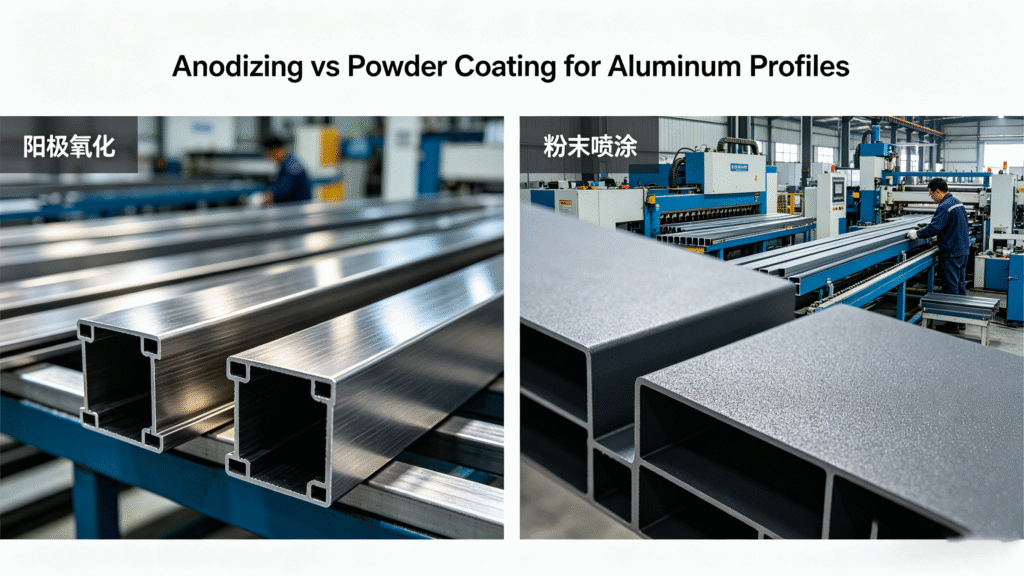
When selecting a surface finish for aluminum profiles, one of the most common questions is: Should you choose anodizing or powder coating?
Both finishes are widely used in aluminum extrusion and offer unique advantages in terms of durability, appearance, and performance. However, the right choice depends on the specific application, environment, and design requirements.
This guide compares anodized aluminum vs powder coated aluminum to help you make the best decision for your project.
What Is Anodized Aluminum?
Anodizing is an electrochemical process that enhances the natural oxide layer on aluminum.
This process creates a protective surface that is:
- Hard and durable
- Corrosion-resistant
- Integrated with the metal (not a coating)
The result is a metallic finish that maintains the natural look of aluminum.
What Is Powder Coated Aluminum?
Powder coating is a finishing process where dry powder is applied to the aluminum surface and then cured under heat to form a solid coating.
This creates a protective layer that is:
- Thick and uniform
- Available in various colors and textures
- Resistant to weather and UV exposure
Powder coating provides more design flexibility compared to anodizing.
Appearance Comparison
Anodized Aluminum
- Metallic and natural look
- Smooth and consistent surface
- Limited color options (silver, bronze, black, etc.)
Powder Coated Aluminum
- Wide range of colors
- Matte, glossy, or textured finishes
- Custom color matching available
👉 Conclusion:
If your project requires a natural metal appearance, anodizing is ideal.
If color customization is important, powder coating is the better choice.
Durability and Wear Resistance
Anodizing
- Extremely hard surface
- Resistant to scratches and abrasion
- Does not peel or chip
Powder Coating
- Good impact resistance
- Can chip under heavy force
- Coating thickness provides protection
👉 Conclusion:
Anodizing offers superior wear resistance, especially for high-contact surfaces.
Corrosion Resistance
Both finishes provide strong corrosion protection, but their performance differs slightly.
Anodized Aluminum
- Excellent corrosion resistance
- Ideal for outdoor and marine environments
Powder Coated Aluminum
- Very good corrosion resistance
- Performance depends on coating quality
👉 Conclusion:
Both are suitable for outdoor use, but anodizing has a slight advantage in extreme environments.
Maintenance Requirements
Anodized Aluminum
- Low maintenance
- Easy to clean
- Does not fade easily
Powder Coated Aluminum
- Also low maintenance
- May require occasional cleaning to maintain appearance
👉 Conclusion:
Both finishes are easy to maintain, making them suitable for long-term use.
Thickness and Precision
Anodizing
- Very thin layer
- Maintains precise dimensions
Powder Coating
- Thicker coating
- May slightly affect tight tolerances
👉 Conclusion:
Anodizing is better for applications requiring high precision.
Cost Comparison
Anodizing
- Generally cost-effective
- Lower processing complexity
Powder Coating
- Slightly higher cost for custom colors
- Additional processing steps
👉 Conclusion:
Anodizing is often more economical, but powder coating offers more customization value.
Typical Applications
Anodized Aluminum Applications
- Window and door systems
- Curtain walls
- Industrial components
- Aluminum skirting boards
Powder Coated Aluminum Applications
- Interior design elements
- Decorative profiles
- Furniture
- Commercial buildings
When to Choose Anodizing
Choose anodized aluminum when you need:
- High wear resistance
- Metallic appearance
- Tight tolerances
- Long-term durability in harsh environments
When to Choose Powder Coating
Choose powder coated aluminum when you need:
- Custom colors and finishes
- Design flexibility
- Decorative applications
- Branding consistency
Can You Combine Both?
In some advanced applications, anodizing and powder coating can be used together to enhance performance and aesthetics.
However, this approach is less common and typically used for specialized projects.
Common Mistakes to Avoid
- Choosing based only on appearance without considering environment
- Ignoring tolerance requirements
- Over-specifying finishes that increase cost
- Not consulting with manufacturers
Proper selection ensures better long-term results.
Conclusion
Both anodized and powder coated aluminum offer excellent performance, but they serve different purposes. Anodizing provides superior durability and a natural metallic look, while powder coating offers unmatched flexibility in color and design.
By understanding the differences and aligning them with your project requirements, you can choose the most suitable finish for optimal performance and visual impact.